
What MEDLANE knows about the instrument
Recognising architectures, materials, control protocols, marking and traceability, inspection: five documented axes, each linked to its source. Nothing here is published as a contractual specification or as current proof of conformity.
MEDLANE Instrument Atlas
An atlas of recognition: complete silhouettes, jaw macros, architecture comparisons, eponyms and verified quizzes, all built on real MEDLANE references and their catalogue photographs.
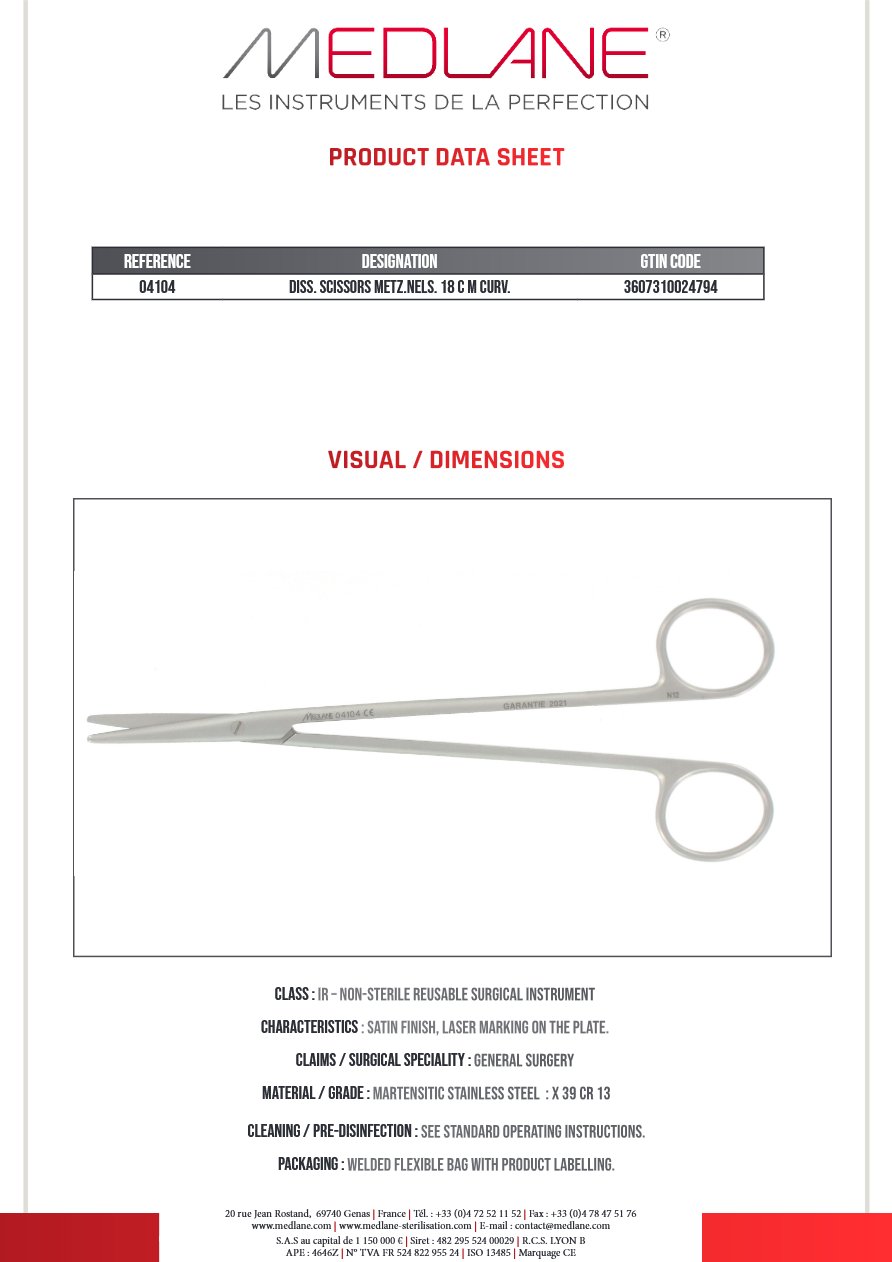
Ciseaux Dissection Metzenbaum nelson 180 mm Courbe
Scissors — atlas no. 01
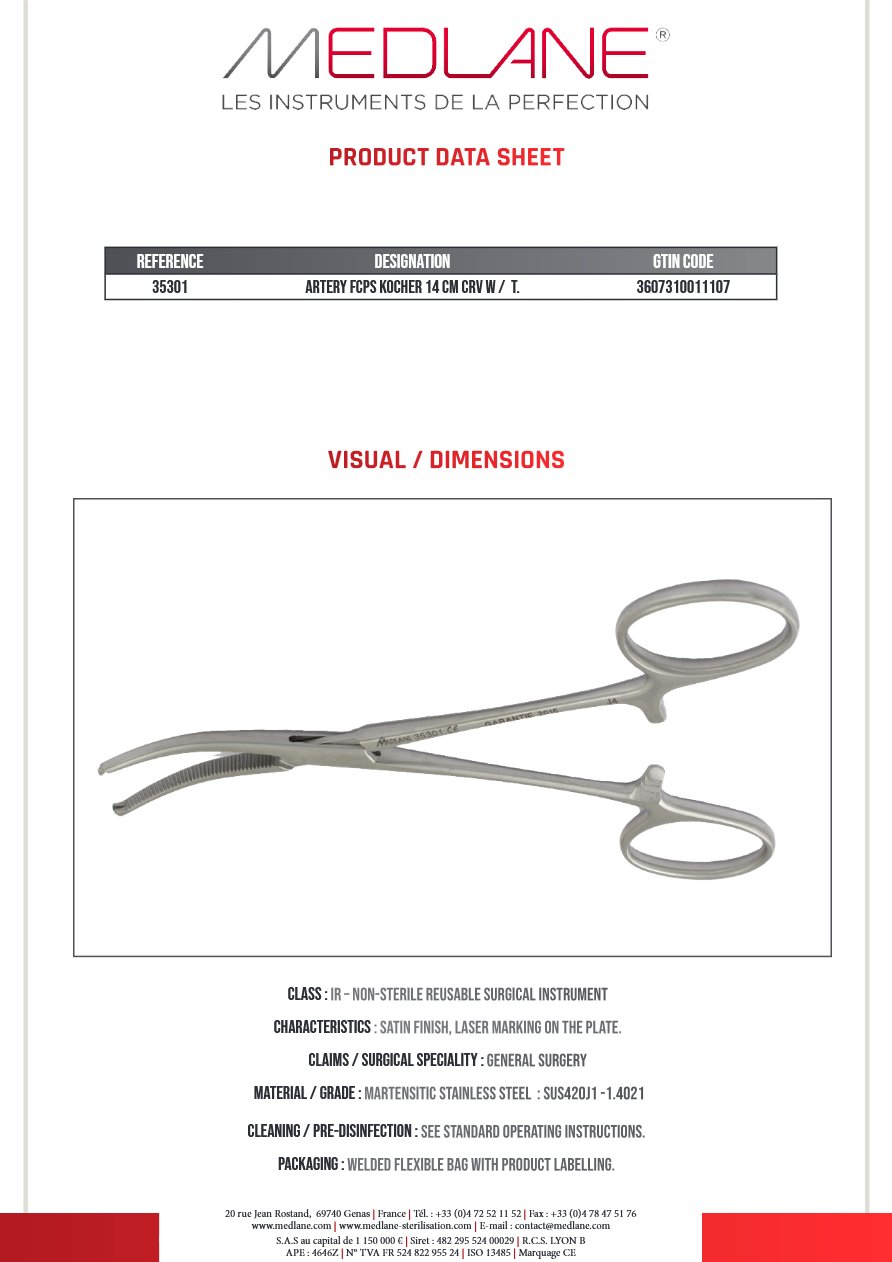
Pince Hémostatique Kocher 140 mm C. avec Griffes
Haemostatic forceps — atlas no. 02
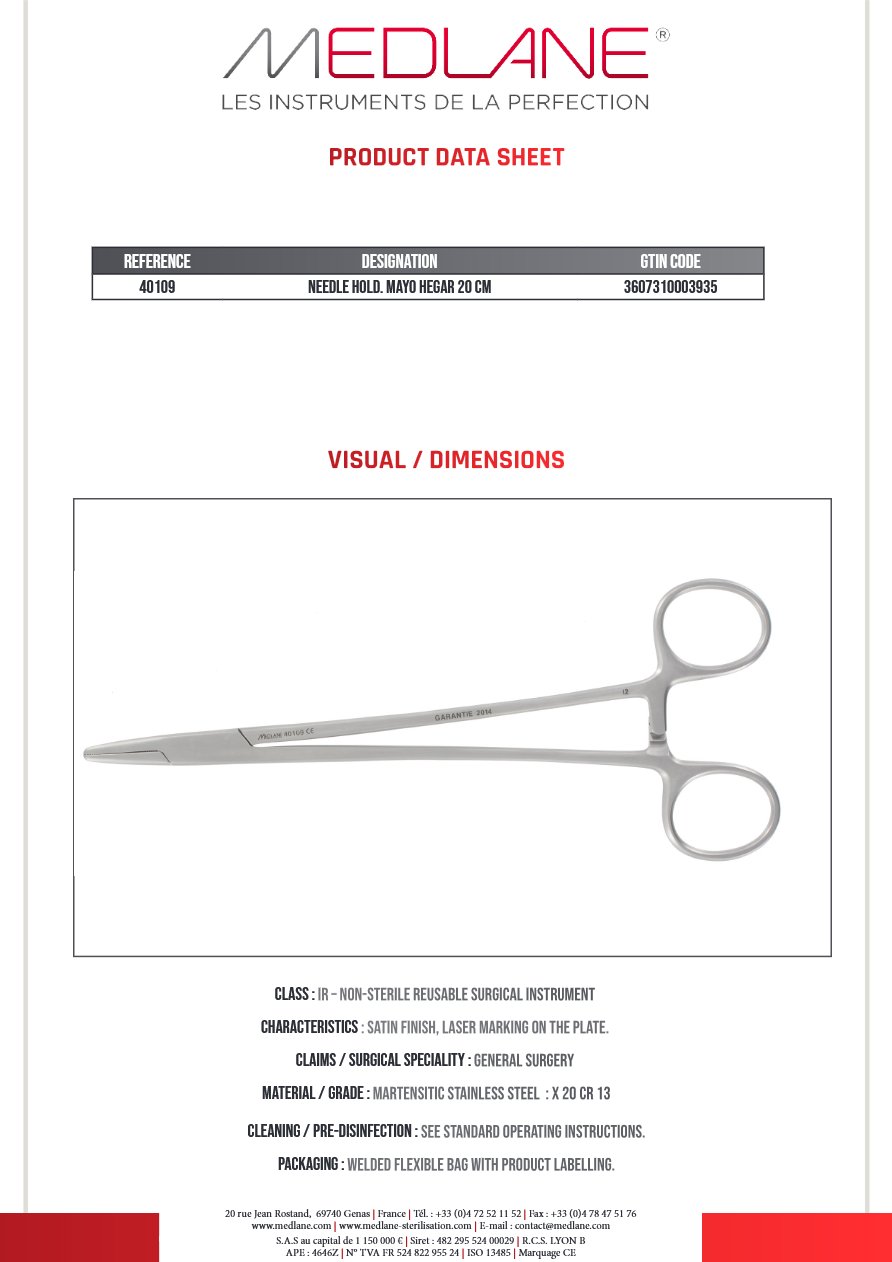
Porte Aiguille Mayo Hegar 200 mm
Needle holders — atlas no. 04
- 01Metzenbaum & Mayo scissors
- 02Surgical needle holders: selection criteria
- 03Kocher, Kelly, Crile, Halsted & Leriche
- 04Dissecting forceps — the art of the grip
- 05Needle holders — understanding gripping architectures
- 06Hand-held retractors — reading the architecture before the name
- 07Kerrison rongeurs & disc rongeurs — understanding spinal resection instruments
Materials and grades
Family → steel type → grades table, reproduced exactly from MEDLANE technical documentation. The data sits at family level, not at individual reference level.
| Family | Type | Grades | Numbers |
|---|---|---|---|
| Haemostatic forceps | Martensitic | X20Cr13 | 1.4021 |
| Dissecting forceps | Martensitic | X15Cr13 | 1.4021 |
| Grasping forceps | Martensitic | X20Cr13 | 1.4021 |
| Towel clamps | Martensitic | X20Cr13 | 1.4021 |
| Needle holders | Martensitic | X20Cr13 | 1.4021 |
| Ligature carriers | Martensitic | X20Cr13 | 1.4021 |
| Clamps | Martensitic | X20Cr13 | 1.4021 |
| Scissors | Martensitic | X46Cr13 · X30Cr13 · X38CrMoV15 | 1.4034 · 1.4028 · 1.4117 |
| Self-retaining retractors | Martensitic | X20Cr13 | 1.4021 |
| Raspatories, curettes, gouges | Martensitic | X20Cr13 · X46Cr13 | 1.4021 · 1.4034 |
| Chisels, osteotomes | Martensitic | X46Cr13 · X90CrMoV18 · X50CrMoV15 | 1.4034 · 1.4112 · 1.4028 |
| Bone rongeurs | Martensitic | X20Cr13 | 1.4021 |
| Disc forceps | Martensitic | X20Cr13 | 1.4021 |
| Gouge and cutting forceps | Martensitic | X20Cr13 · X46Cr13 | 1.4021 · 1.4034 |
| Hand-held retractors, blades, specula | Austenitic | X20Cr13 · X15Cr13 | 1.4021 · 1.4024 |
MEDLANE documentation · Nuances d'acier inoxydable utilisées pour la fabrication des instruments · 2021-12
Data from historical MEDLANE technical documentation; QARA validation is required before any use as a current contractual or regulatory specification.
Role of the alloying elements
- Carbon determines hardness, chromium corrosion resistance.
- Molybdenum and vanadium are optional elements adding cutting-edge longevity and impact resistance respectively.
MEDLANE documentation · Tableau de propriétés des aciers MEDLANE · 2022-02
Quality Lab — how an instrument is controlled
MEDLANE documented protocols, described here for their educational value. They do not constitute the release criteria in force.
The five control families
- Rockwell hardness testing.
- Visual and functional inspection.
- Mechanical testing.
- Cutting performance testing.
- Corrosion-resistance testing.
MEDLANE documentation · Dossier technique instrumentation MEDLANE — version 21 · 2021-12
Quality system in force
- MEDLANE's quality management system is certified to ISO 13485:2016 by IMQ (certificate 0270.2026) for the design, production management and distribution of operating-room surgical instrumentation and sterilization containers.
Current QMS · Certificat ISO 13485:2016 — IMQ 0270.2026 · 2026-03
Elasticity test
- 01The instrument is closed to the last ratchet tooth and held under load for 3 hours at room temperature.
- 02After the corrosion test, the instrument is inspected for cracks and permanent deformation.
MEDLANE documentation · Dossier technique instrumentation MEDLANE — version 21 · 2021-12
Gripping function test
- 01A plastic thread or suture of diameter 0.2 mm or less is placed in the active part, then the instrument is closed.
- 02A 20 N pull is applied: the thread must not escape under either longitudinal or transverse load.
MEDLANE documentation · Dossier technique instrumentation MEDLANE — version 21 · 2021-12
Cutting test
- 01The test material is selected according to the instrument category; Mayo and Metzenbaum scissors appear in the “medium, ring-handled” category of the documented table.
- 02Cutting is performed over two thirds of the blade, three times, without lateral pressure.
- 03The expected cut is clean, with no tearing of the test material.
MEDLANE documentation · Dossier technique instrumentation MEDLANE — version 21 · 2021-12
Corrosion test
- 01A cleaning cycle is applied to the instrument before testing.
- 02The instrument is immersed in demineralised water at 90 °C for 1 hour, then air-dried.
- 03Visual inspection looks for rust marks, micro-cracks and other surface defects.
MEDLANE documentation · Dossier technique instrumentation MEDLANE — version 21 · 2021-12
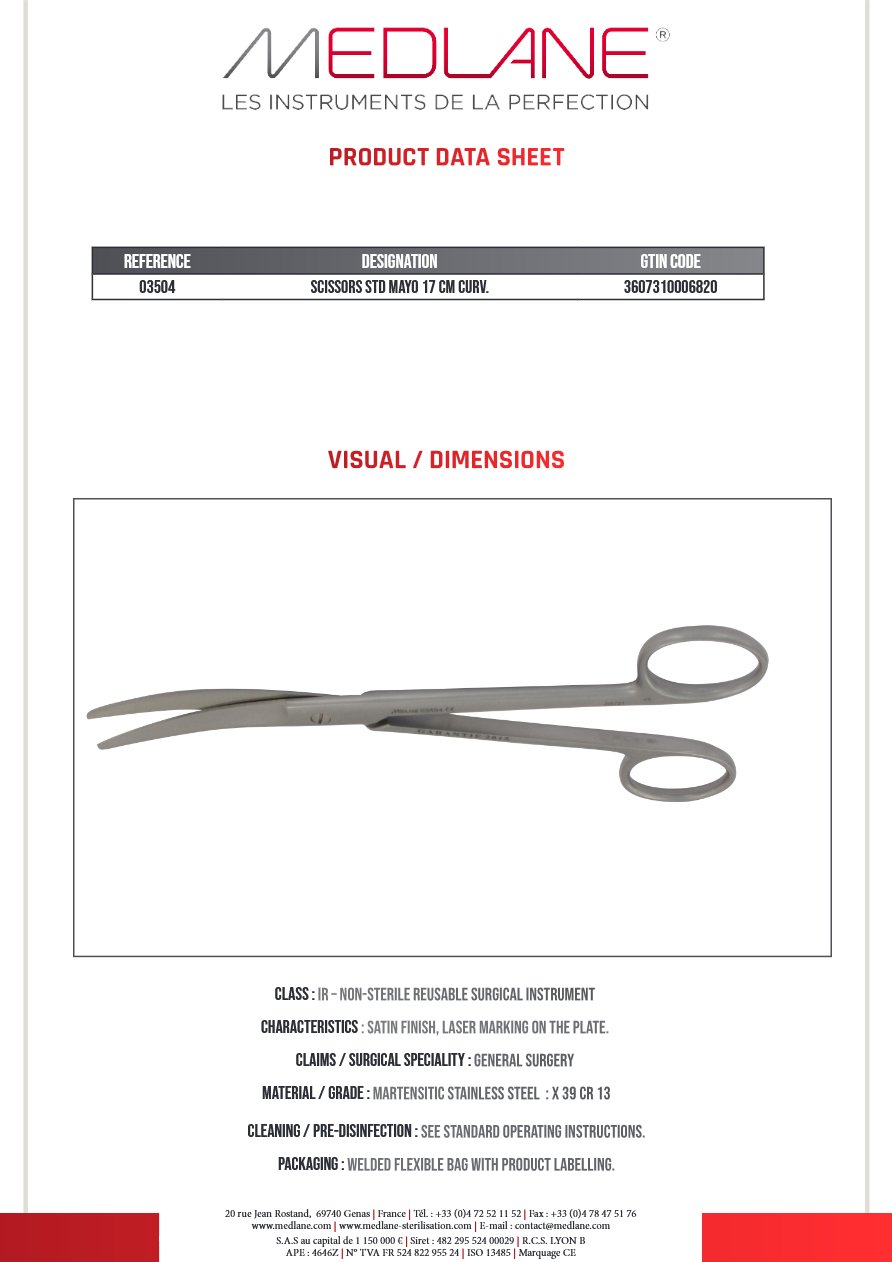
Ciseaux Courants Mayo 170 mm Courbe
Cutting test — ring-handled scissors
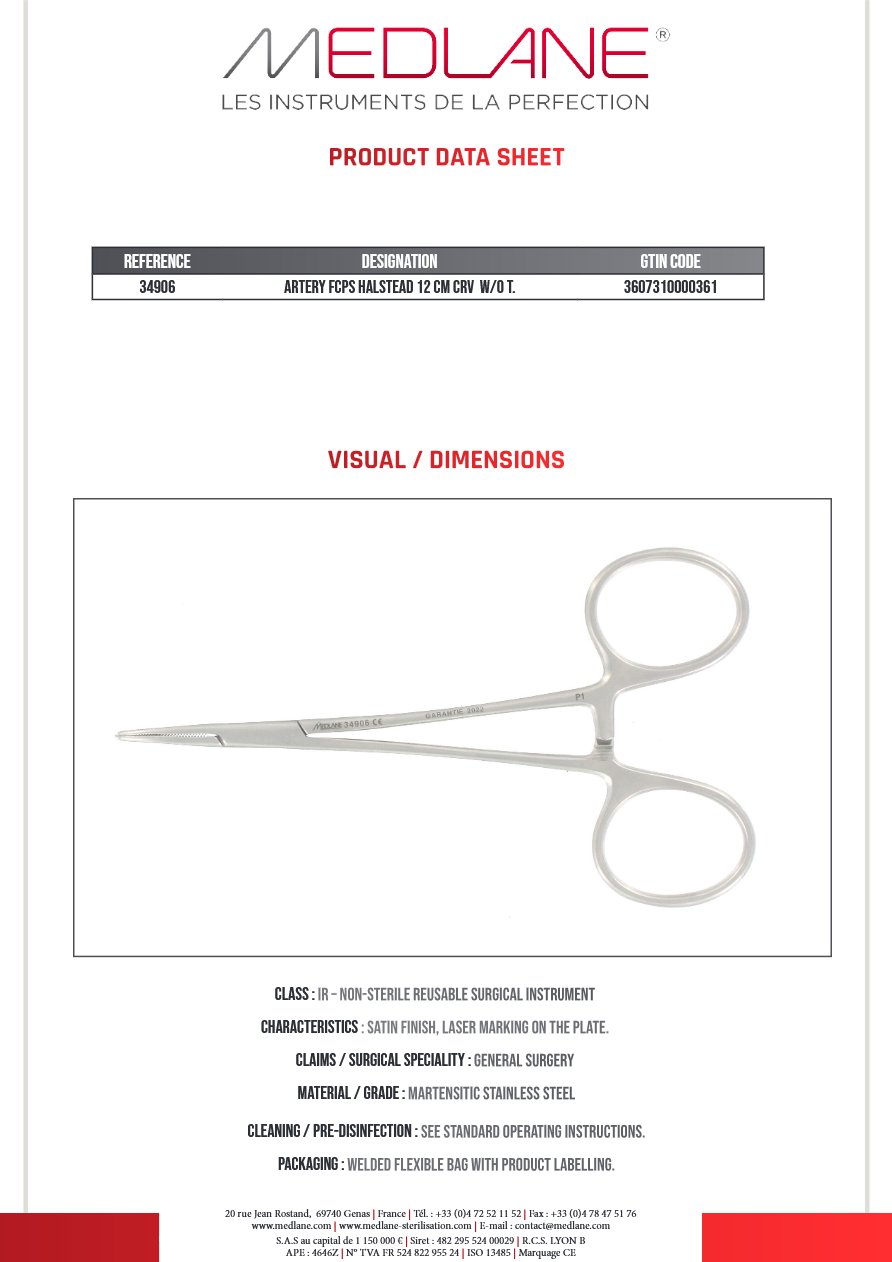
Pince Hémostatique Halstead 120 mm C. sans Griffes
Elasticity test — ratchet closed
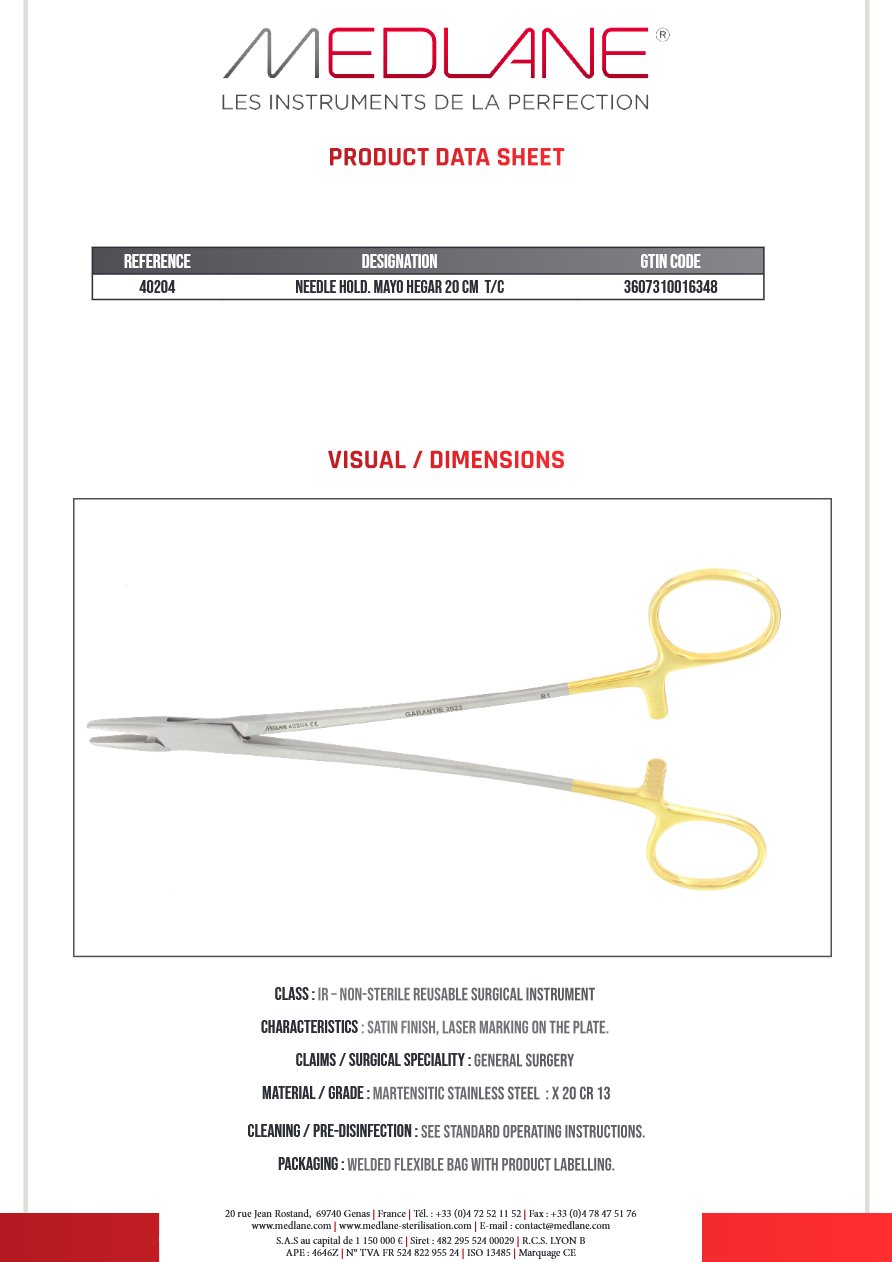
Porte Aiguille Mayo Hegar 200 mm Tungstène
Function test — tungsten-carbide jaws
Care, inspection and reprocessing
An educational reading of instrument inspection after cleaning. Cleaning, disinfection and sterilization parameters are not published here.
- 01Visible cleanliness of surfaces, joints and serrations
- 02No bent, broken, cracked or worn parts
- 03Unobstructed cannulas and trocars
- 04Continuous edges, free of nicks
- 05Smooth articulation without excessive play
- 06Correct operation of locks and ratchets
- 07Correct reassembly of dismountable instruments
- 08Condition of the cutting edges
MEDLANE documentation · Notice d'utilisation MEDLANE — dispositifs médicaux ré-stérilisables (version 15) · 2020-09
Detailed pre-disinfection, cleaning, drying, lubrication and sterilization instructions are governed by the current MEDLANE instructions for use supplied with the devices.
From marking to traceability
Marking is the entry point for identifying an instrument. The characteristics below describe MEDLANE's documented process and are not a commitment regarding current equipment.
- 01
Instrument
MEDLANE catalogue reference
- 02
Laser marking
Thermal annealing, no material removal
- 03
Data Matrix ECC200
Date, time and serial-number variables
- 04
Identification
Logos and barcodes supported
- 05
Hospital scanning
Barcode-reader, PLC or RS232 input
- 06
Reprocessing traceability
Histories generated at the marking station
In-house laser marking
- Instrument marking is performed in-house by laser, using a thermal annealing process that marks without removing material.
- The installation described in the process documentation is a YAG TD412 laser: 254 mm focal length, 180 × 180 mm marking field, motorised Z axis, dedicated enclosure accepting up to 600 × 300 × 260 mm.
- The T700W software drives the marking: Data Matrix ECC200, barcodes and logos, date / time / serial-number variables, material library, history generation.
- The station accepts ODBC, Excel, ASCII and CSV database links, as well as a barcode-reader, PLC or RS232 input.
MEDLANE documentation · Documentation process laser MEDLANE · 2021-12
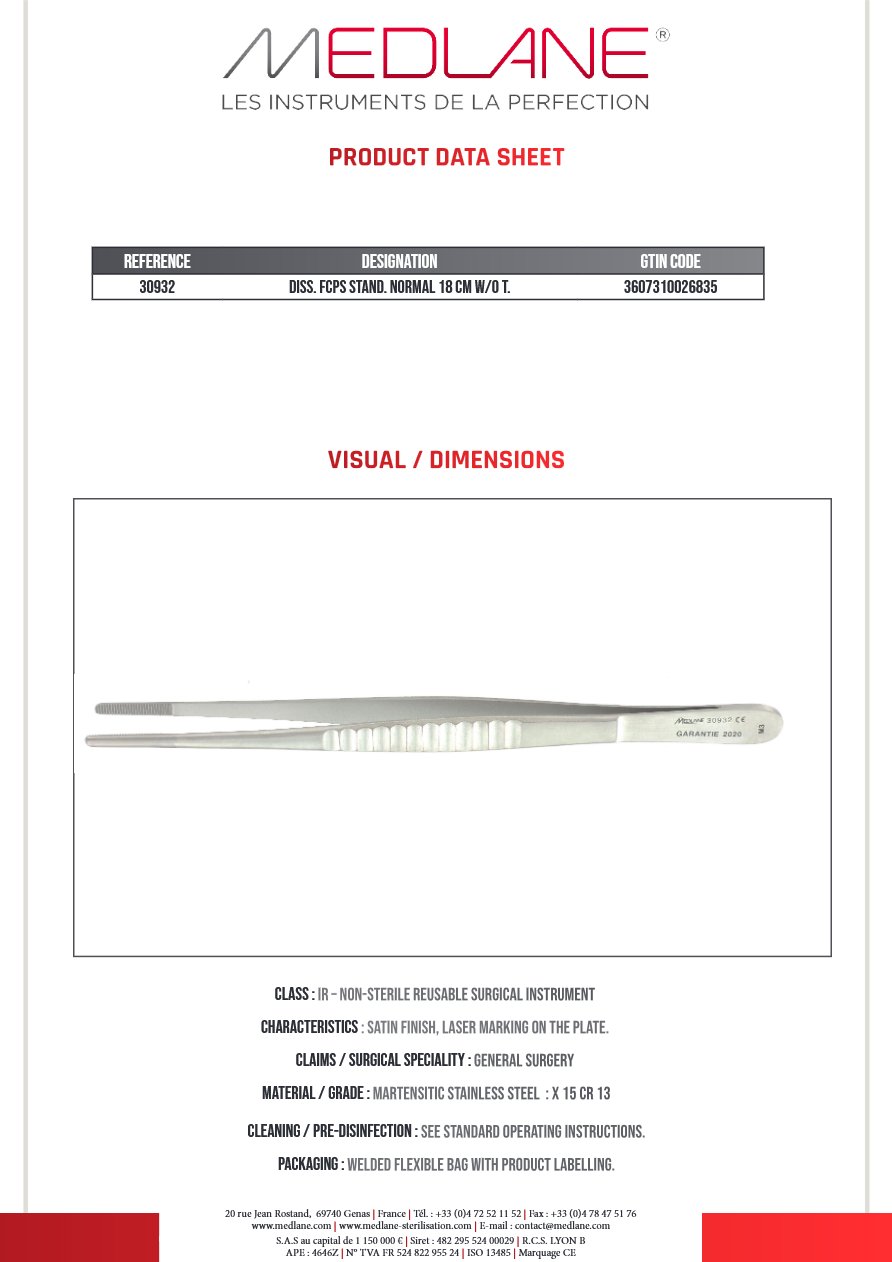
Pince Dissection Standard Norma 180 mm Ss Griffes
Markable surface — forceps body
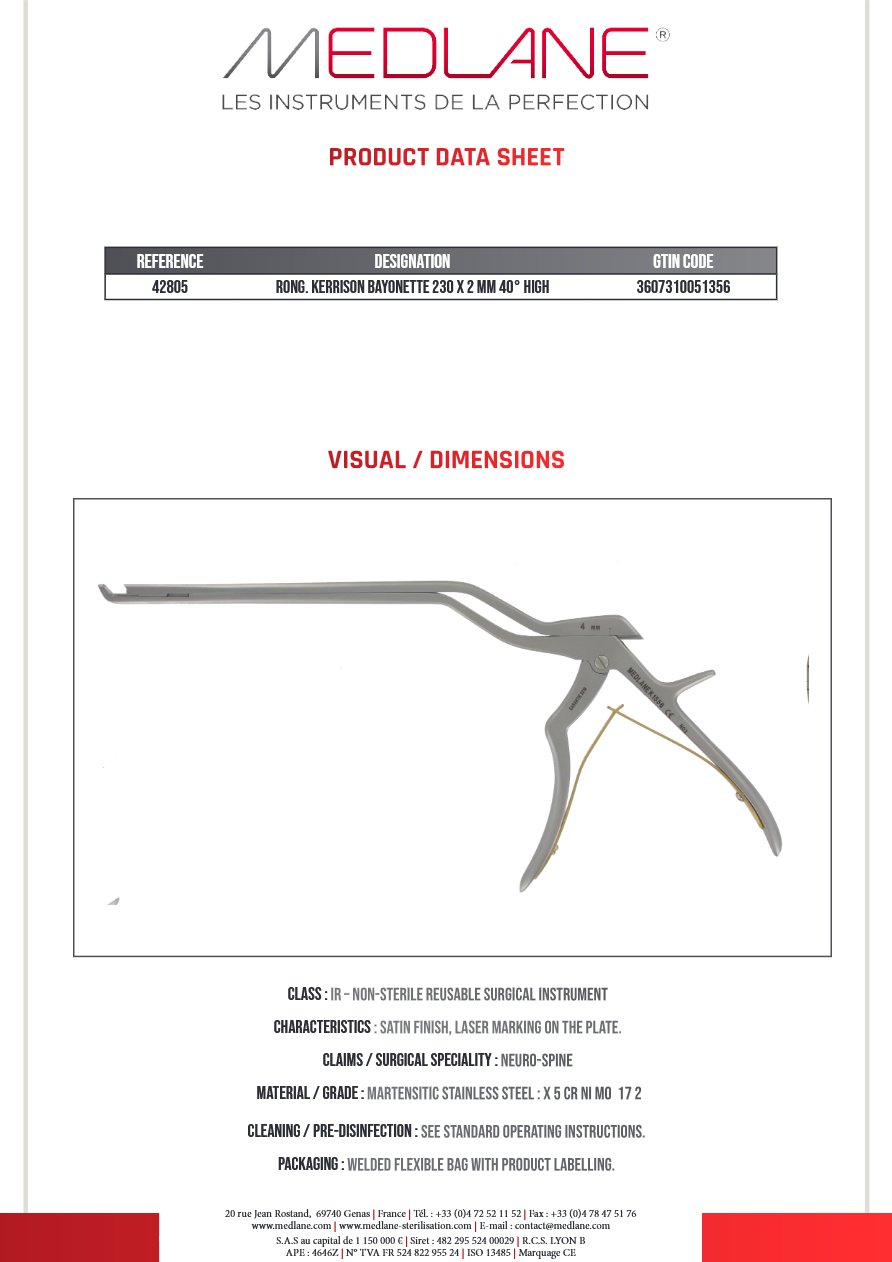
Rongeur KERRISON BAYONETTE 230 X 2 MM 40° HIGH
Markable surface — rongeur shaft
6 documented modules published