
Not all stainless steels are the same.
An instrument is not defined by “stainless steel”. Its behaviour depends on a metallurgical architecture, a carbon content, alloying elements and a heat treatment chosen according to what the part has to do. This page explains how to read that, with no prescription of use.
Martensitic or austenitic
Two architectures, two logics. Neither is superior to the other: they answer different requirements depending on the part.
Martensitic
A structure that can be hardened by heat treatment. This is the architecture of instruments whose function relies on an edge, a tip or a firm grip.
- Can be hardened, then balanced by tempering.
- Magnetic.
- Used where the mechanical behaviour of the active part is decisive.
Austenitic
A structure that cannot be hardened by heat treatment, valued for its formability and its behaviour in aggressive environments. It is the typical architecture of formed parts and components without a functional edge.
- Not hardenable by heat treatment.
- Generally non-magnetic.
- Used on formed parts: blades, specula, hand-held retractors.
Reading a steel grade
A designation is not a commercial code: each segment carries metallurgical information. An example of how to read one.
X20Cr13 — X20Cr13
- X
High-alloy steel
In the European designation system, the leading letter denotes a high-alloy steel — the family to which instrument-grade stainless steels belong.
- 20
Carbon content index
The following number expresses the carbon content in hundredths of a percent. Carbon is what makes hardening possible: the higher the index, the more the grade is oriented towards edge retention.
- Cr
Main alloying element
The chemical symbols list the defining alloying elements. Cr is chromium, the source of corrosion resistance. Other grades add Mo (molybdenum) or V (vanadium).
- 13
Alloying-element content
The final number expresses the nominal content of the element preceding it, as a percentage. It is read in the order of the chemical symbols in the designation.
Each designation has a corresponding material number (for example 1.40xx). The two notations denote the same grade: one is read, the other is indexed.
Role of the alloying elements
- Carbon determines hardness, chromium corrosion resistance.
- Molybdenum and vanadium are optional elements adding cutting-edge longevity and impact resistance respectively.
MEDLANE documentation · Tableau de propriétés des aciers MEDLANE · 2022-02
How properties are tuned
On a martensitic grade, mechanical properties do not come from the grade alone: they are tuned by the hardening / tempering sequence.
- 01
Forming
The blank receives its geometry before its mechanical properties are set.
- 02
Hardening / quenching
On a martensitic grade, quenching transforms the structure and raises hardness. On its own it leaves the steel too brittle for direct use.
- 03
Tempering
Tempering restores toughness and sets the hardness / resilience balance sought for the instrument's function.
- 04
Finishing and passivation
Surface condition and the passive layer govern how the instrument behaves through the reprocessing cycle.
The heat-treatment parameters applied in production (temperatures, durations, target hardness ranges) are managed per reference in the quality system in force and are not published here.
Selection follows the instrument's architecture
The question is not “which is the best steel”, but “what must this part do”. The Instrument Atlas guides show these architectures on real references.
Cutting
The active part must hold an edge under repeated load: the grade is chosen among those that heat treatment can harden.
See in the atlas →Gripping / clamping
The requirement lies in branch elasticity, ratchet retention and the stability of the serration or of the inserted carbide.
See in the atlas →Precise handling
Fine tips impose a compromise between rigidity and the absence of brittle failure.
See in the atlas →Retracting / exposing
Formed parts, often without a functional edge: formability and surface behaviour take precedence over hardness.
See in the atlas →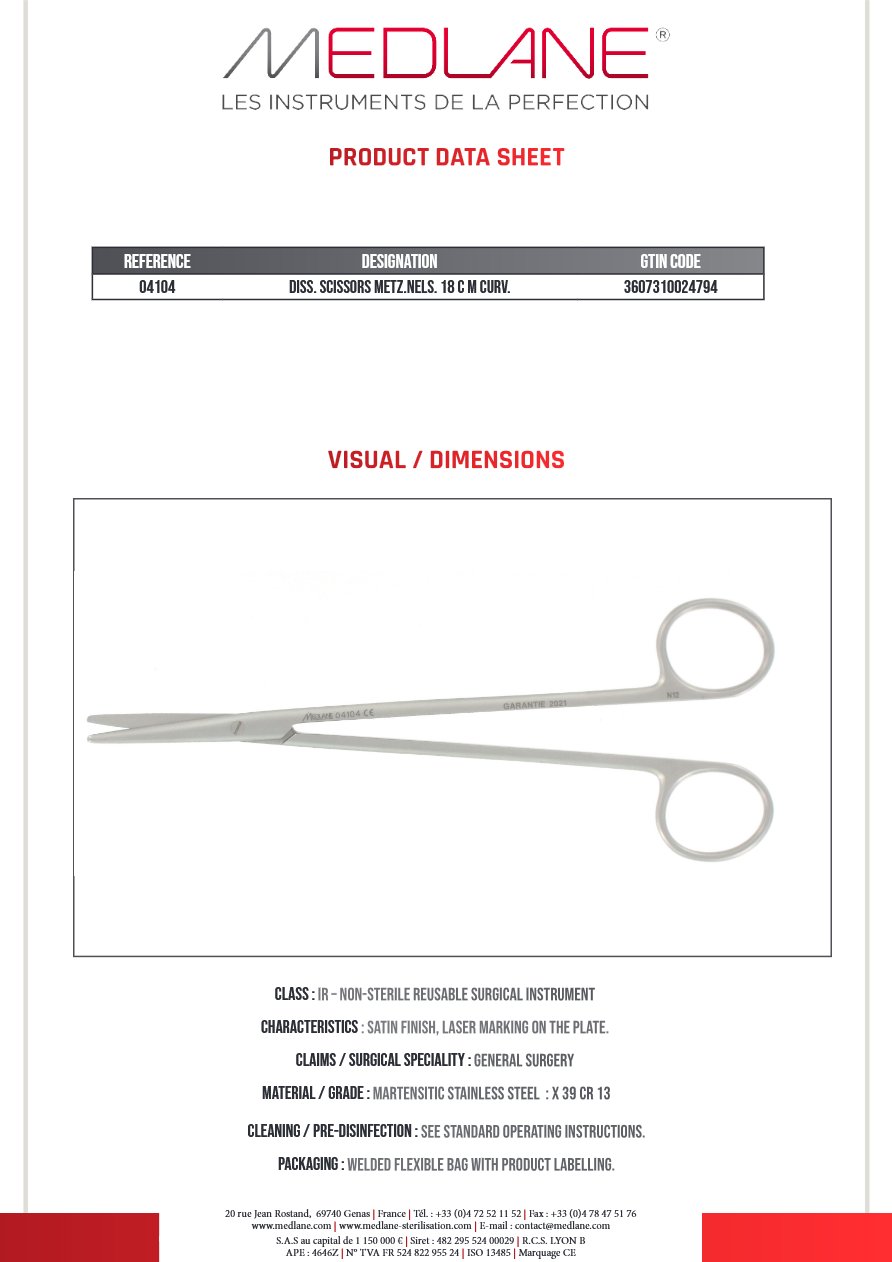
Ciseaux Dissection Metzenbaum nelson 180 mm Courbe
Cutting architecture
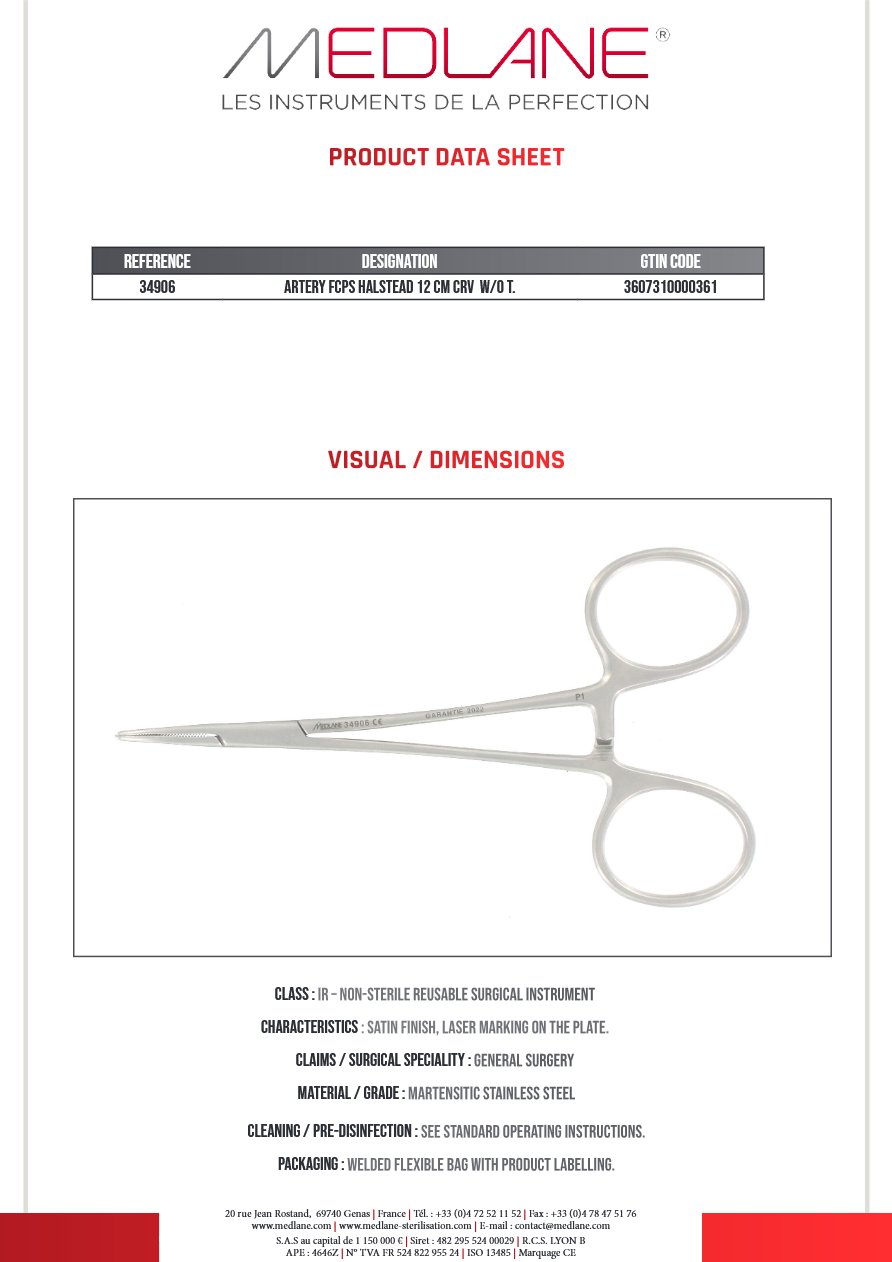
Pince Hémostatique Halstead 120 mm C. sans Griffes
Ratcheted architecture
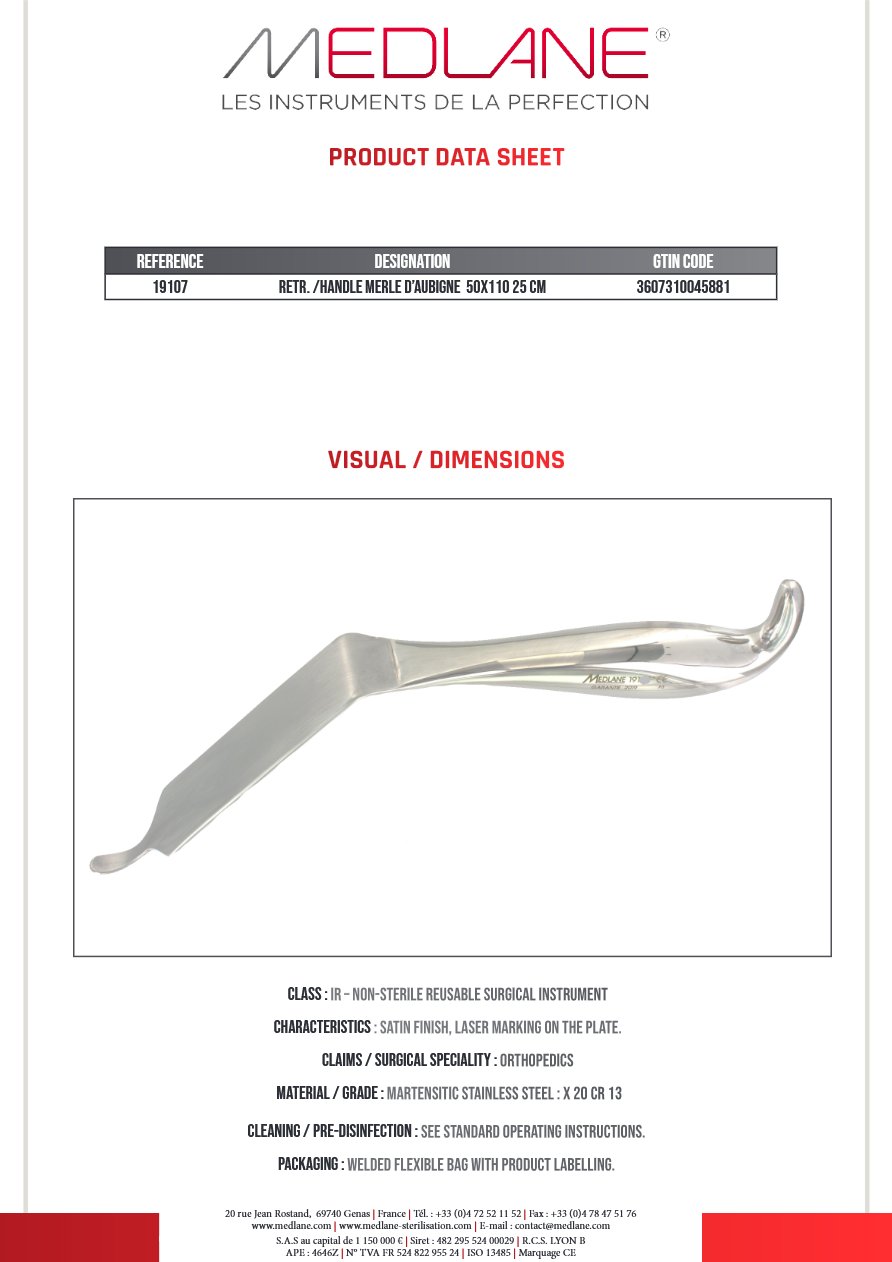
Ecarteur /manche Merle D'aubigne 50X110 250 mm
Formed part
Grades by instrument family
Table reproduced exactly from MEDLANE technical documentation. The data sits at family level, never at individual reference level.
| Family | Type | Grades | Numbers |
|---|---|---|---|
| Haemostatic forceps | Martensitic | X20Cr13 | 1.4021 |
| Dissecting forceps | Martensitic | X15Cr13 | 1.4021 |
| Grasping forceps | Martensitic | X20Cr13 | 1.4021 |
| Towel clamps | Martensitic | X20Cr13 | 1.4021 |
| Needle holders | Martensitic | X20Cr13 | 1.4021 |
| Ligature carriers | Martensitic | X20Cr13 | 1.4021 |
| Clamps | Martensitic | X20Cr13 | 1.4021 |
| Scissors | Martensitic | X46Cr13 · X30Cr13 · X38CrMoV15 | 1.4034 · 1.4028 · 1.4117 |
| Self-retaining retractors | Martensitic | X20Cr13 | 1.4021 |
| Raspatories, curettes, gouges | Martensitic | X20Cr13 · X46Cr13 | 1.4021 · 1.4034 |
| Chisels, osteotomes | Martensitic | X46Cr13 · X90CrMoV18 · X50CrMoV15 | 1.4034 · 1.4112 · 1.4028 |
| Bone rongeurs | Martensitic | X20Cr13 | 1.4021 |
| Disc forceps | Martensitic | X20Cr13 | 1.4021 |
| Gouge and cutting forceps | Martensitic | X20Cr13 · X46Cr13 | 1.4021 · 1.4034 |
| Hand-held retractors, blades, specula | Austenitic * | X20Cr13 · X15Cr13 | 1.4021 · 1.4024 |
* Hand-held retractors, blades, specula — Point to be validated: the source document states “austenitic” whereas the grades cited (X20Cr13, X15Cr13) are described as martensitic elsewhere in MEDLANE documentation, including on product data sheets. The row is reproduced as is, without correction.
MEDLANE documentation · Nuances d'acier inoxydable utilisées pour la fabrication des instruments · 2021-12
Data from historical MEDLANE technical documentation; QARA validation is required before any use as a current contractual or regulatory specification.
Beyond steel
Four families structure MEDLANE's materials scope. The documentation status is stated for each: nothing is published until a validated current source allows it.
Stainless steel
The basis of MEDLANE instrumentation, in martensitic or austenitic architecture depending on the function of the part.
Documented · Grades by instrument family documented in MEDLANE technical documentation.
Tungsten carbide
A material inserted into the active part of certain architectures, notably needle holders and scissors in the catalogue.
Documented · Presence identified at catalogue family level; no hardness value published.
Titanium
Used on lightweight architectures in the catalogue. The behaviour tests held in the technical archives remain under internal review.
Pending validation · No quantitative data published: QARA validation required.
Surface technologies
Finishes and surface treatments governing appearance, marking legibility and reprocessing behaviour.
Pending validation · Scope still being documented: no quantified performance published.