
A needle holder holds a needle, not a tissue. Everything in its construction serves that single function: a handle that transmits force, a mechanism that locks the grip, and two short jaws that immobilise the needle without letting it rotate.
This guide follows those three elements in order: the overall silhouette, then the gripping mechanism, then the jaws. The main named architectures — Mayo-Hegar, Mathieu, Crile-Wood, DeBakey, Ryder, Olsen-Hegar — then appear as combinations of those three choices.
No clinical usage advice here: only what an eye can verify on the instrument and on its reference.
Start with the silhouette
Five architectures, five MEDLANE product photographs shown at the same orientation and the same scale. Before any detail, the silhouette alone separates the families.
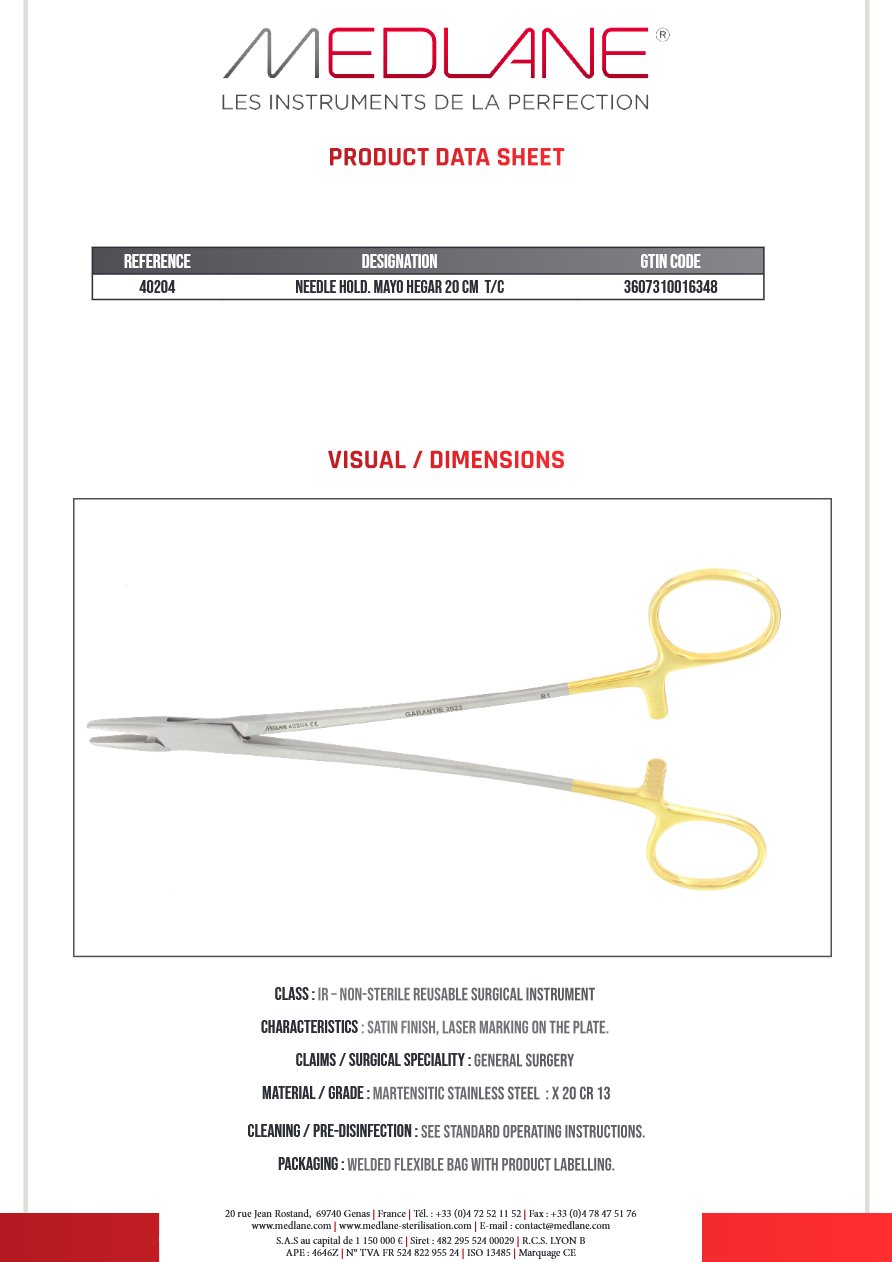
Porte Aiguille Mayo Hegar 200 mm Tungstène · REF 40204P
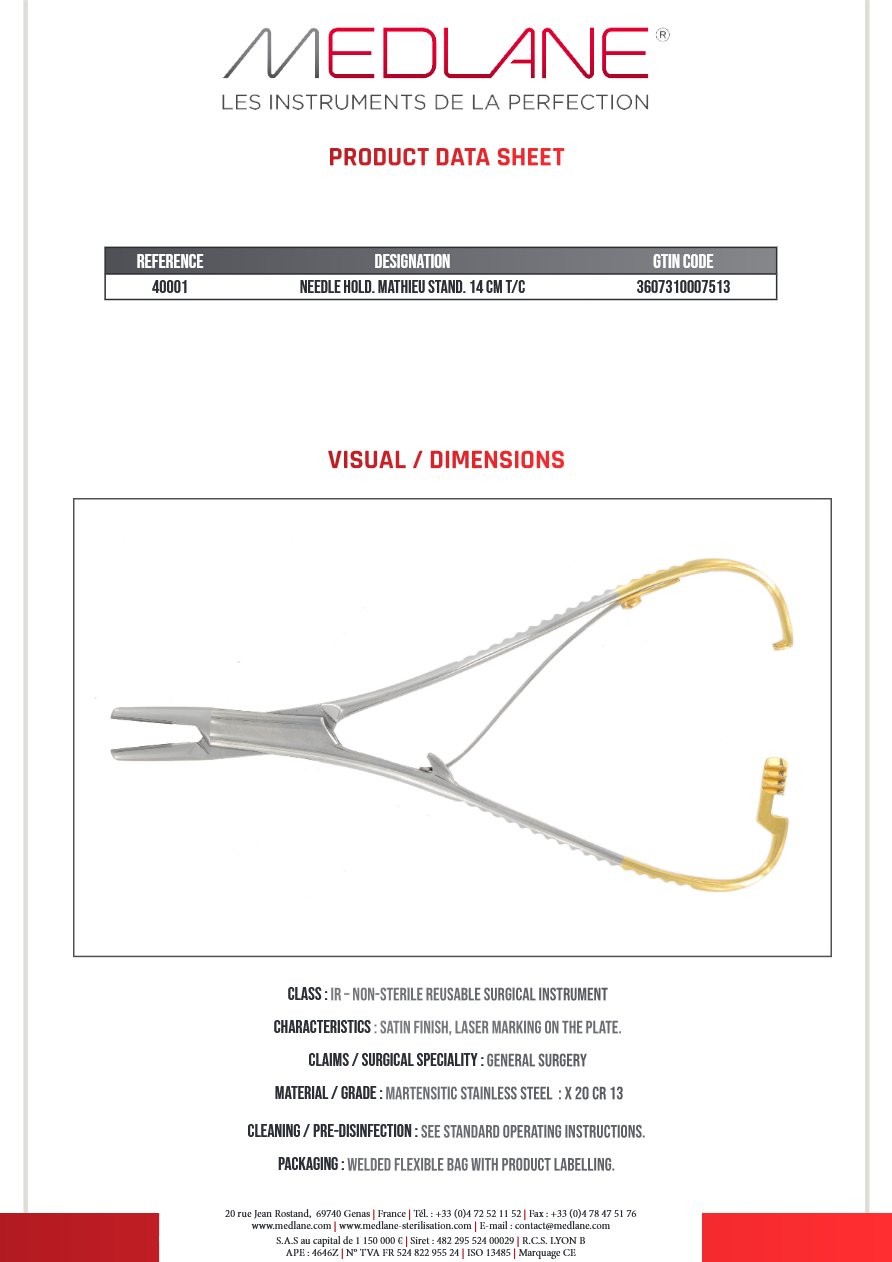
Porte Aiguille Mathieu Standard 140 mm Tungstène · REF 40001P
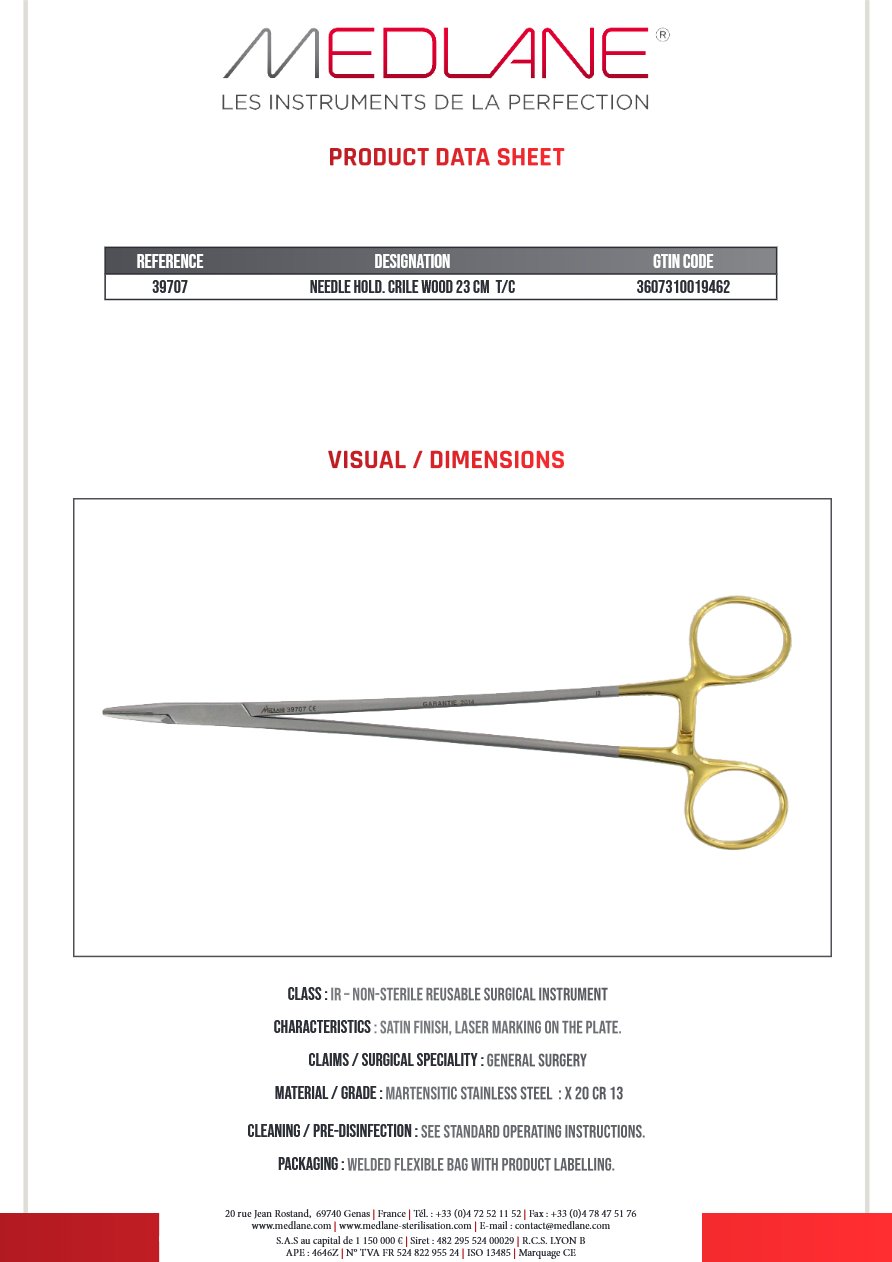
Porte Aiguille Crile Wood 230 mm Tungstène · REF 39707P
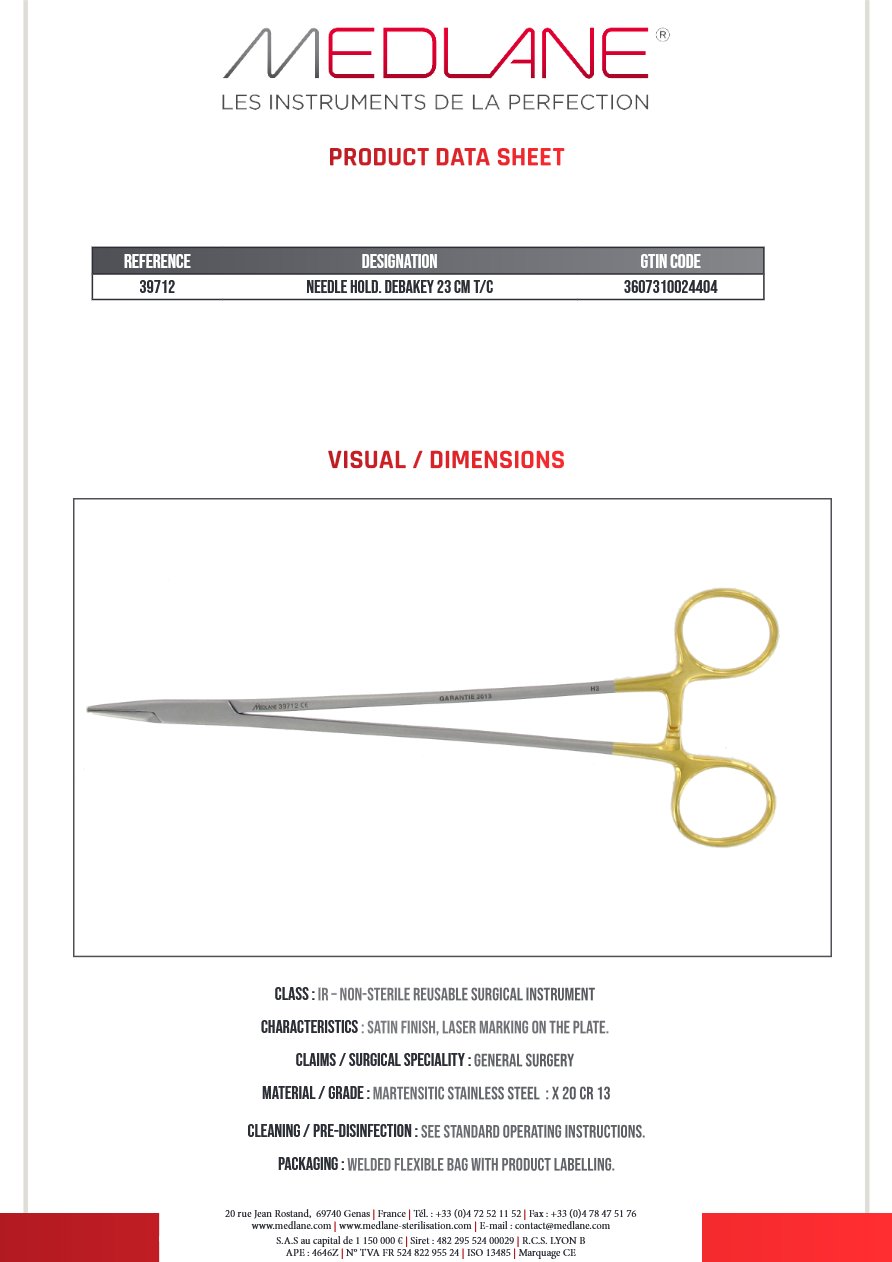
Porte Aiguille Debakey 230 mm Tungstène · REF 39712P
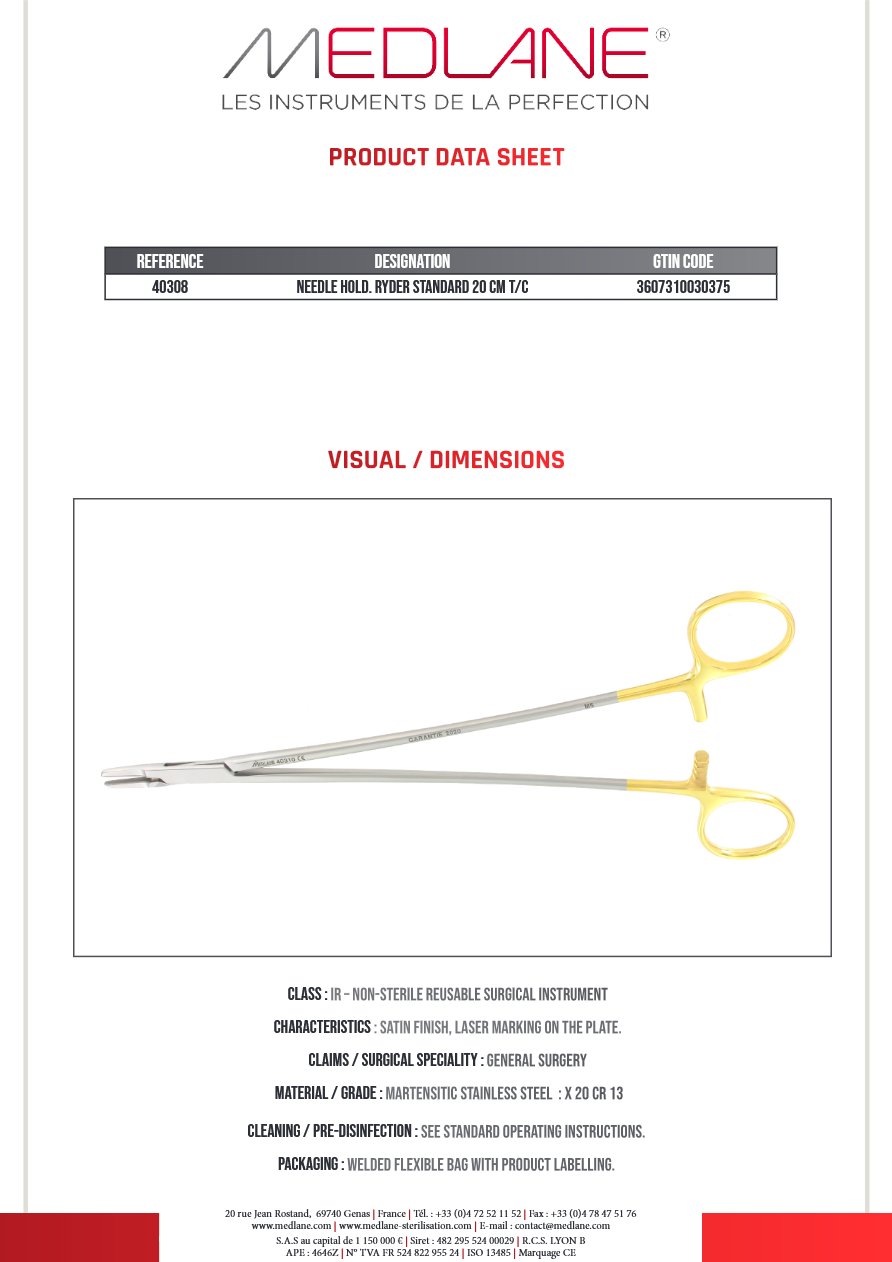
Porte Aiguille Ryder Standard 200 mm Tungstène · REF 40308P
Every characteristic quoted here is the one carried by the catalogue designation of the reference shown. The exact configuration is always read from the reference and its documentation.
Look at the mechanism
Full instrument → observed zone → identifying detail
The handle half of the product plate, with an identical frame for all three references: this is where the closing and locking mode can be read.
- 01 — Closed finger rings
- 02 — Side ratchet
- 03 — Screw joint
- 01 — Ringless shanks
- 02 — Opening spring
- 03 — Curved ratchet
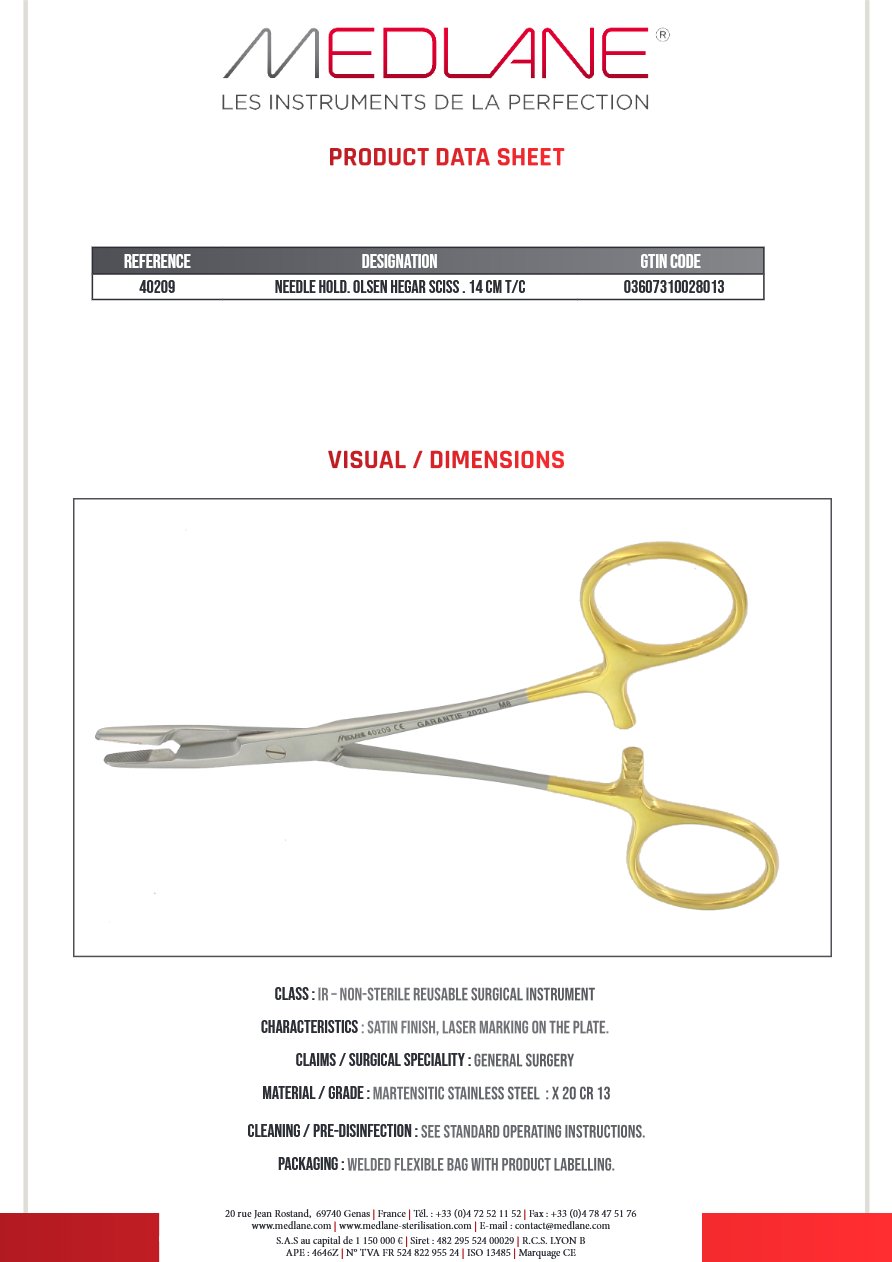
- 01 — Closed finger rings
- 02 — Scissor-blade shanks
- 03 — Side ratchet
The hand decides the handle; the handle decides the rest.
Look at the jaws
The same observation window and the same scale for all five references: only the instrument's position on its product plate changes. No image is distorted or enlarged beyond what its resolution allows.
- 01 — SHORT, BROAD JAWS
- 02 — MILLED SURFACE
- 01 — FINE, TAPERED JAWS
- 02 — NARROW SHANKS
- 01 — NARROW TIP
- 02 — SLENDER PROFILE
- 01 — VERY FINE JAWS
- 02 — SLENDER SHANKS
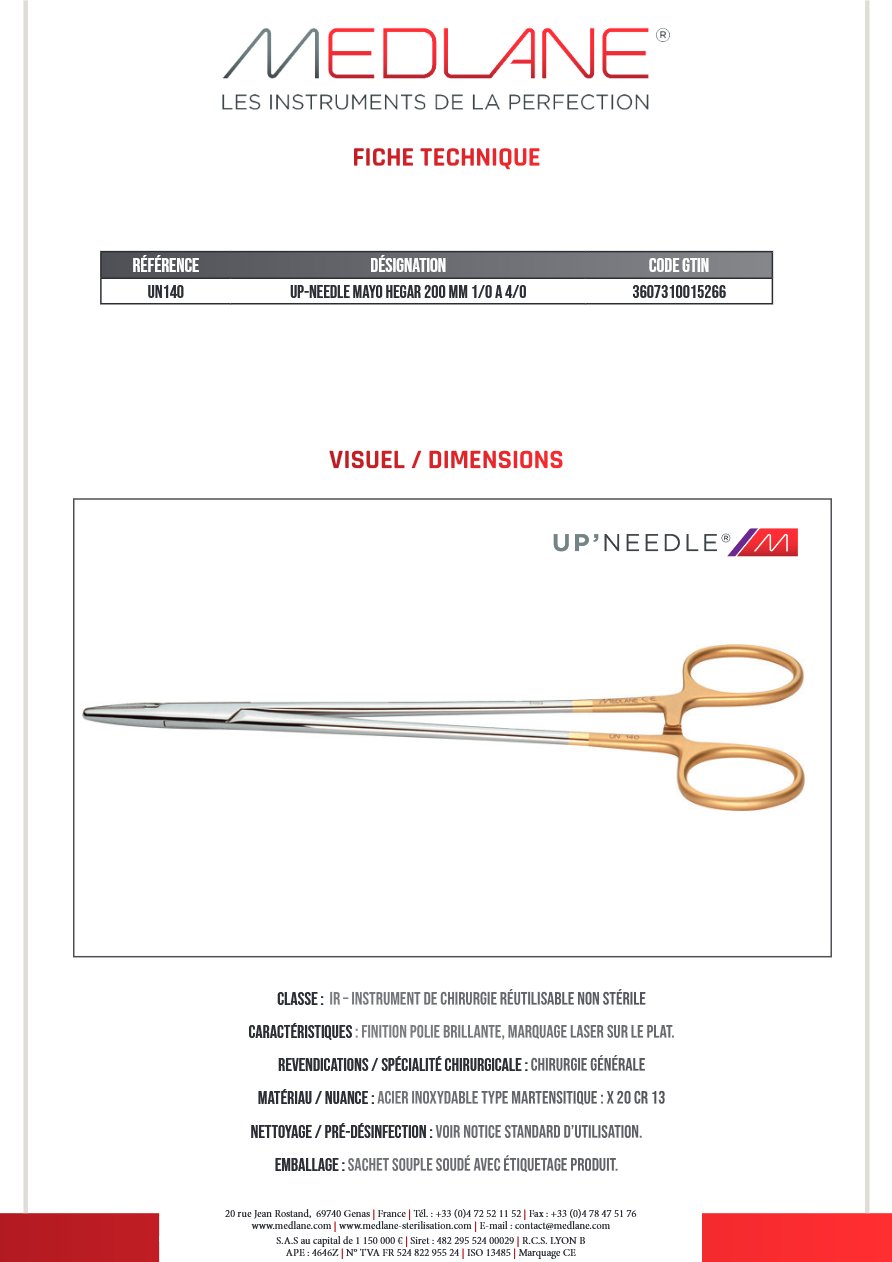
- 01 — MILLED CARBIDE JAWS
- 02 — 1/0 TO 4/0 SEGMENTATION
It is the jaw surface that holds the needle, not the strength of the hand.
The main architectures
Six named architectures, as designated in the MEDLANE catalogue. The descriptions below are strictly morphological.
Porte Aiguille Mayo Hegar 200 mm Tungstène · REF 40204P
Porte Aiguille Mathieu Standard 140 mm Tungstène · REF 40001P
Porte Aiguille Crile Wood 230 mm Tungstène · REF 39707P
Porte Aiguille Debakey 230 mm Tungstène · REF 39712P
Porte Aiguille Ryder Standard 200 mm Tungstène · REF 40308P
Porte Aiguille Olsen Hegar Ciseaux 140 mm Tungstène · REF 40209P
MAYO-HEGAR
- Ring handle, side ratchet
- Broad shanks, short and broad jaws
- In the MEDLANE catalogue: 140 to 300 mm
- Standard (40106P → 40111P) and tungsten (40201P → 40207P) series
MATHIEU
- Ringless spring architecture
- Curved ratchet on the inner face
- In the MEDLANE catalogue: 140, 170 and 200 mm
- Standard, Delicate, Bayonet and Olsen scissors series
CRILE-WOOD
- Ring handle, narrow shanks
- Finer, tapered jaws
- In the MEDLANE catalogue: 150 to 300 mm
- Standard (39702P, 39703P) and tungsten (39704P → 39709P) versions
DEBAKEY
- Slender silhouette, narrow tip
- In the MEDLANE catalogue: 150 to 300 mm
- Every reference listed here has tungsten jaws
- A 370 mm double-joint version is referenced
RYDER
- Very fine jaws, slender shanks
- In the MEDLANE catalogue: 130 to 260 mm
- Two referenced series: Standard and Mini
- All with tungsten-carbide jaws
OLSEN-HEGAR
- Ring handle with scissor-blade shanks
- In the MEDLANE catalogue: 120, 140 and 170 mm
- References 40208, 40209P, 40210P
- A Mathieu Olsen scissors variant is also referenced
The name designates an architecture; the reference specifies its configuration.
Standard or tungsten carbide
In the MEDLANE catalogue the tungsten-carbide version is written into the designation: it carries the word “Tungstène”. On the references where this applies, the gold rings on the product photograph identify that version.
Mayo-Hegar
200 mm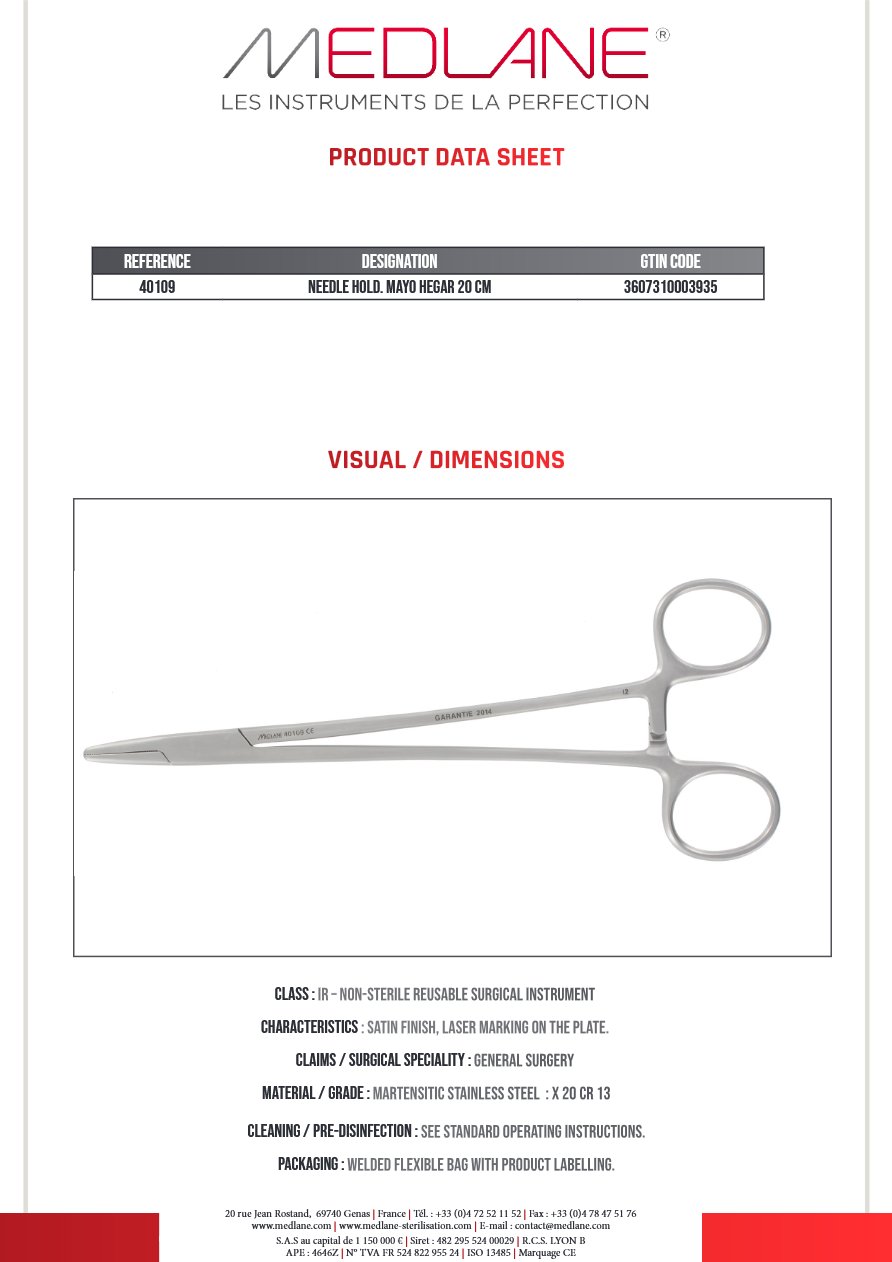
Halsey
130 mm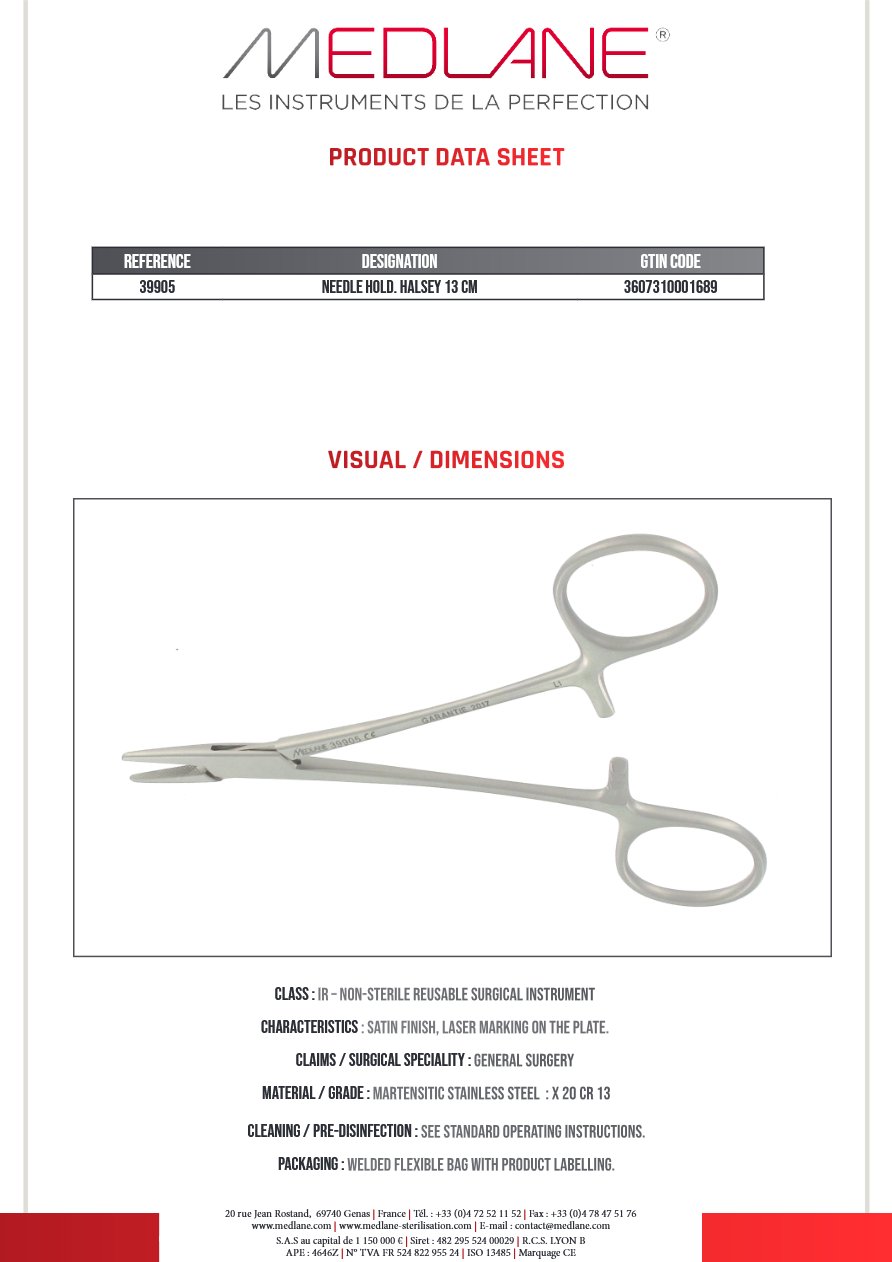
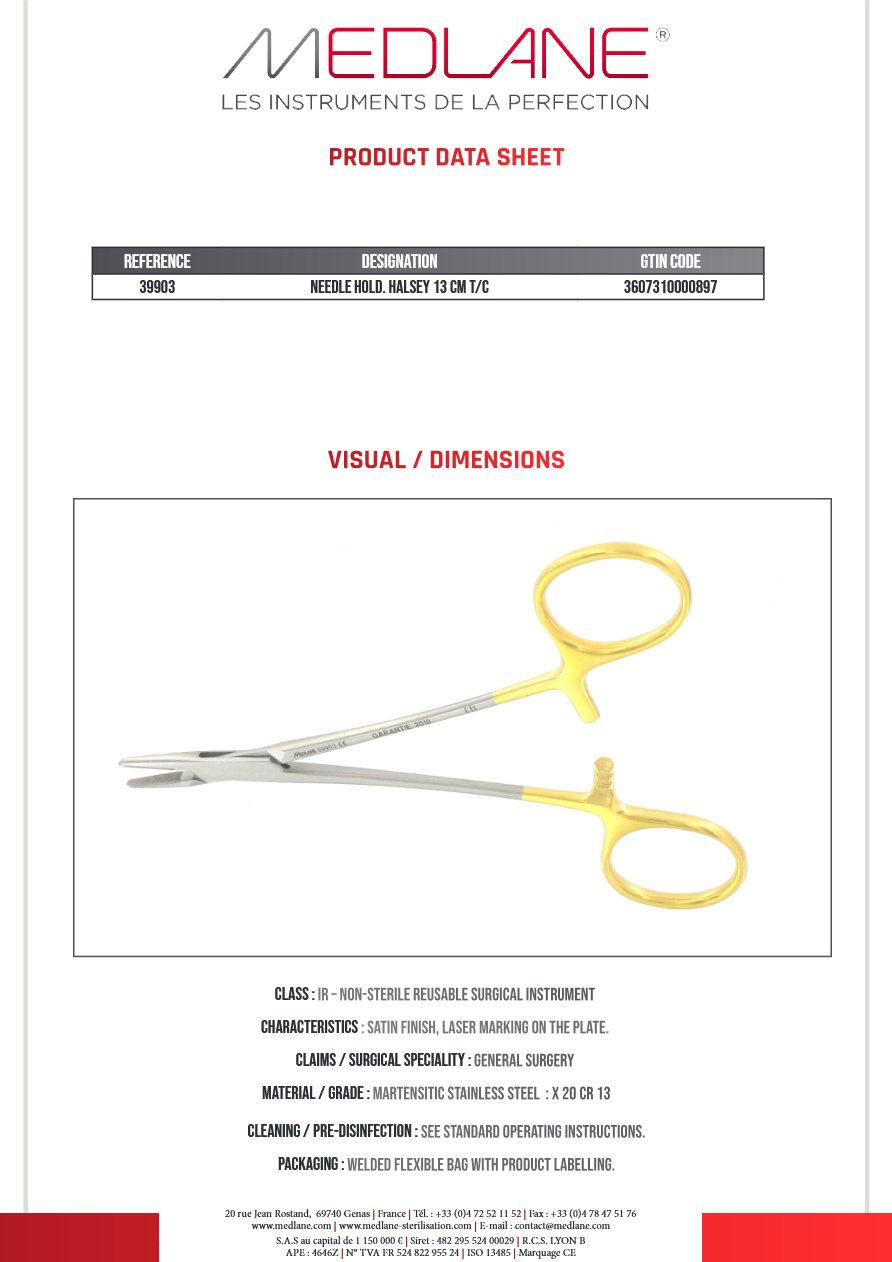
Same family, same length, two designations: this is the only comparison that truly isolates the word “Tungstène”. This reading applies only to the references whose designation carries it.
From precision to micro precision
Four short references from the MEDLANE catalogue, all with tungsten-carbide jaws: jaw fineness and shank slenderness increase as length decreases.
130 mm
Porte Aiguille Halsey 130 mm Tungstène · REF 39903P
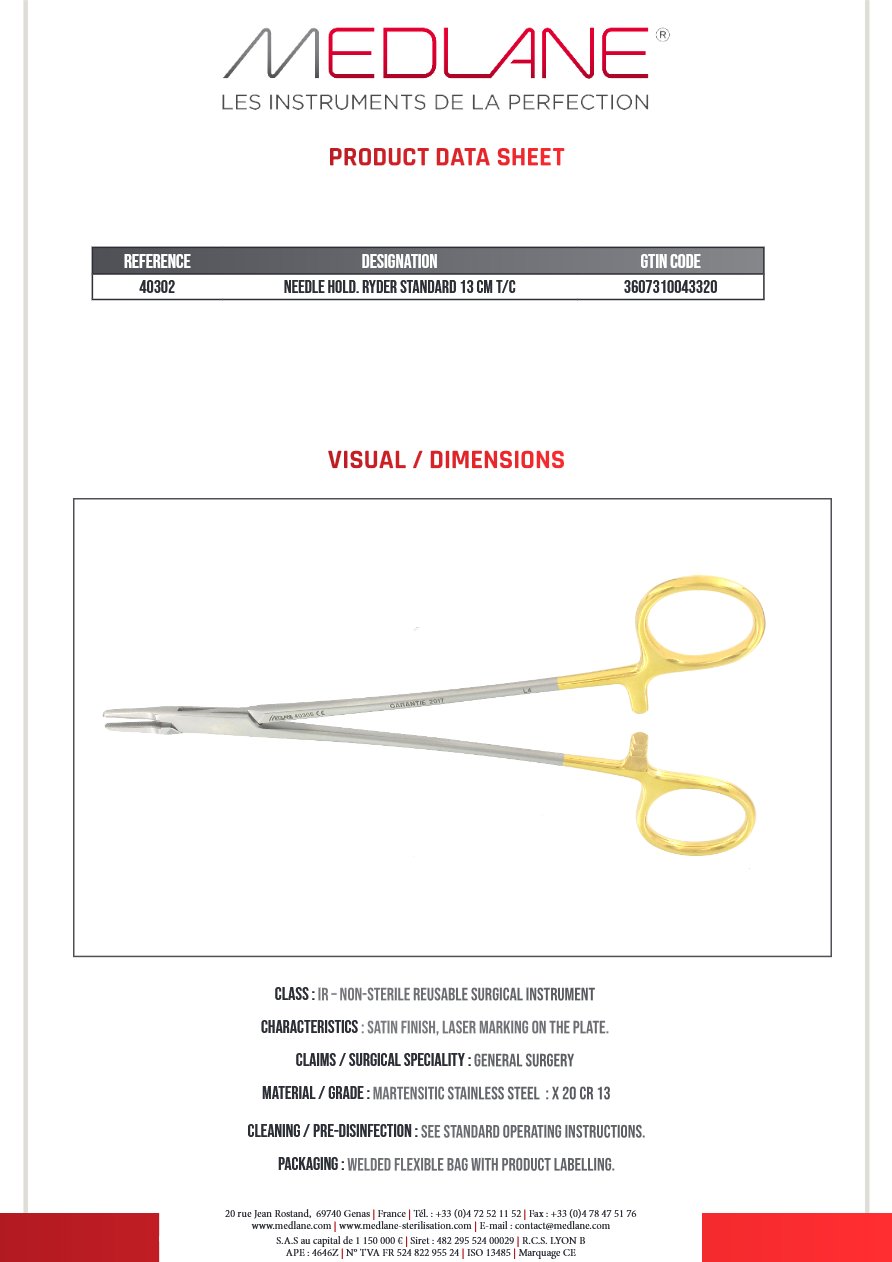
130 mm
Porte Aiguille Ryder Standard 130 mm Tungstène · REF 40302P
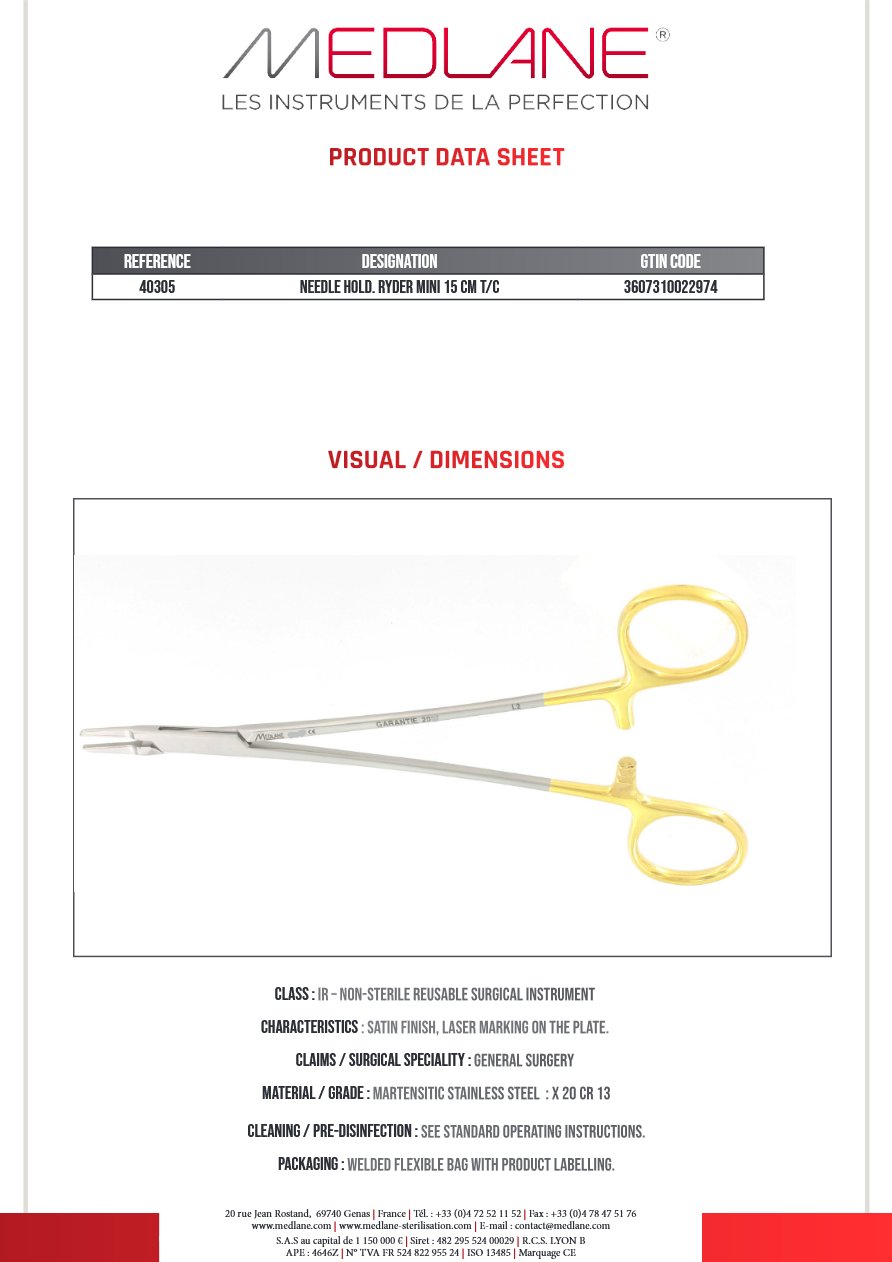
150 mm
Porte Aiguille Ryder Mini 150 mm Tungstène · REF 40305P
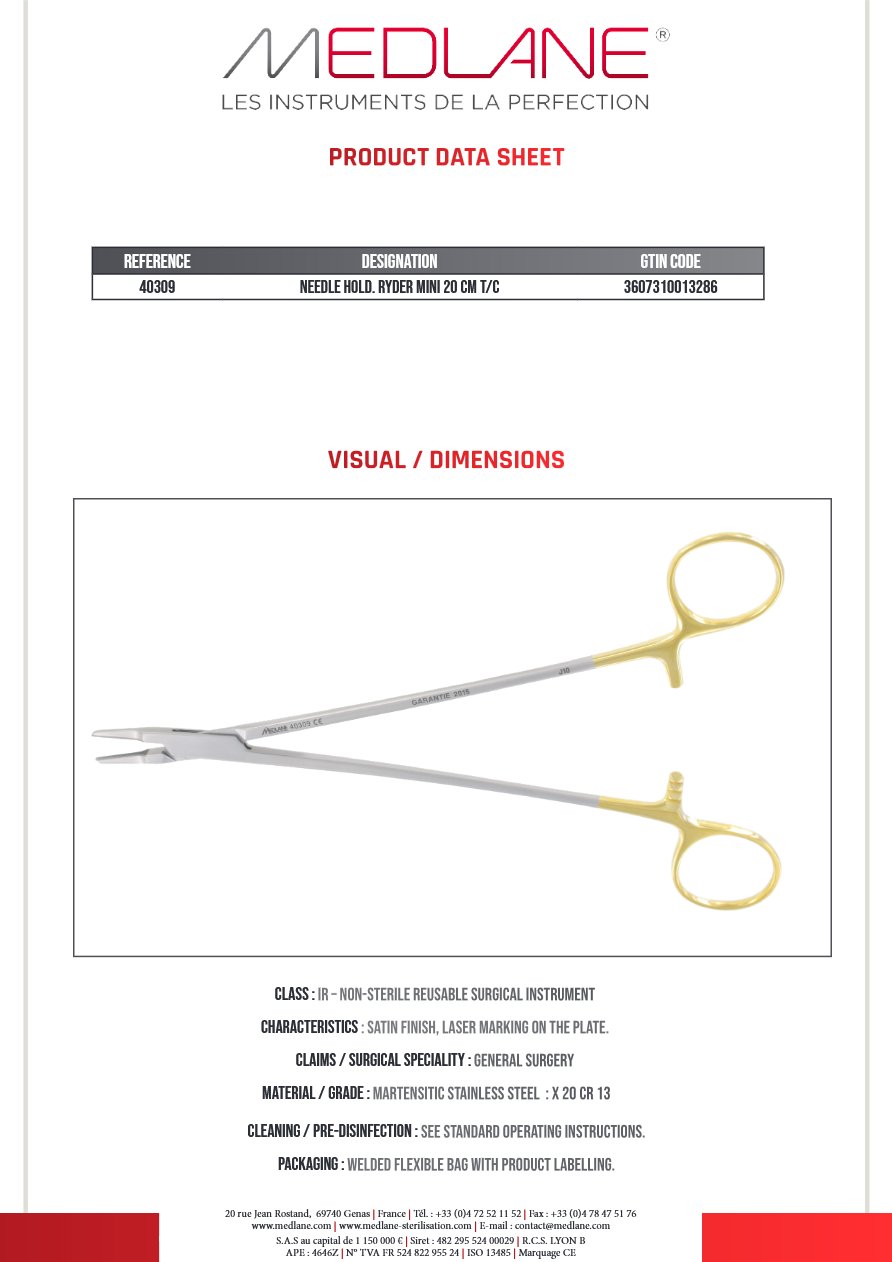
200 mm
Porte Aiguille Ryder Mini 200 mm Tungstène · REF 40309P
The MEDLANE catalogue also references micro needle holders with round or flat bodies — Castro, Jacobson and Yasargil architectures — whose designation carries the exact jaw dimensions.
UP-NEEDLE® — MEDLANE know-how
UP-NEEDLE® is MEDLANE's line of needle holders with milled tungsten-carbide jaws. Its distinctive feature is its segmentation: every reference carries, in its designation, the suture-diameter range for which its jaws are milled.
- 1/0 to 4/0 — Mayo Hegar architecture, 140 to 200 mm (UN000, UN130, UN140)
- 4/0 to 6/0 — DeBakey, Ryder and Crile Wood architectures, 150 to 260 mm
- 5/0 to 7/0 — Microvascular architecture, 150 to 230 mm (UN431, UN322, UN352, UN327)
- 6/0 to 8/0 — Ryder Micro architecture, 130 mm (UN465)
- Steel wires — Berry sternal architecture, 190 mm (UN135)
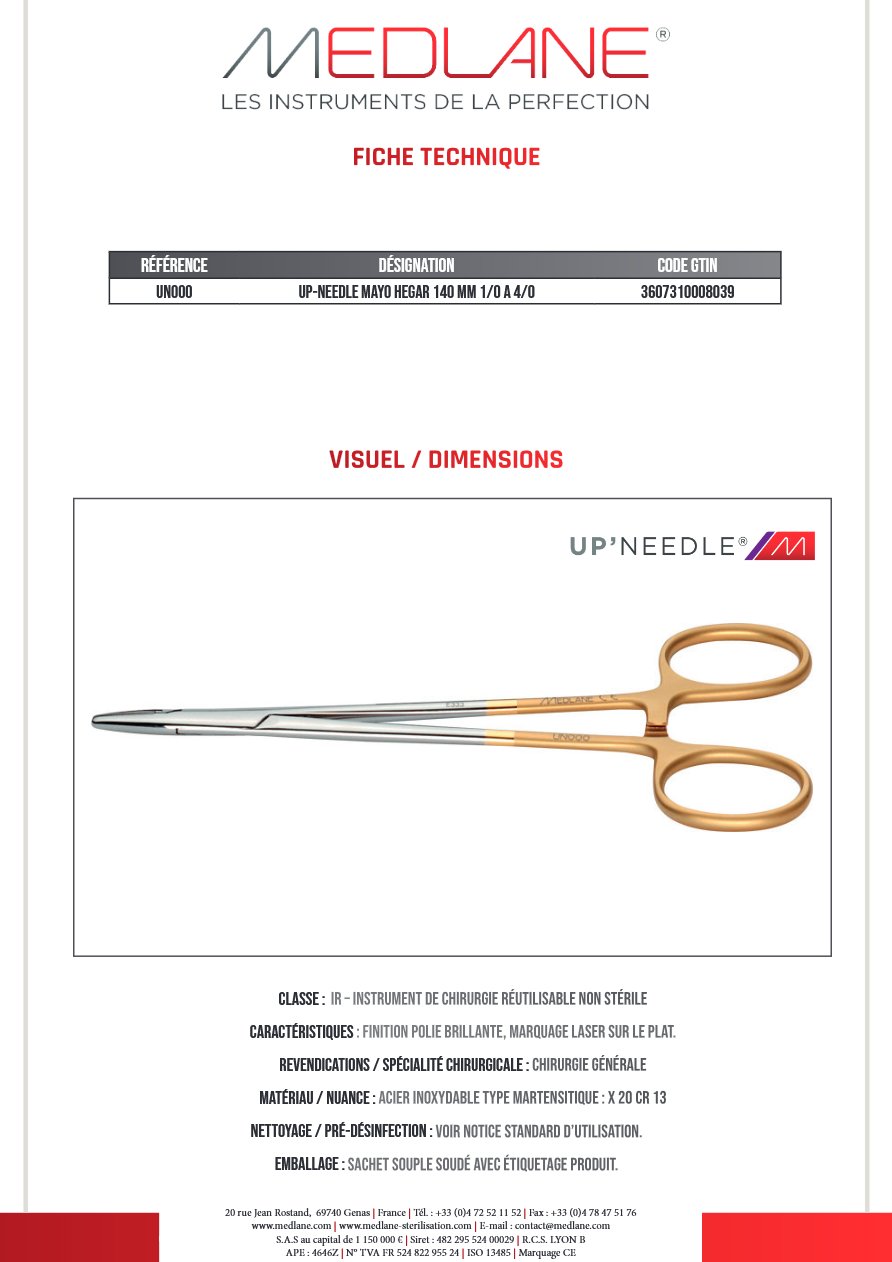
Up-needle Mayo Hegar 140 mm 1/0 a 4/0
REF · UN000· 140 mm· 1/0 → 4/0
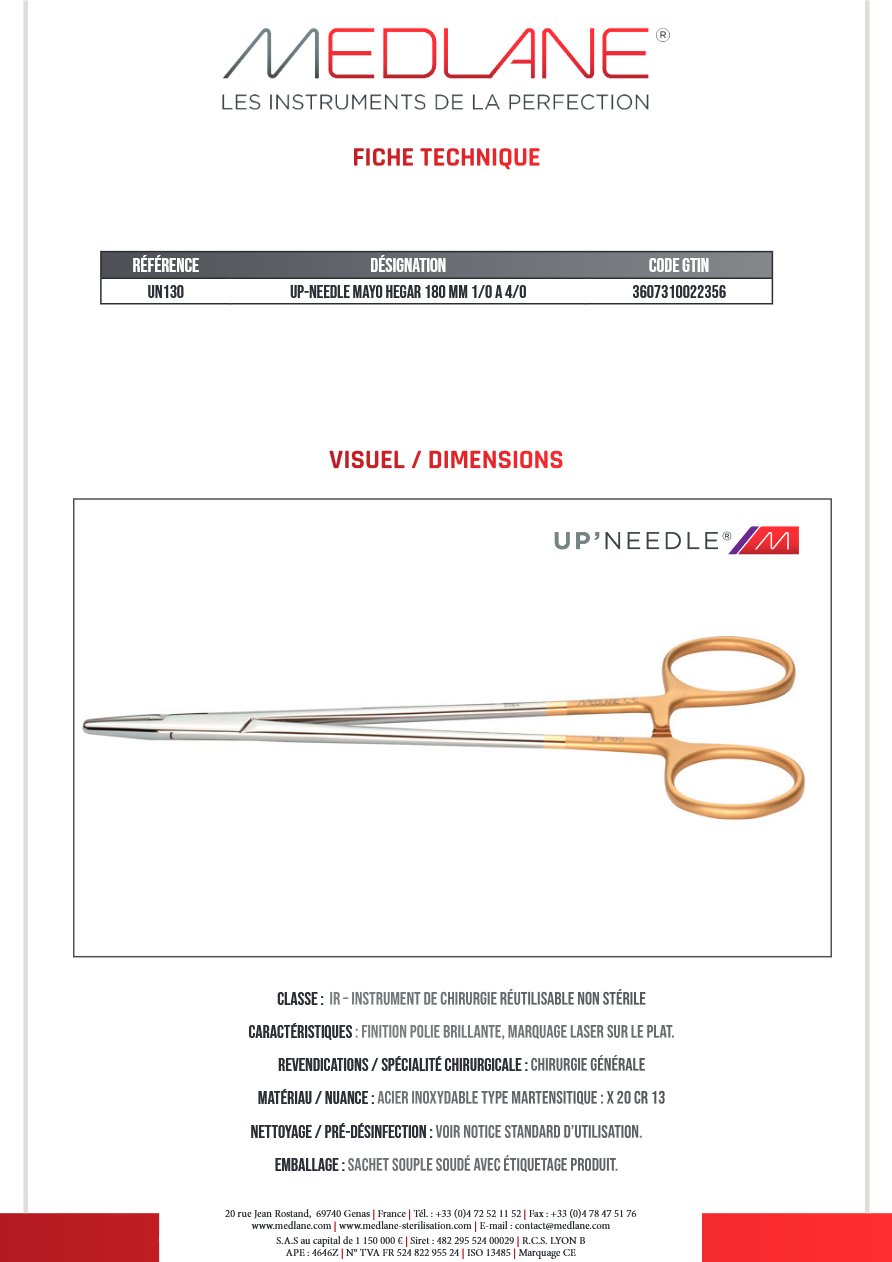
Up-needle Mayo Hegar 180 mm 1/0 a 4/0
REF · UN130· 180 mm· 1/0 → 4/0
Up-needle Mayo Hegar 200 mm 1/0 a 4/0
REF · UN140· 200 mm· 1/0 → 4/0
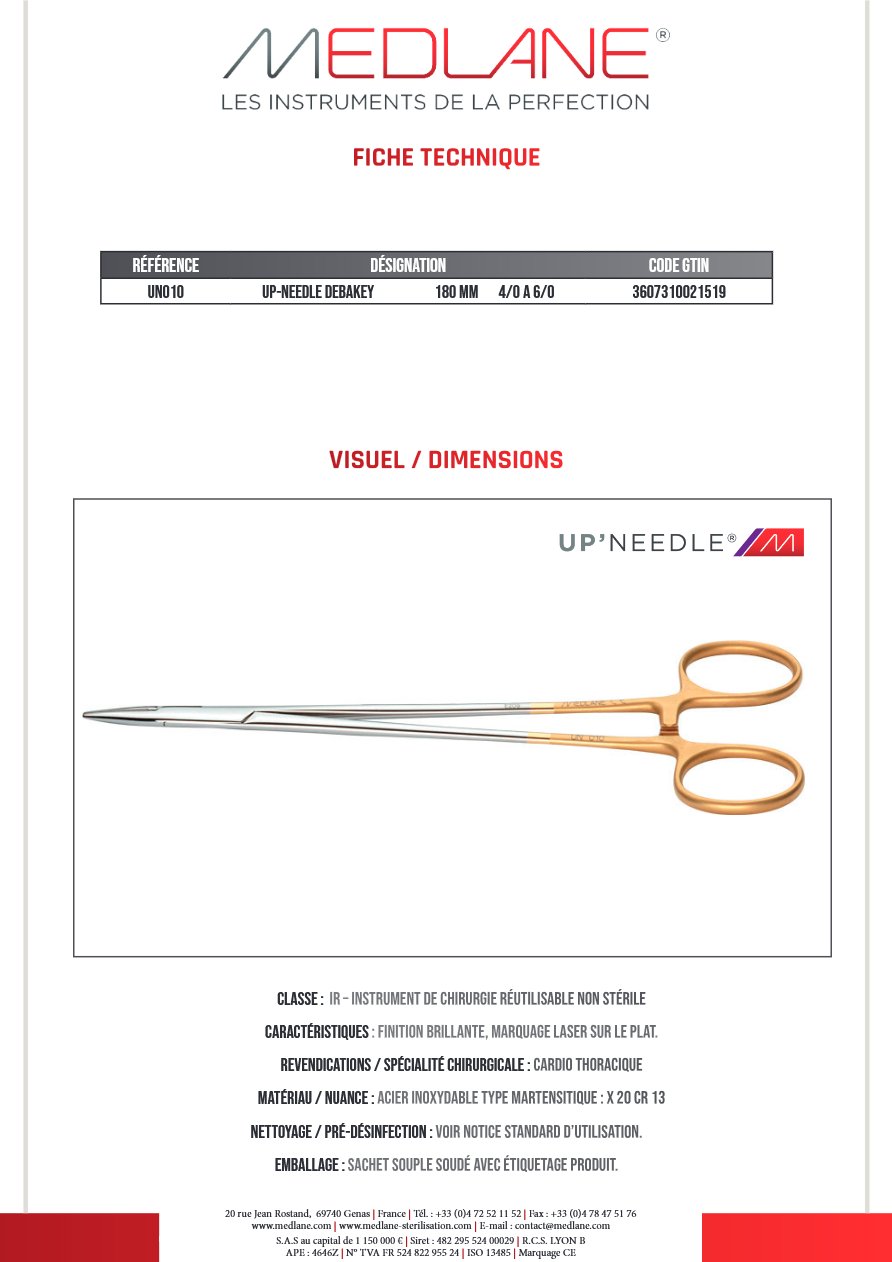
Up-needle Debakey 180 mm 4/0 a 6/0
REF · UN010· 180 mm· 4/0 → 6/0
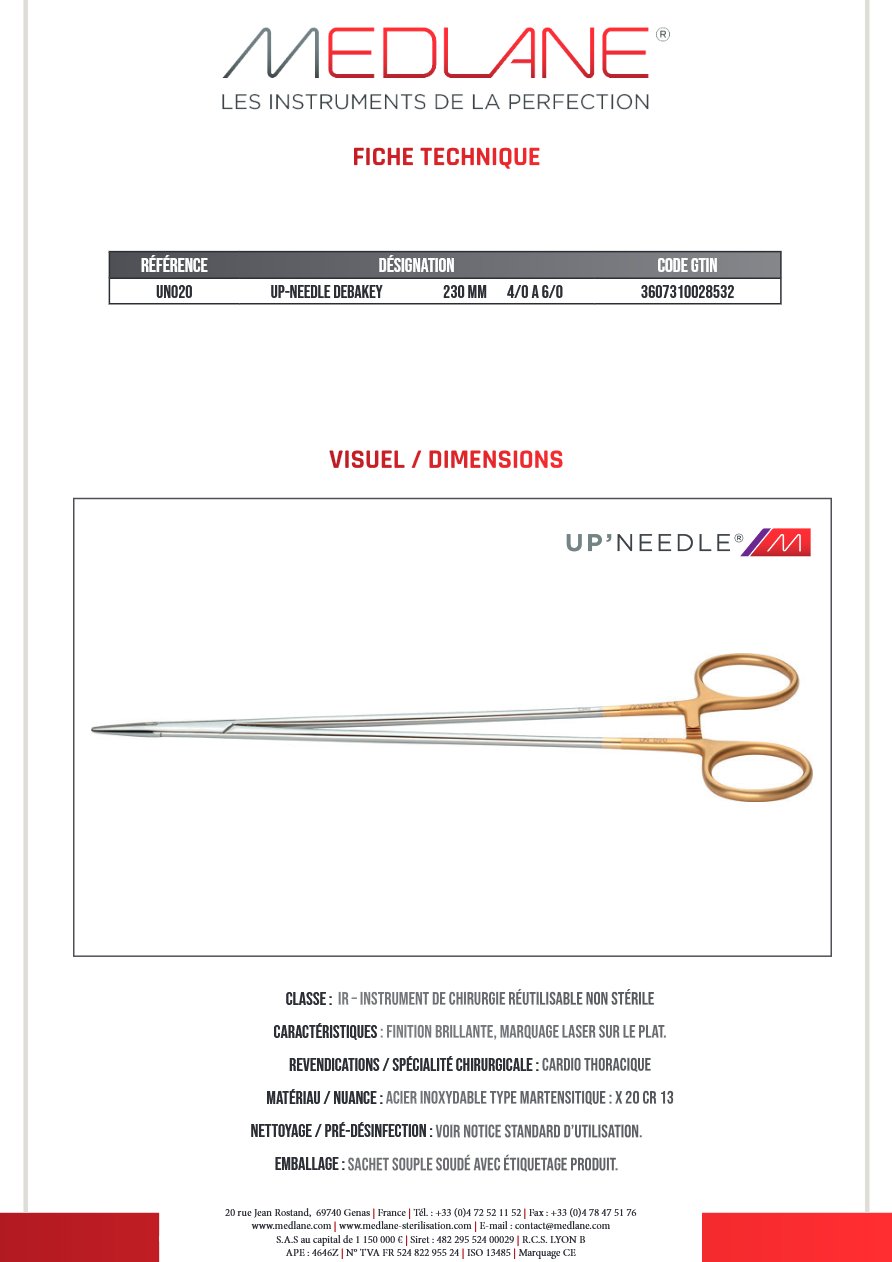
Up-needle Debakey 230 mm 4/0 a 6/0
REF · UN020· 230 mm· 4/0 → 6/0
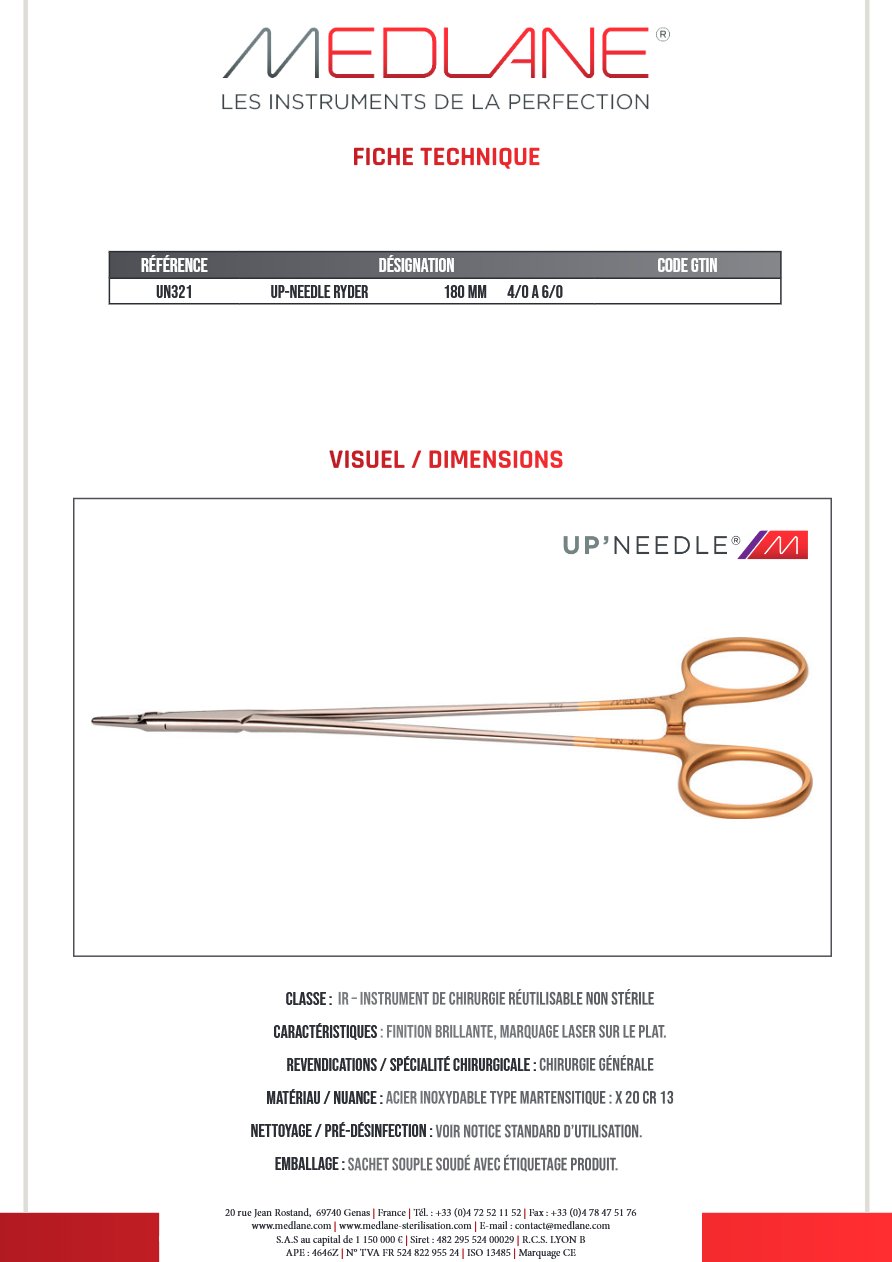
Up-needle Ryder 180 mm 4/0 a 6/0
REF · UN321· 180 mm· 4/0 → 6/0
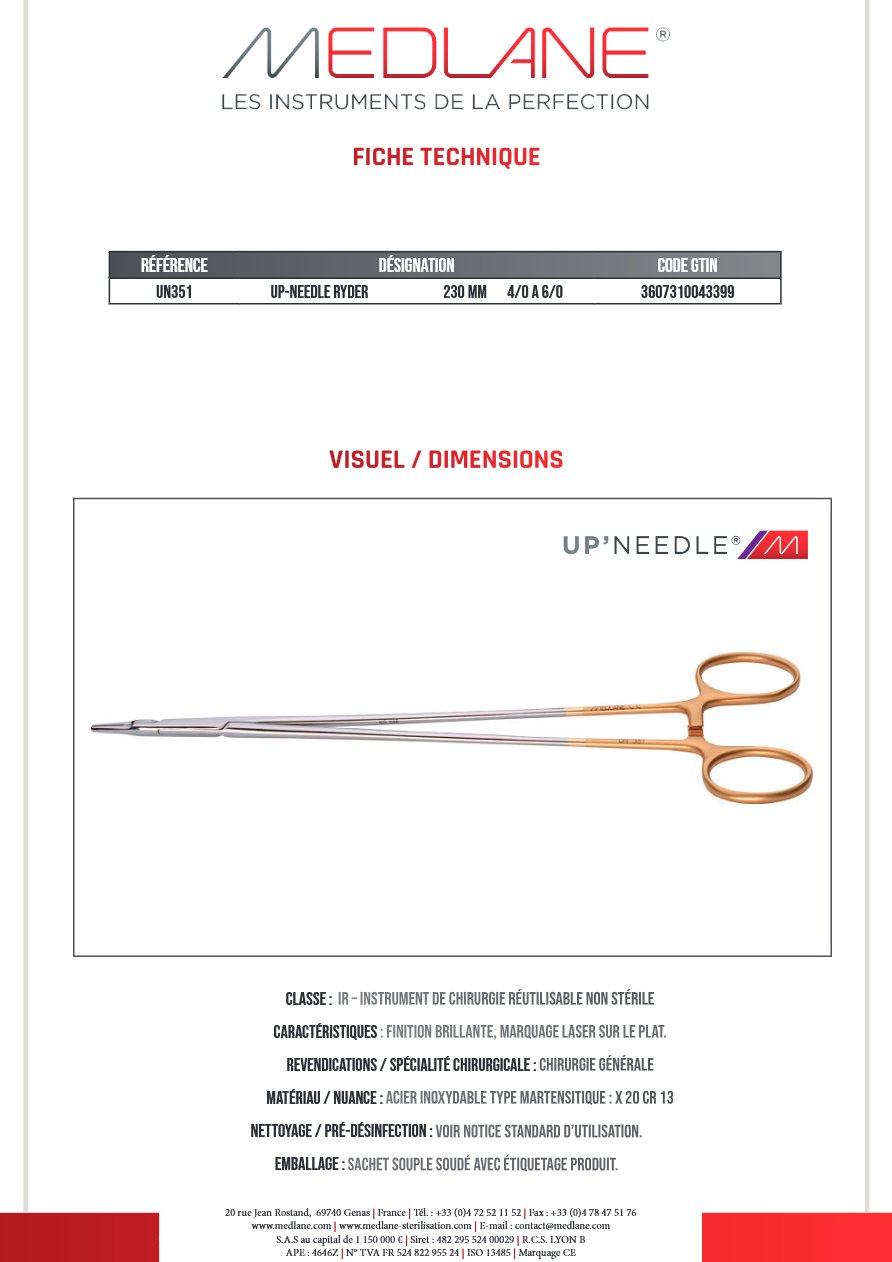
Up-needle Ryder 230 mm 4/0 a 6/0
REF · UN351· 230 mm· 4/0 → 6/0
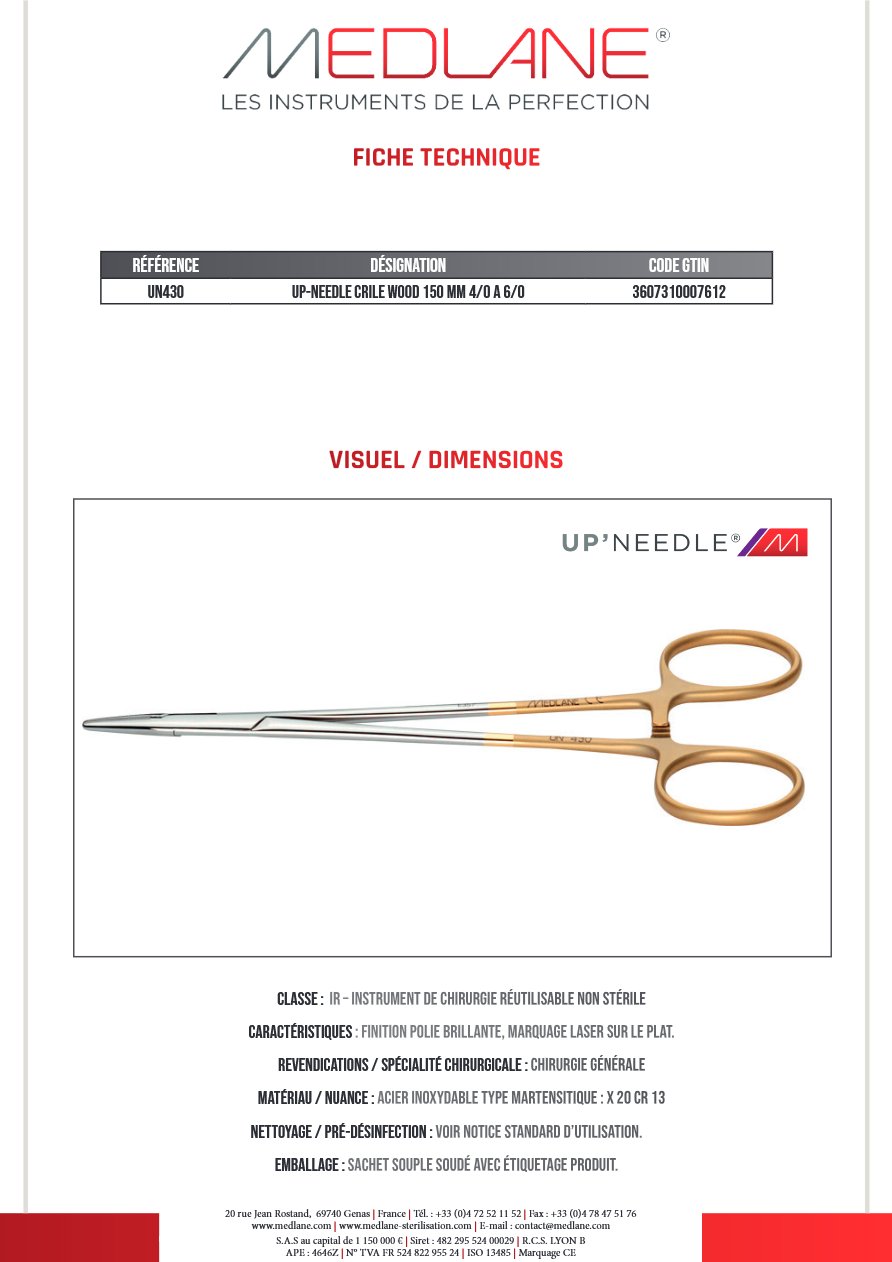
Up-needle Crile Wood 150 mm 4/0 a 6/0
REF · UN430· 150 mm· 4/0 → 6/0
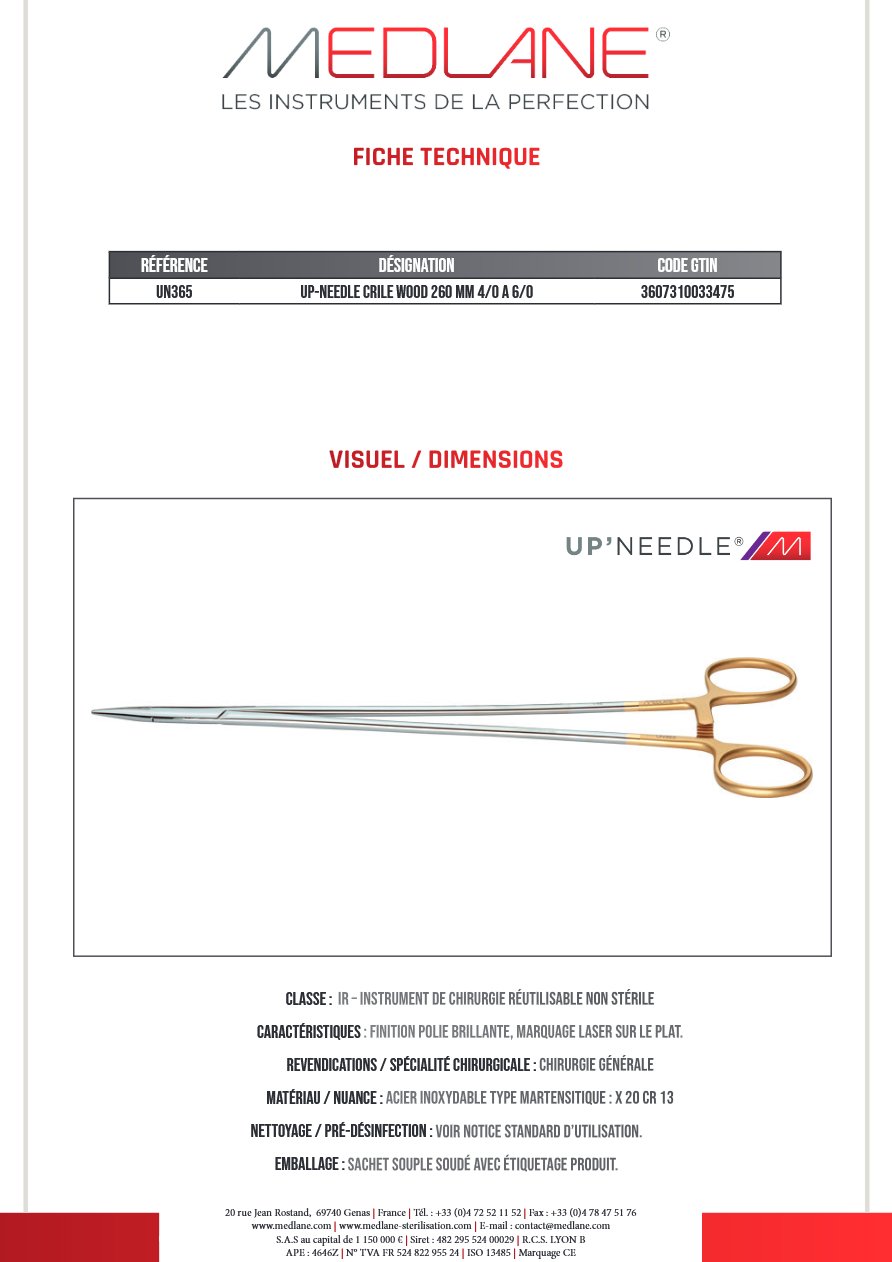
Up-needle Crile Wood 260 mm 4/0 a 6/0
REF · UN365· 260 mm· 4/0 → 6/0
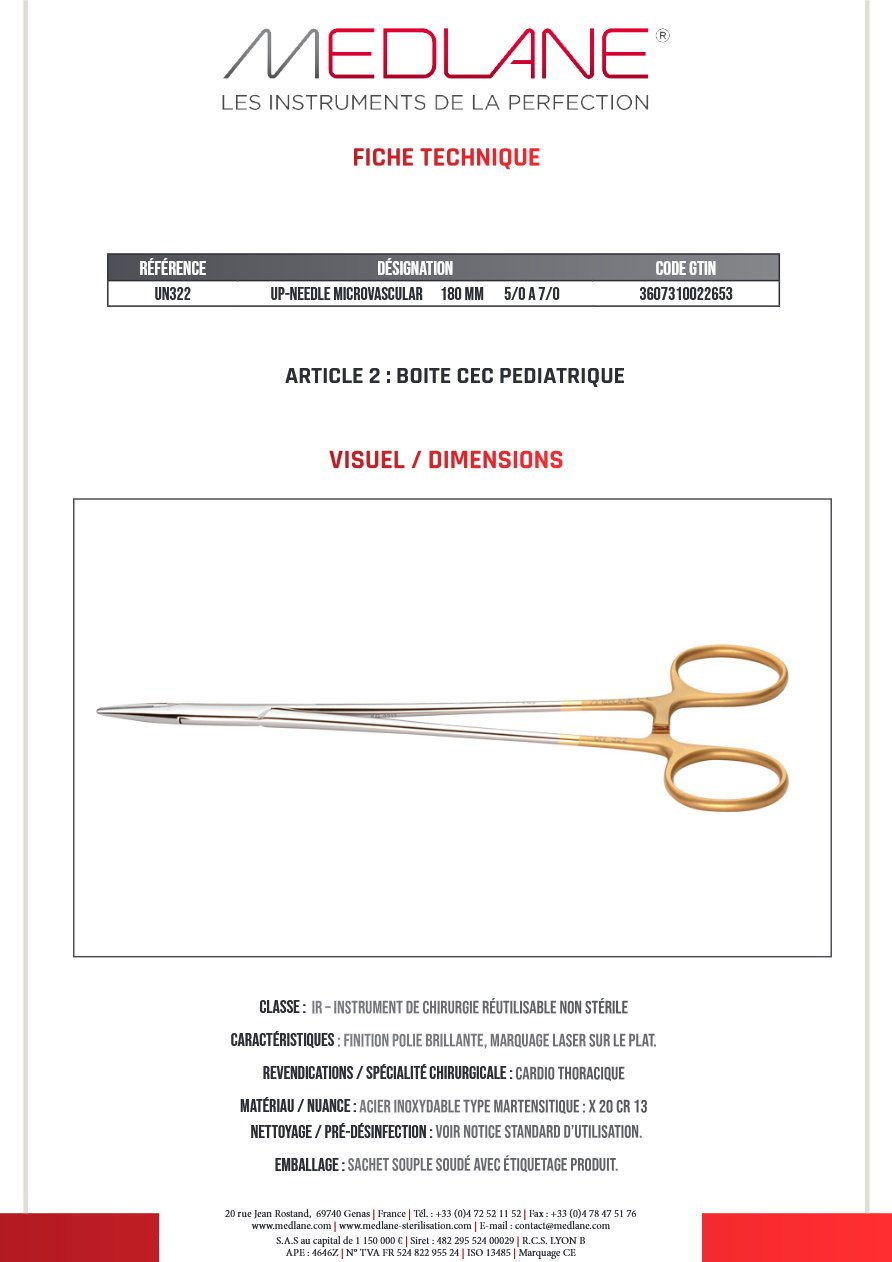
Up-needle Microvascular 180 mm 5/0 a 7/0
REF · UN322· 180 mm· 5/0 → 7/0
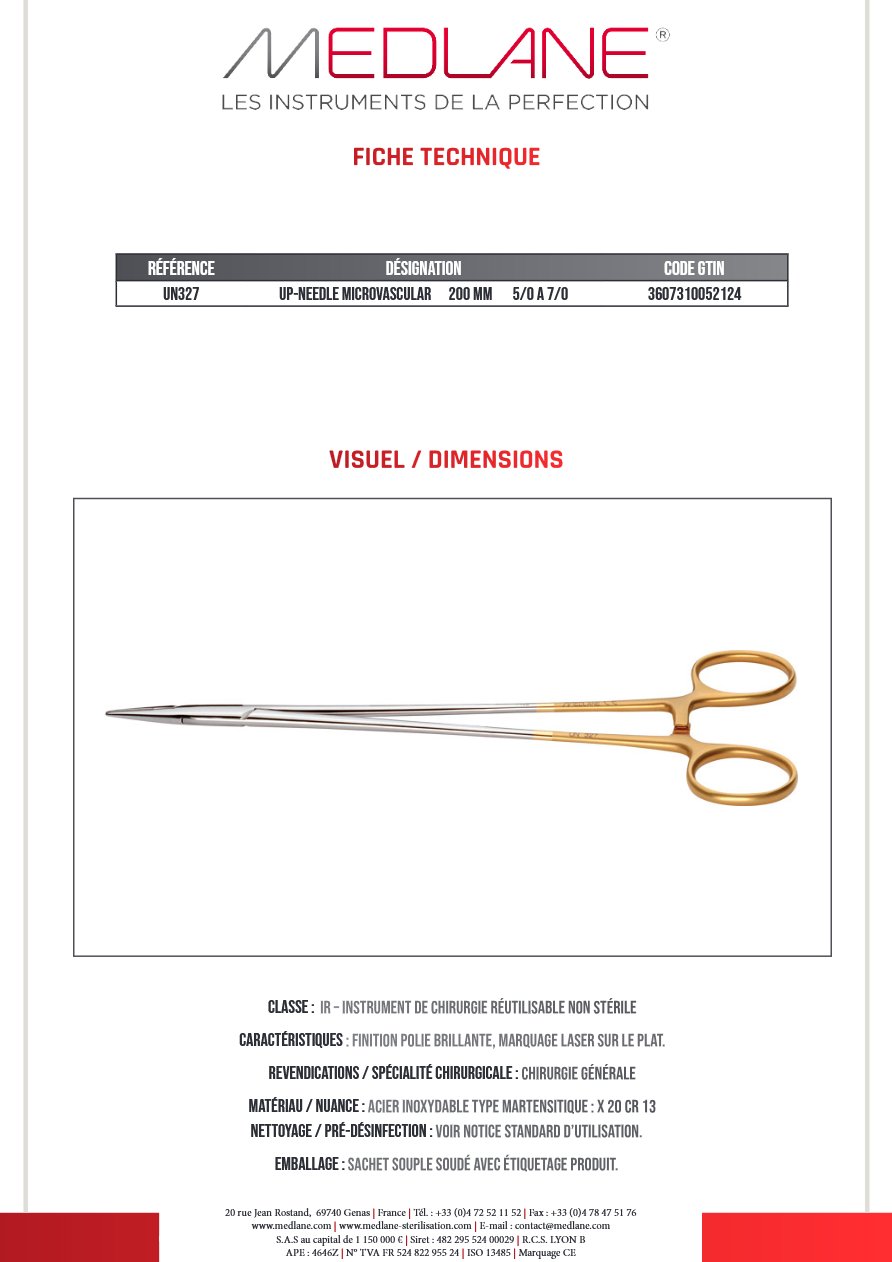
Up-needle Microvascular 200 mm 5/0 a 7/0
REF · UN327· 200 mm· 5/0 → 7/0
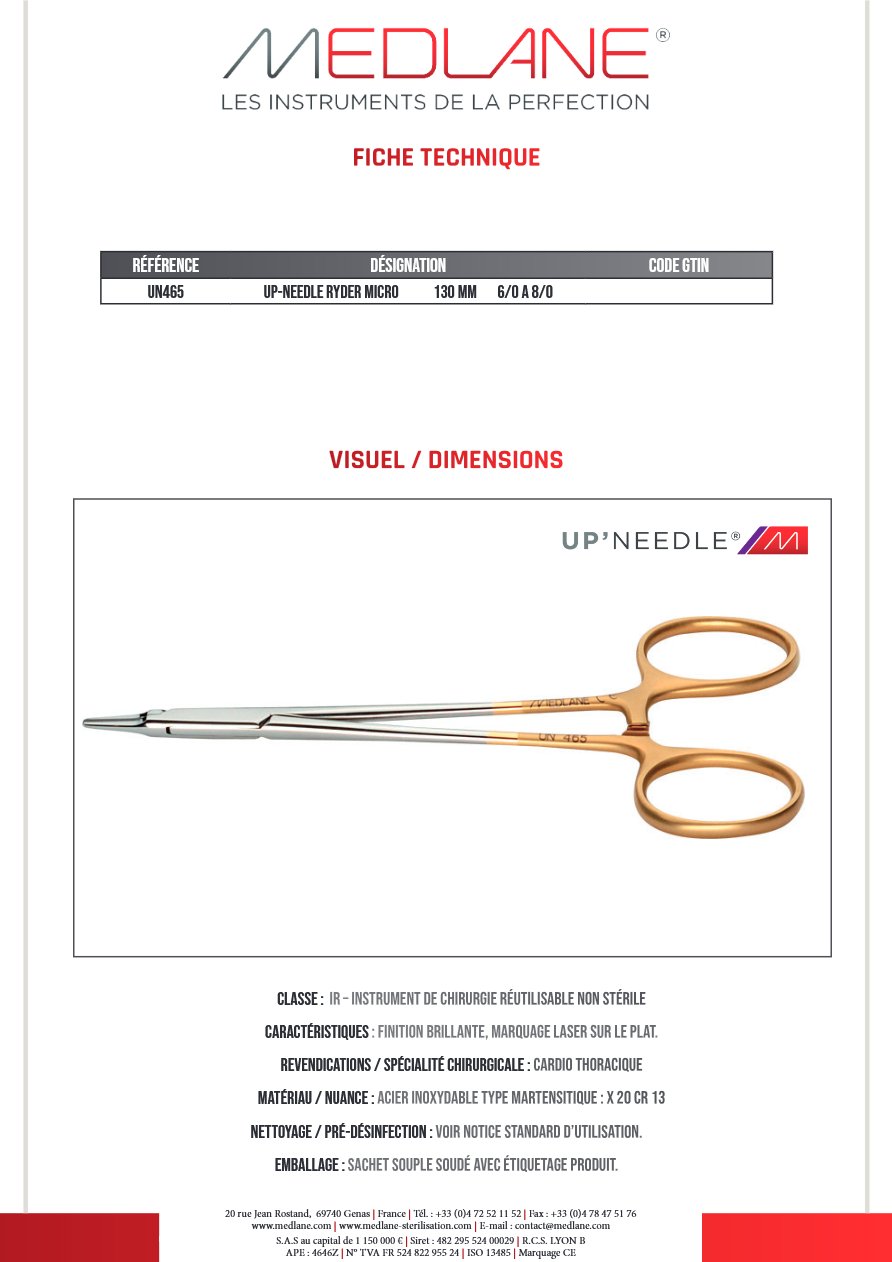
Up-needle Ryder Micro 130 mm 6/0 a 8/0
REF · UN465· 130 mm· Micro· 6/0 → 8/0
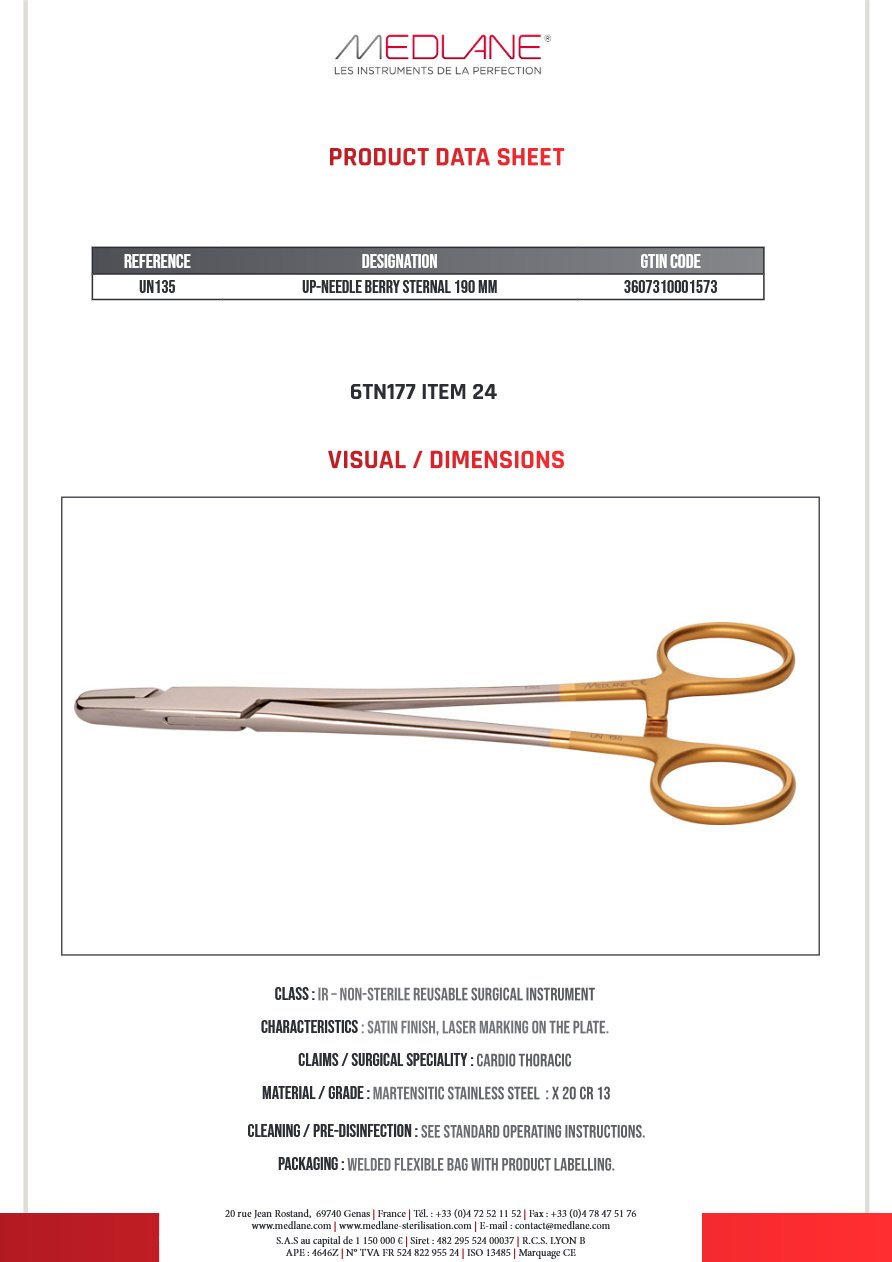
Up-needle Berry Sternal 190 mm Fils Acier
REF · UN135· 190 mm· Steel wires
The characteristics shown on these cards are only those written in each reference's catalogue designation.
Behind the name
1830 — 1914
Alfred Hegar
German gynaecologist. His name remains attached to the most widespread ring-handled needle-holder architecture.
1864 — 1943
George Washington Crile
American surgeon and one of the founders of the Cleveland Clinic. His name today designates several instrument architectures.
1908 — 2008
Michael E. DeBakey
American surgeon and a major figure of cardiovascular surgery. His name designates a slender architecture with a narrow tip.
These names too are eponyms that have become architecture designations. MEDLANE publishes no biography here that is not reliably established: in the catalogue, these names designate a morphology, not a story.
The MEDLANE range
Mayo-Hegar
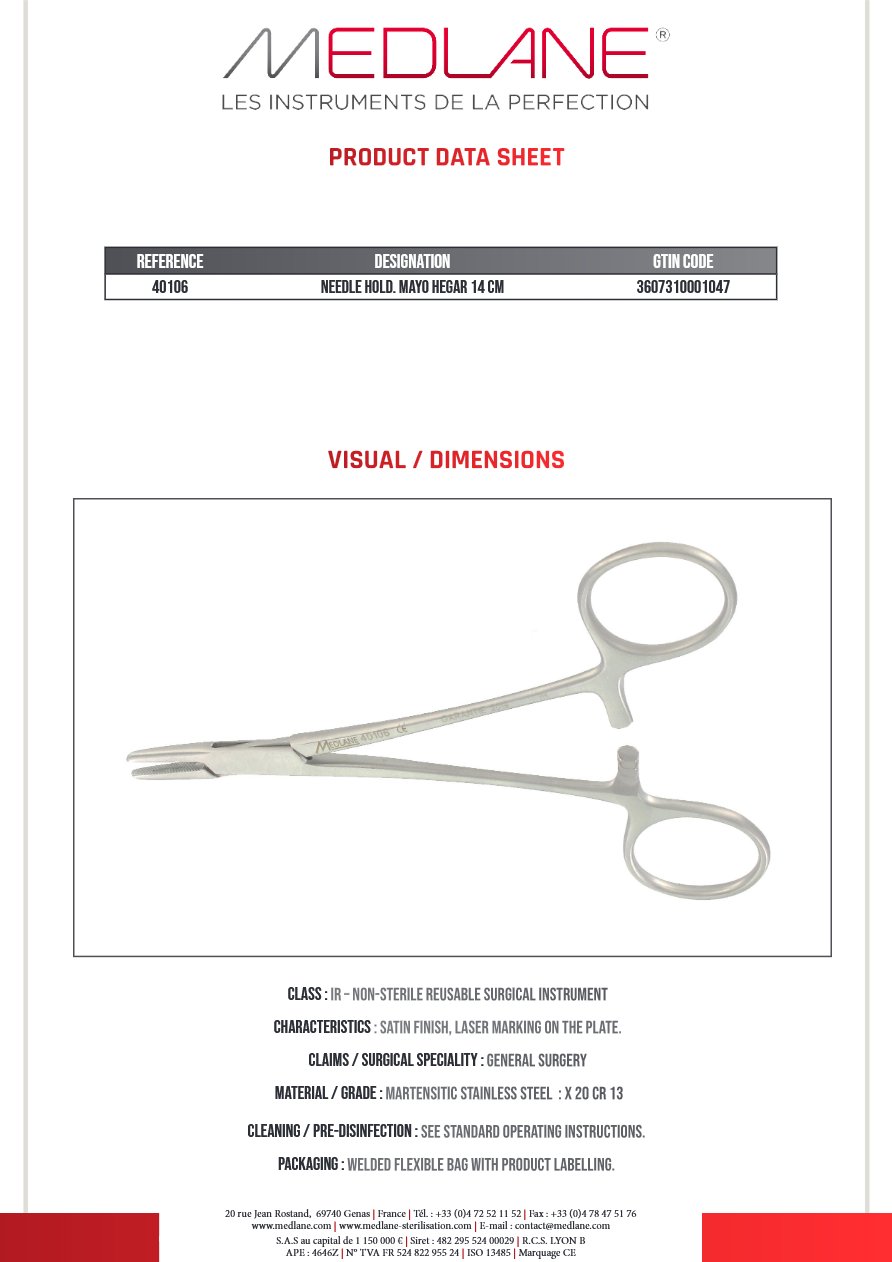
Porte Aiguille Mayo Hegar 140 mm
REF · 40106P· 140 mm
Porte Aiguille Mayo Hegar 200 mm
REF · 40109P· 200 mm
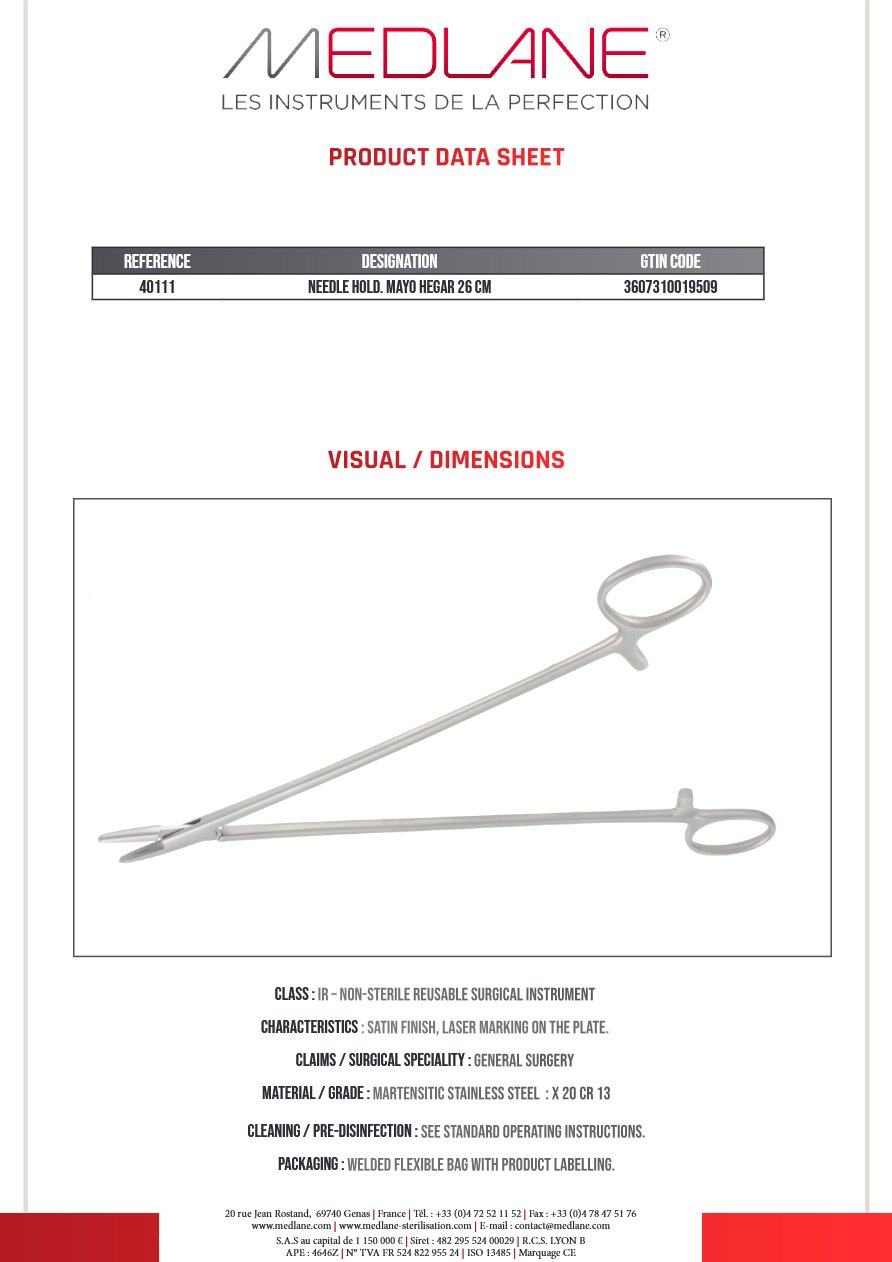
Porte Aiguille Mayo Hegar 260 mm
REF · 40111P· 260 mm
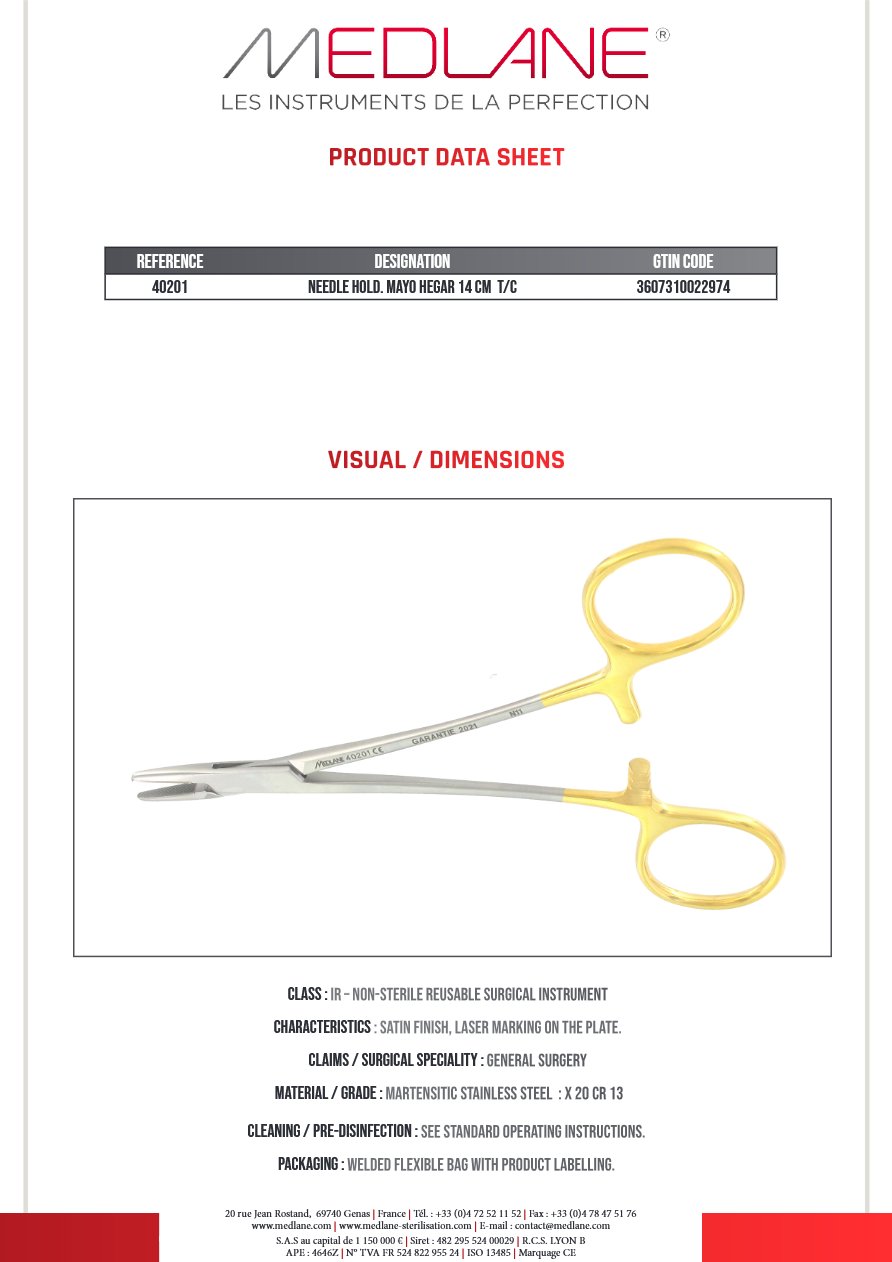
Porte Aiguille Mayo Hegar 140 mm Tungstène
REF · 40201P· 140 mm· Tungsten carbide
Porte Aiguille Mayo Hegar 200 mm Tungstène
REF · 40204P· 200 mm· Tungsten carbide
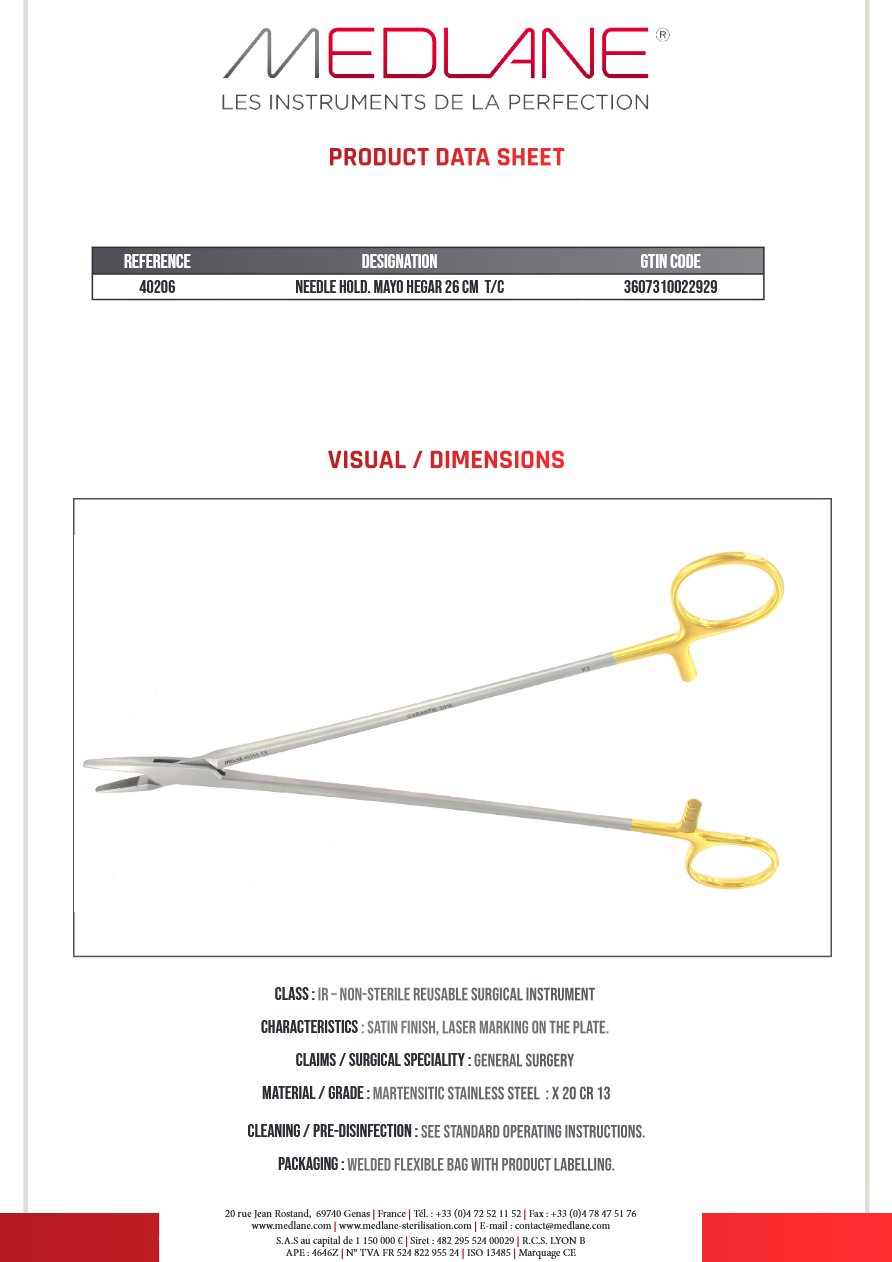
Porte Aiguille Mayo Hegar 260 mm Tungstène
REF · 40206P· 260 mm· Tungsten carbide
Mathieu
Porte Aiguille Mathieu Standard 140 mm Tungstène
REF · 40001P· 140 mm· Tungsten carbide
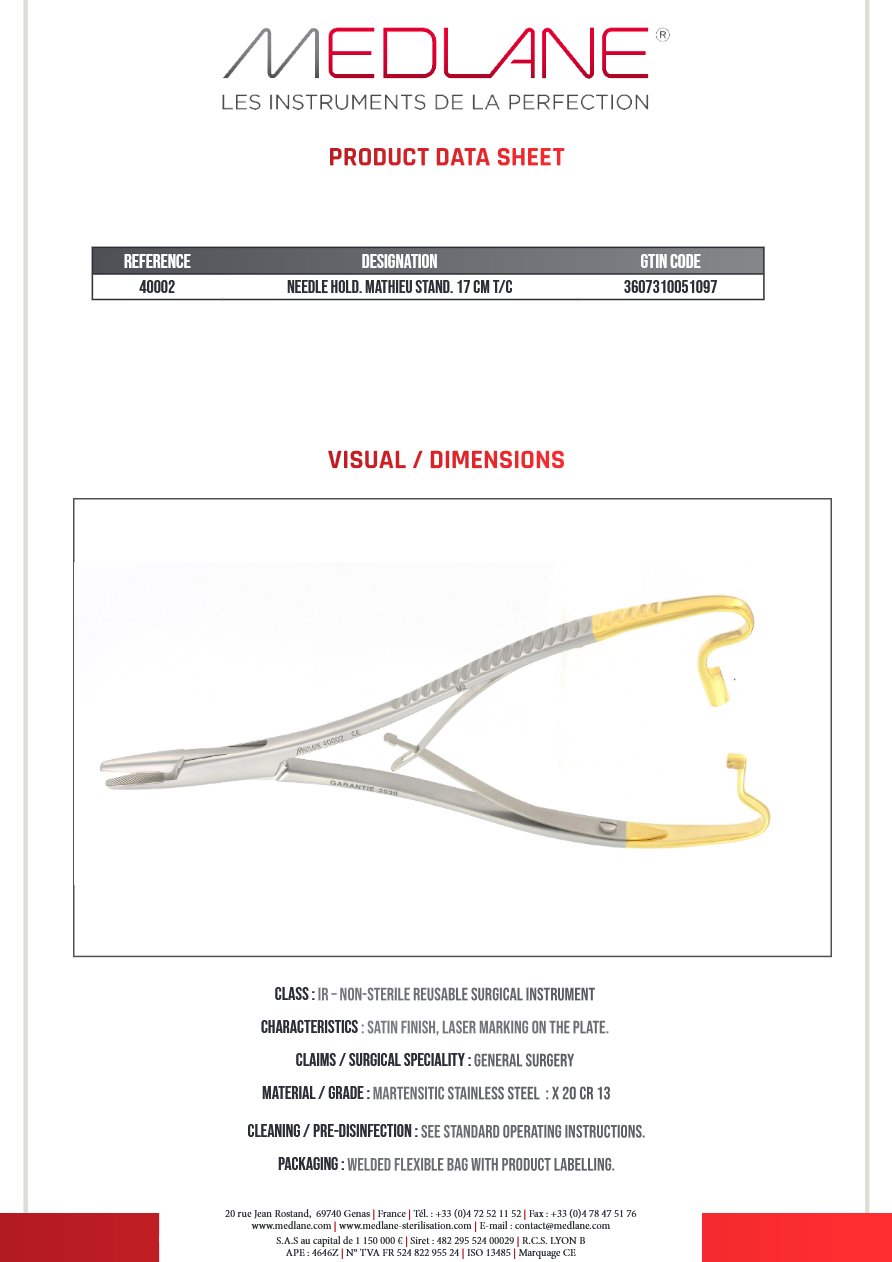
Porte Aiguille Mathieu Standard 170 mm Tungstène
REF · 40002P· 170 mm· Tungsten carbide
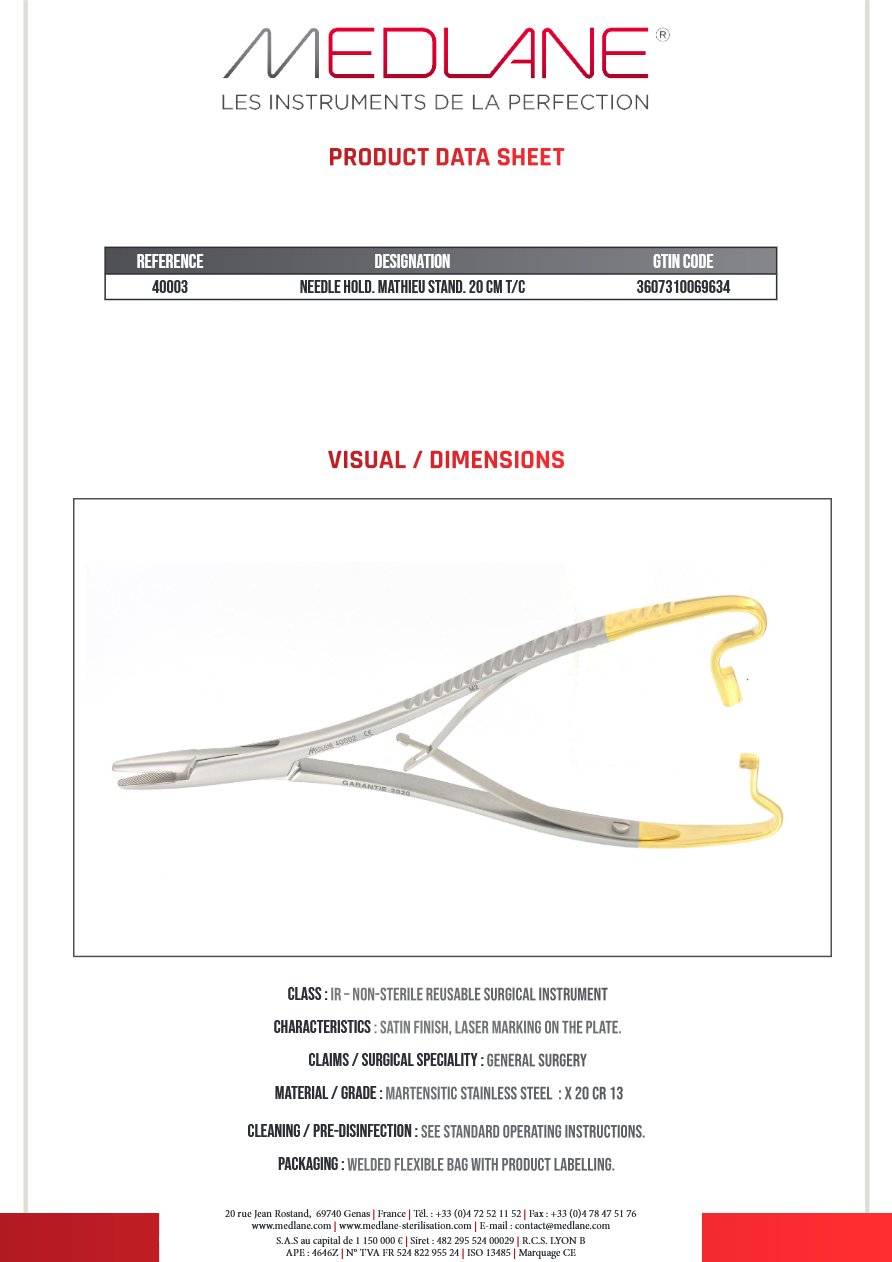
Porte Aiguille Mathieu Standard 200 mm Tungstène
REF · 40003P· 200 mm· Tungsten carbide
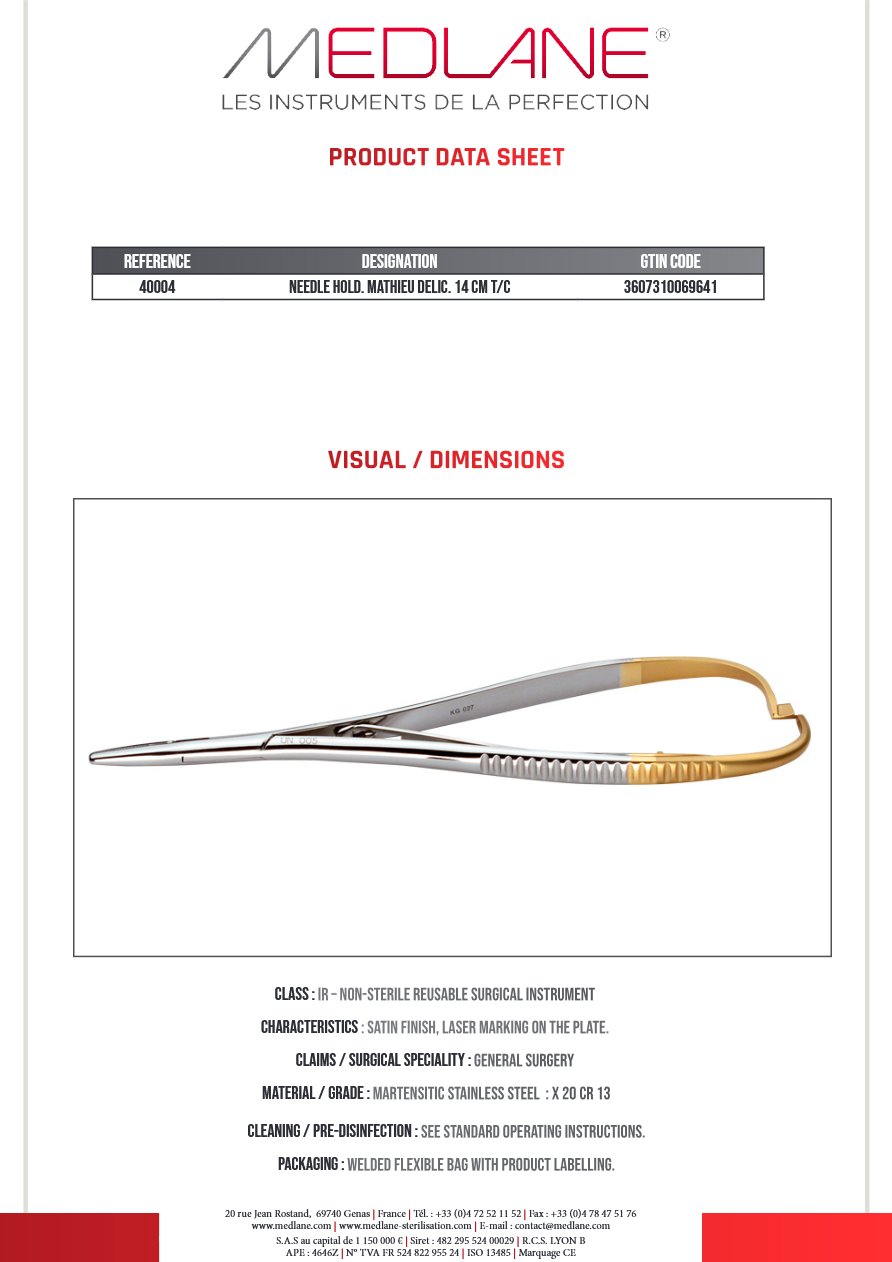
Porte Aiguille Mathieu Delicat 140 mm Tungstène
REF · 40004· 140 mm· Delicate· Tungsten carbide
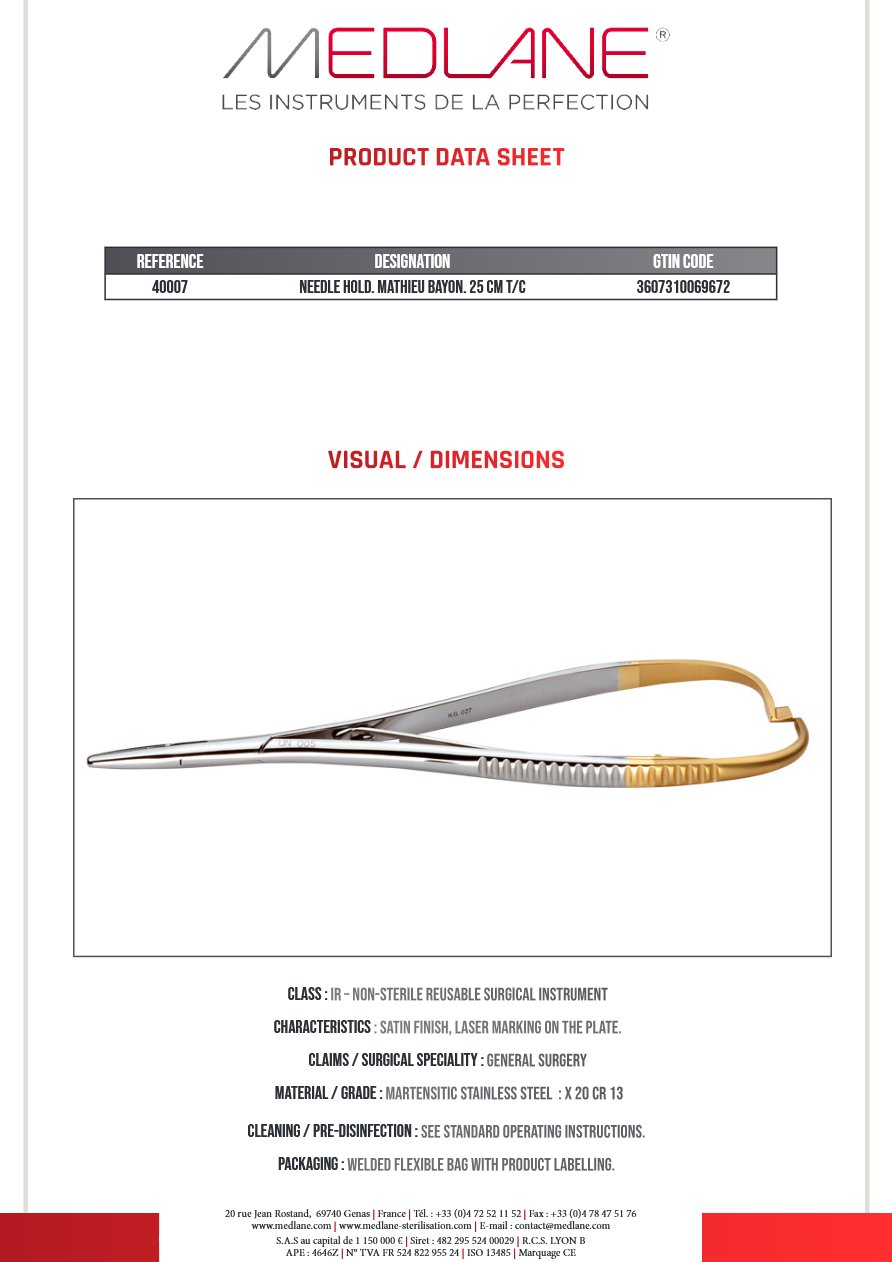
Porte Aiguille Mathieu Baionnette 250 mm Tungstène
REF · 40007· 250 mm· Bayonet· Tungsten carbide
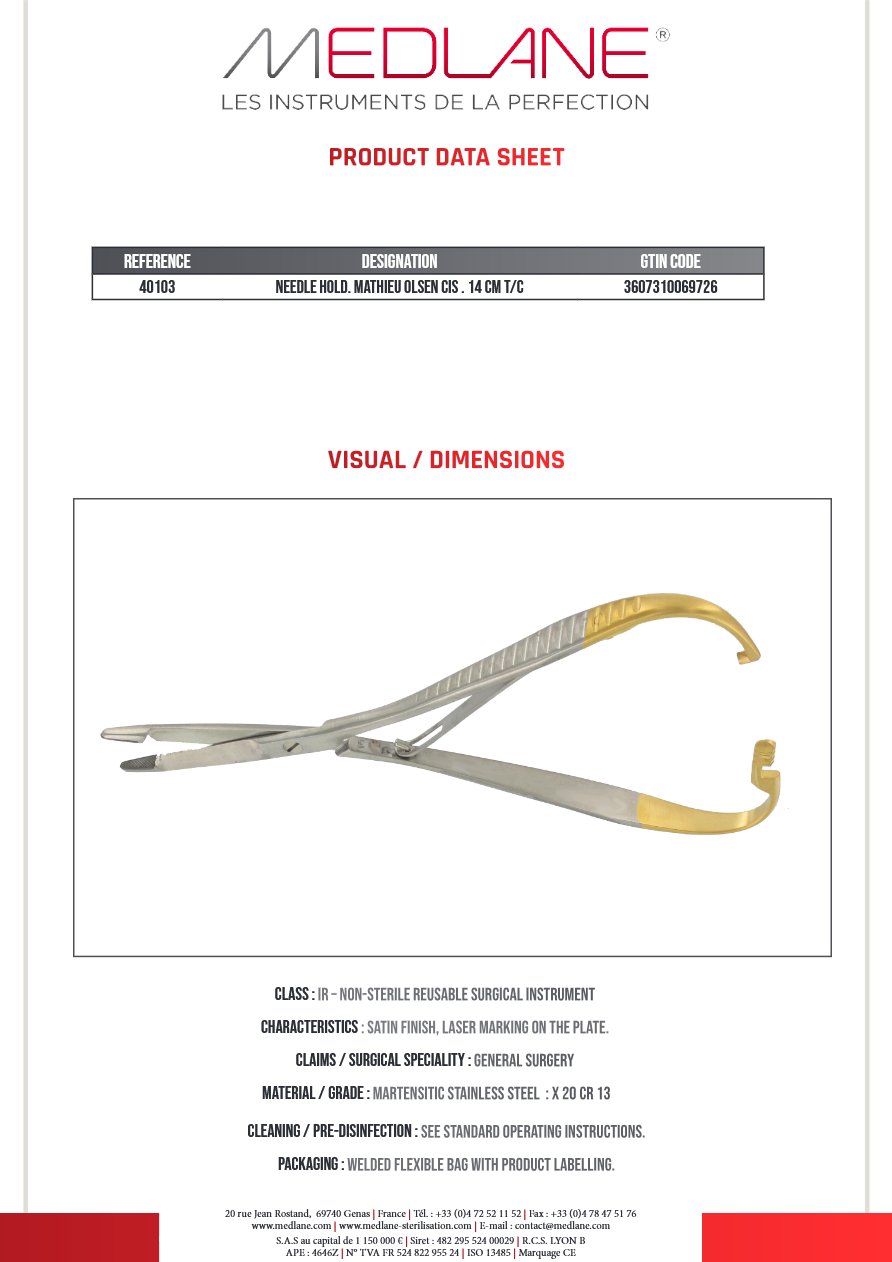
Porte Aiguille Mathieu Olsen Ciseaux 140 mm Tungstène
REF · 40103· 140 mm· Tungsten carbide
Crile-Wood
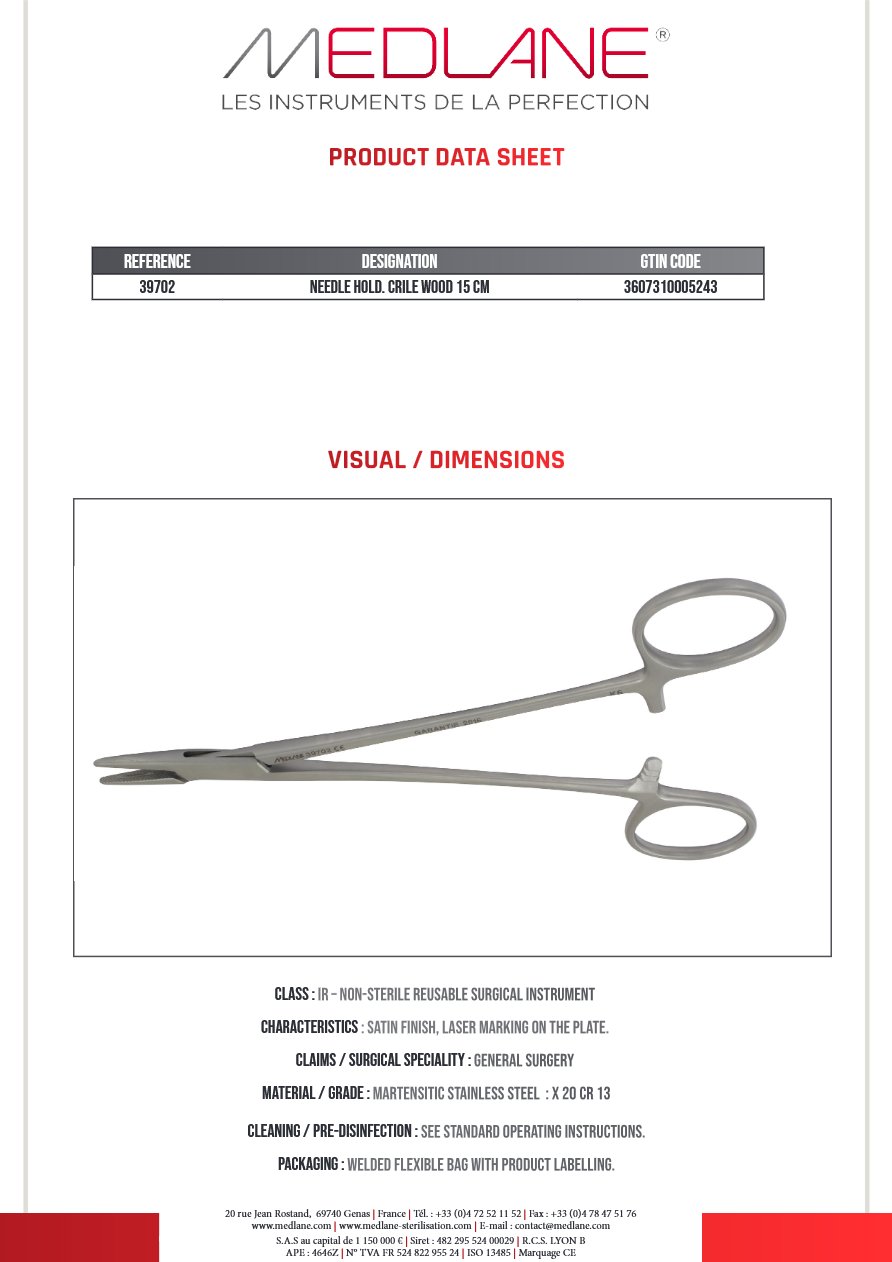
Porte Aiguille Crile Wood 150 mm
REF · 39702P· 150 mm
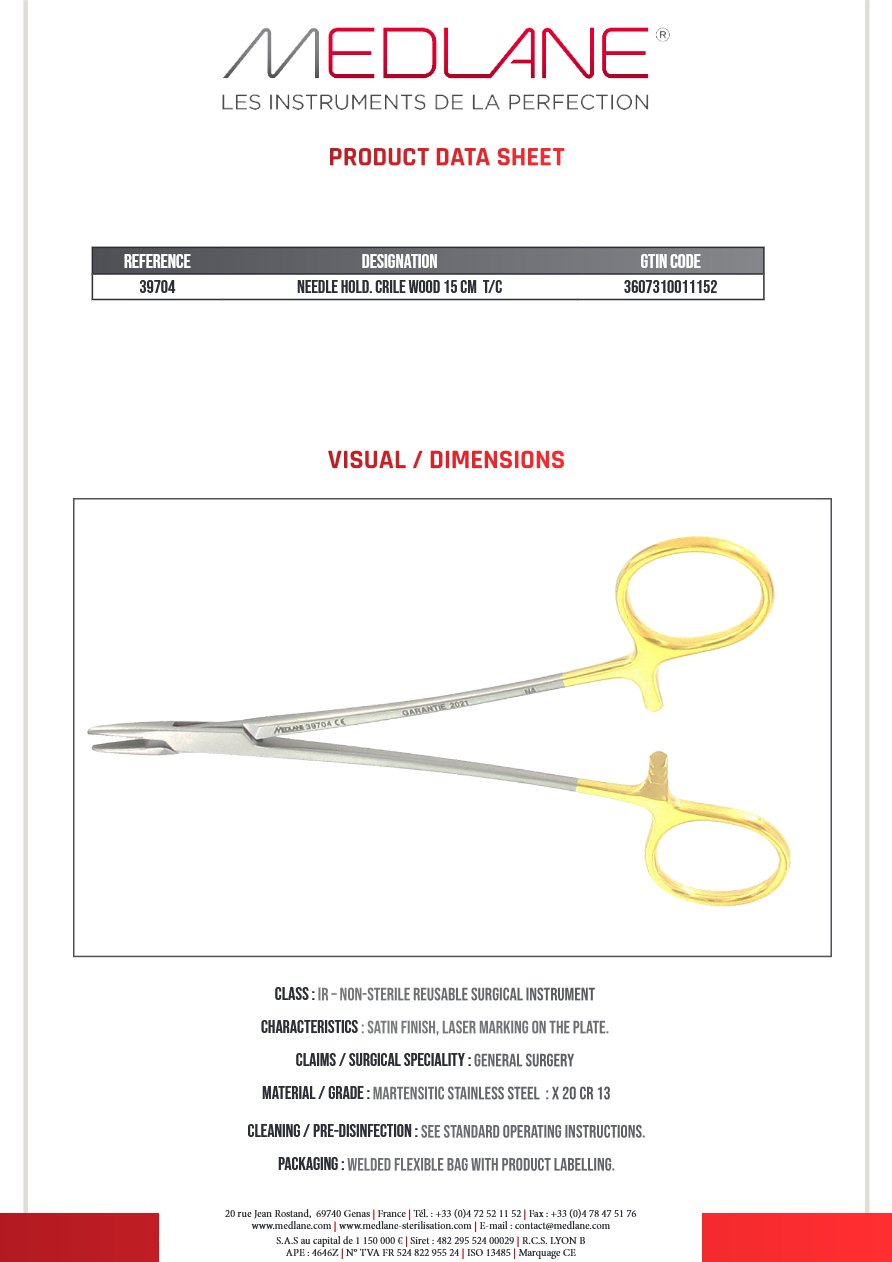
Porte Aiguille Crile Wood 150 mm Tungstène
REF · 39704P· 150 mm· Tungsten carbide
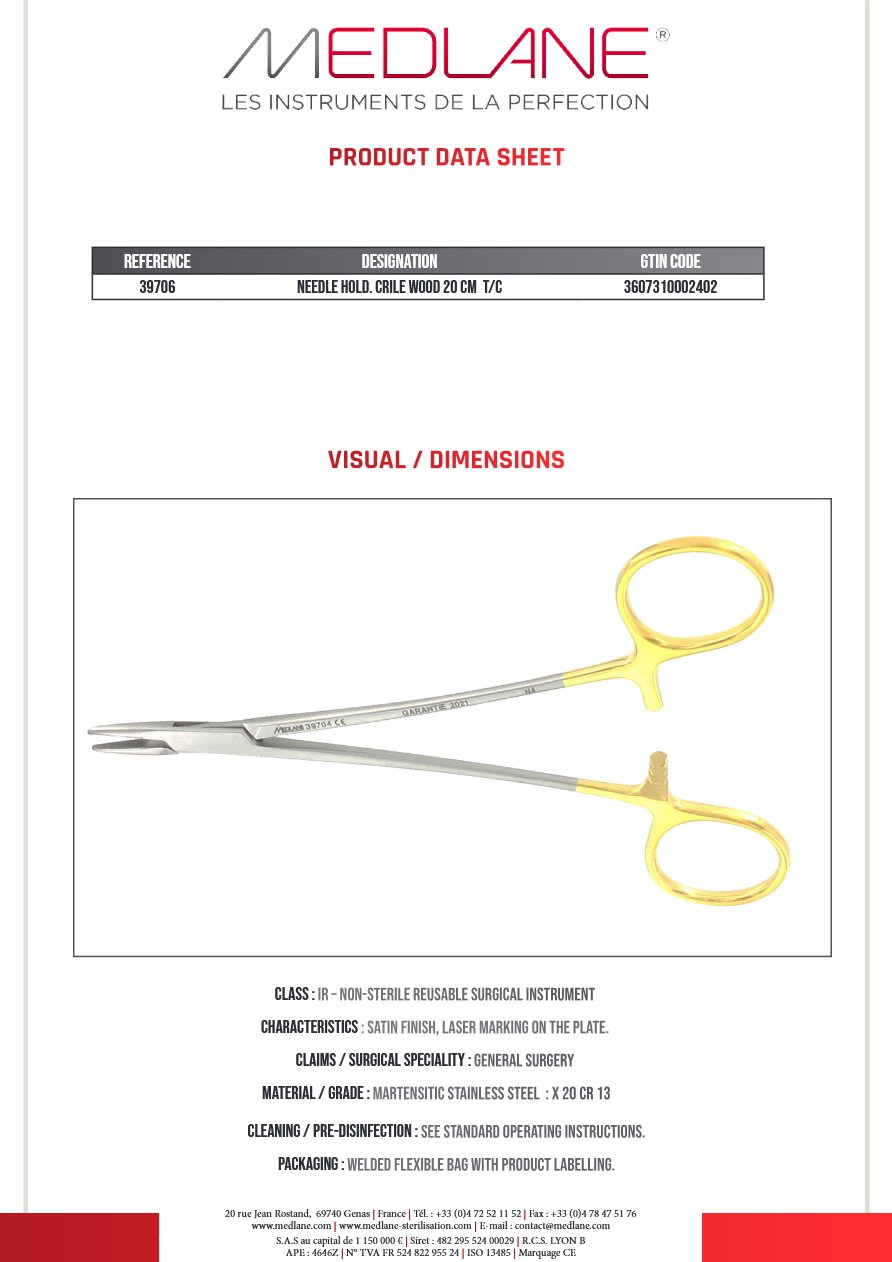
Porte Aiguille Crile Wood 200 mm Tungstène
REF · 39706P· 200 mm· Tungsten carbide
Porte Aiguille Crile Wood 230 mm Tungstène
REF · 39707P· 230 mm· Tungsten carbide
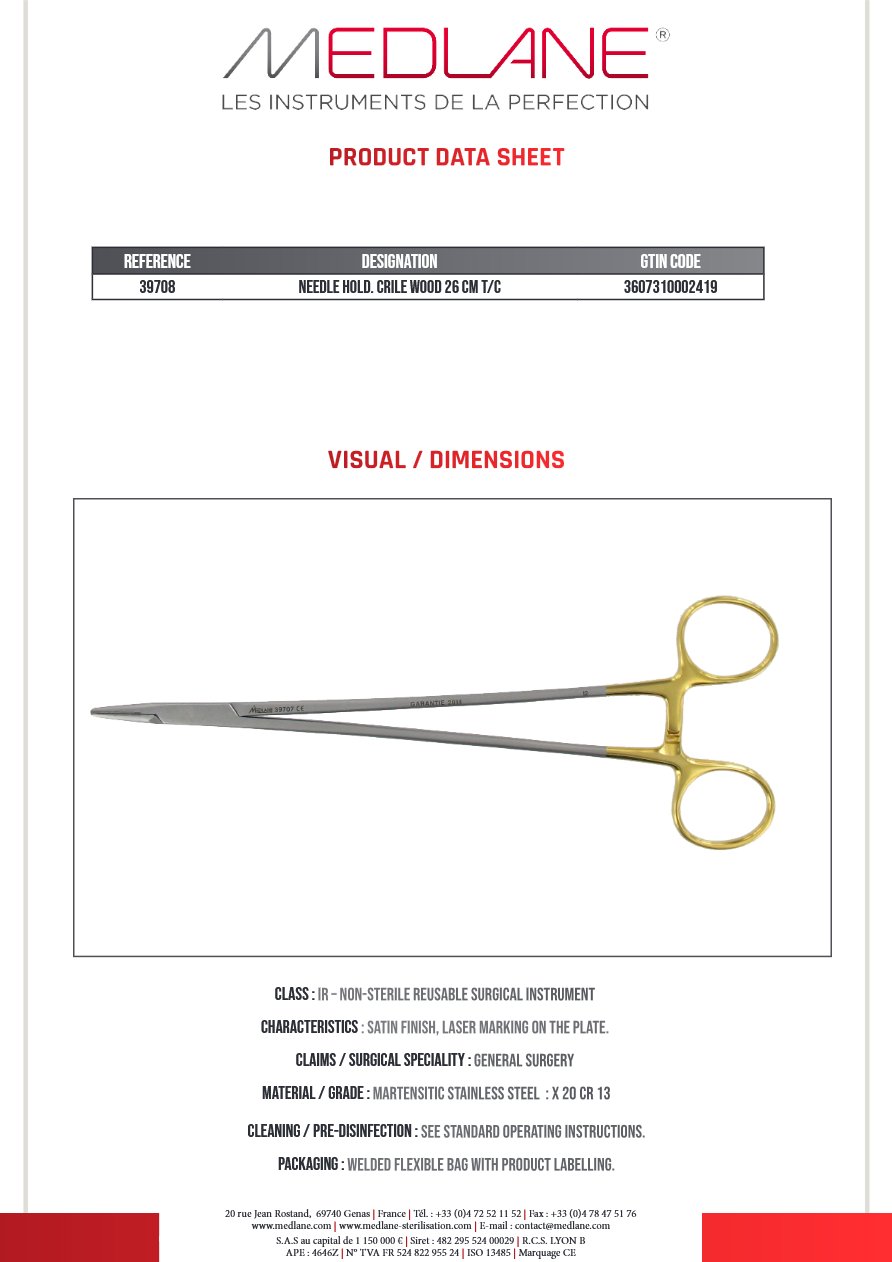
Porte Aiguille Crile Wood 260 mm Tungstène
REF · 39708P· 260 mm· Tungsten carbide
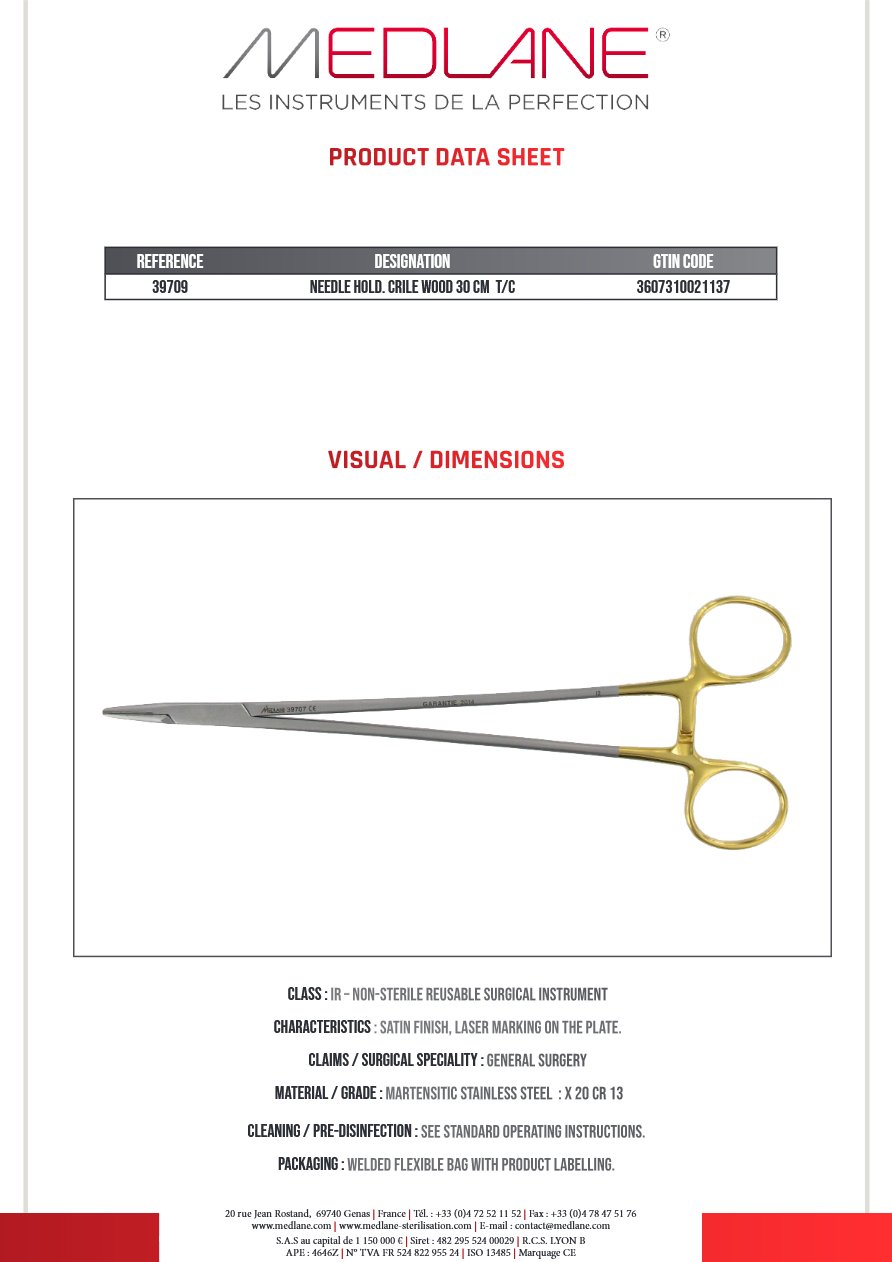
Porte Aiguille Crile Wood 300 mm Tungstène
REF · 39709P· 300 mm· Tungsten carbide
DeBakey
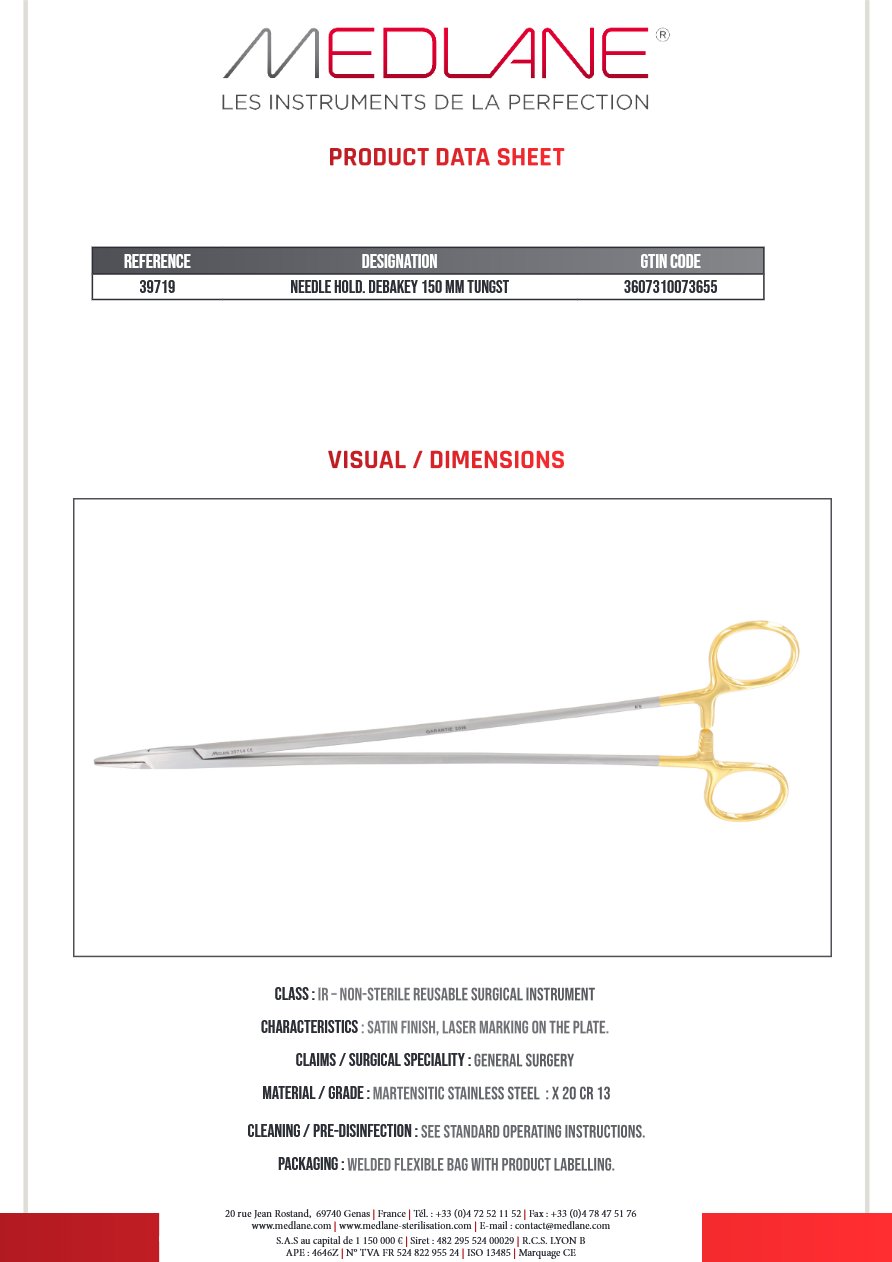
Porte Aiguille Debakey 150 mm Tungstène
REF · 39719· 150 mm· Tungsten carbide
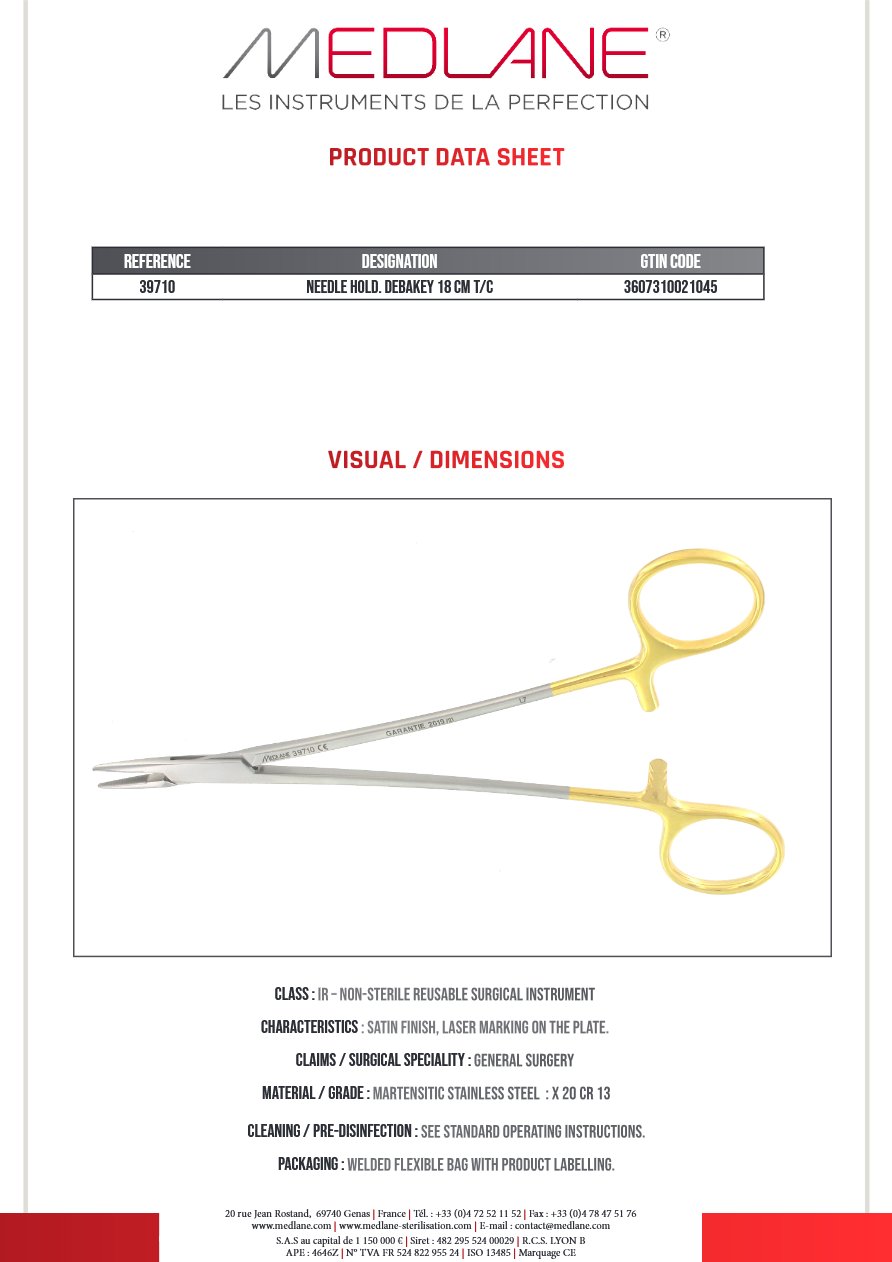
Porte Aiguille Debakey 180 mm Tungstène
REF · 39710P· 180 mm· Tungsten carbide
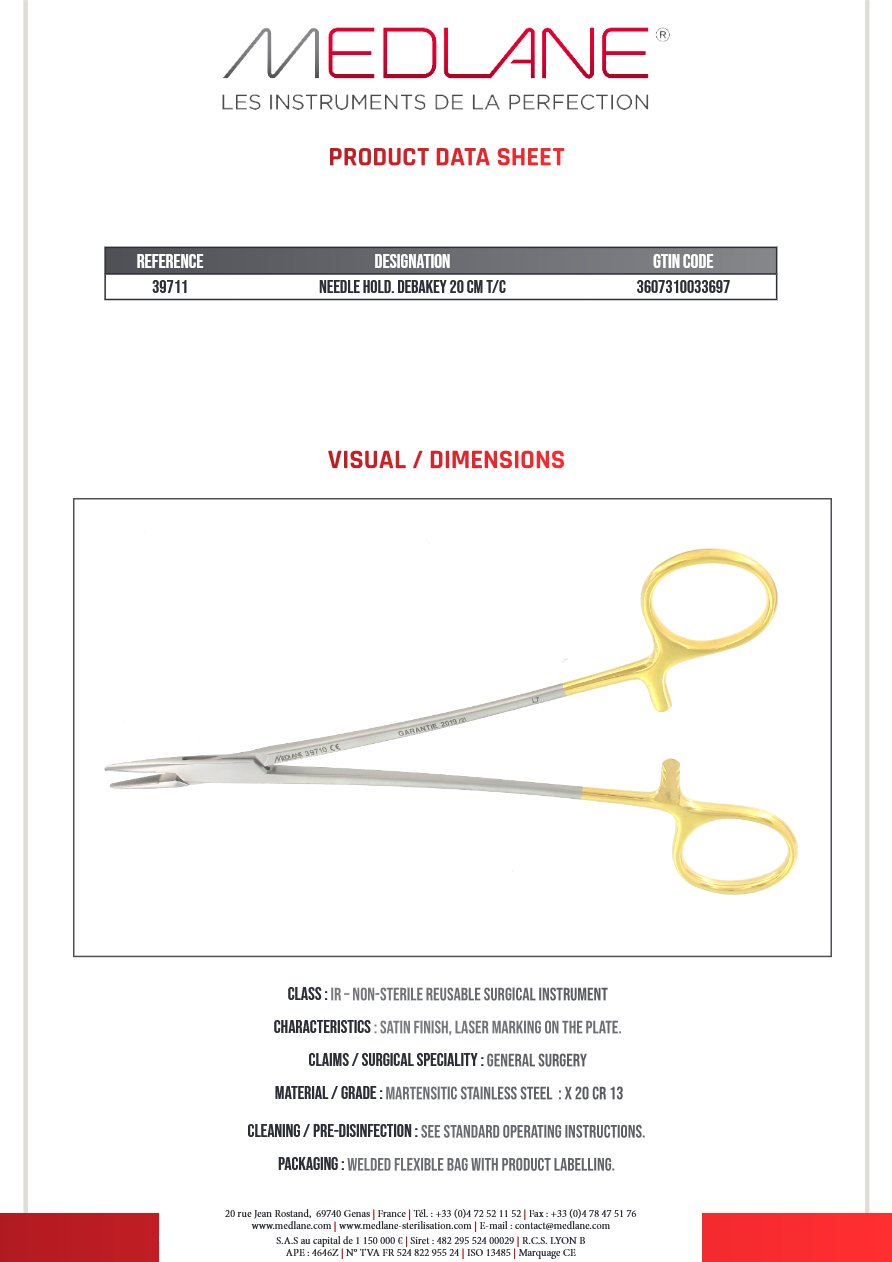
Porte Aiguille Debakey 200 mm Tungstène
REF · 39711P· 200 mm· Tungsten carbide
Porte Aiguille Debakey 230 mm Tungstène
REF · 39712P· 230 mm· Tungsten carbide
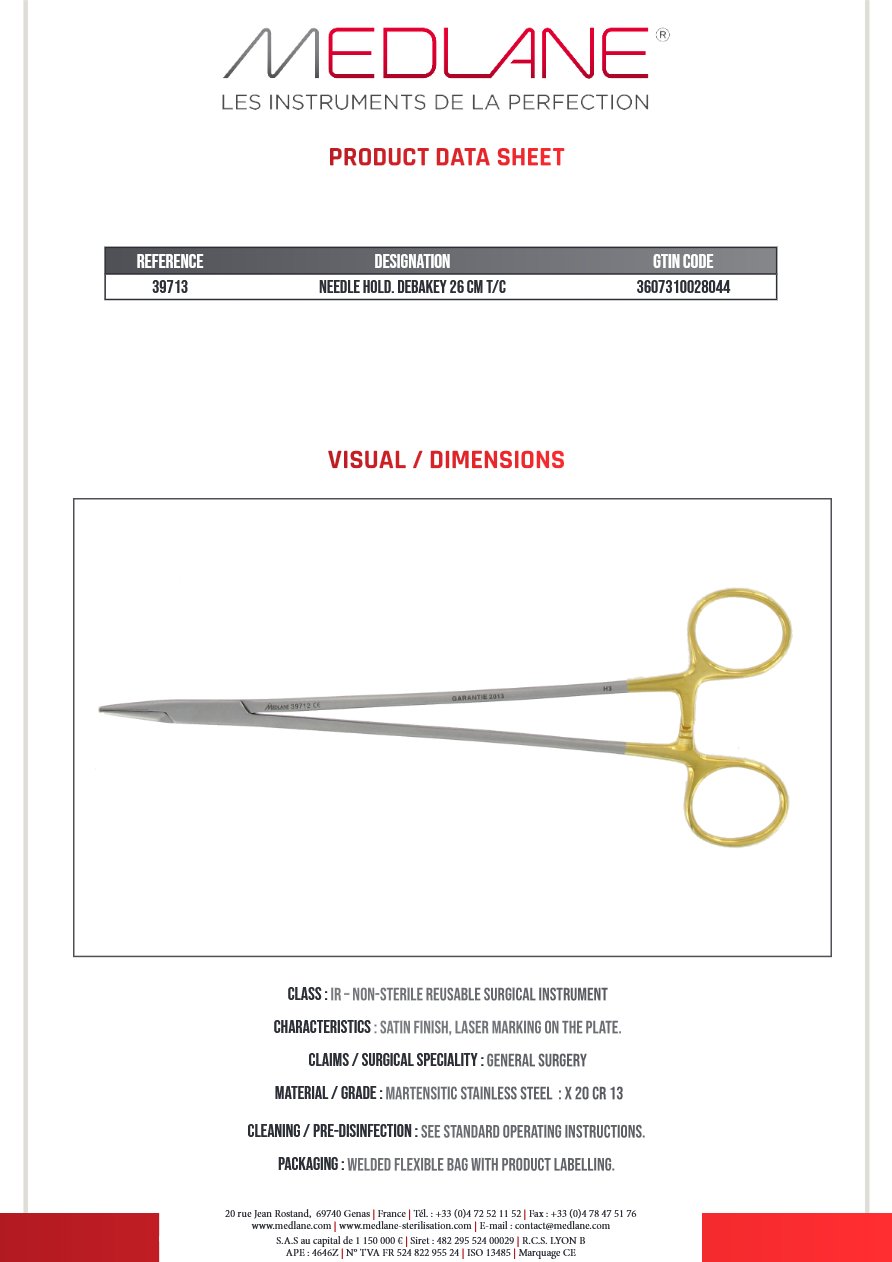
Porte Aiguille Debakey 260 mm Tungstène
REF · 39713P· 260 mm· Tungsten carbide
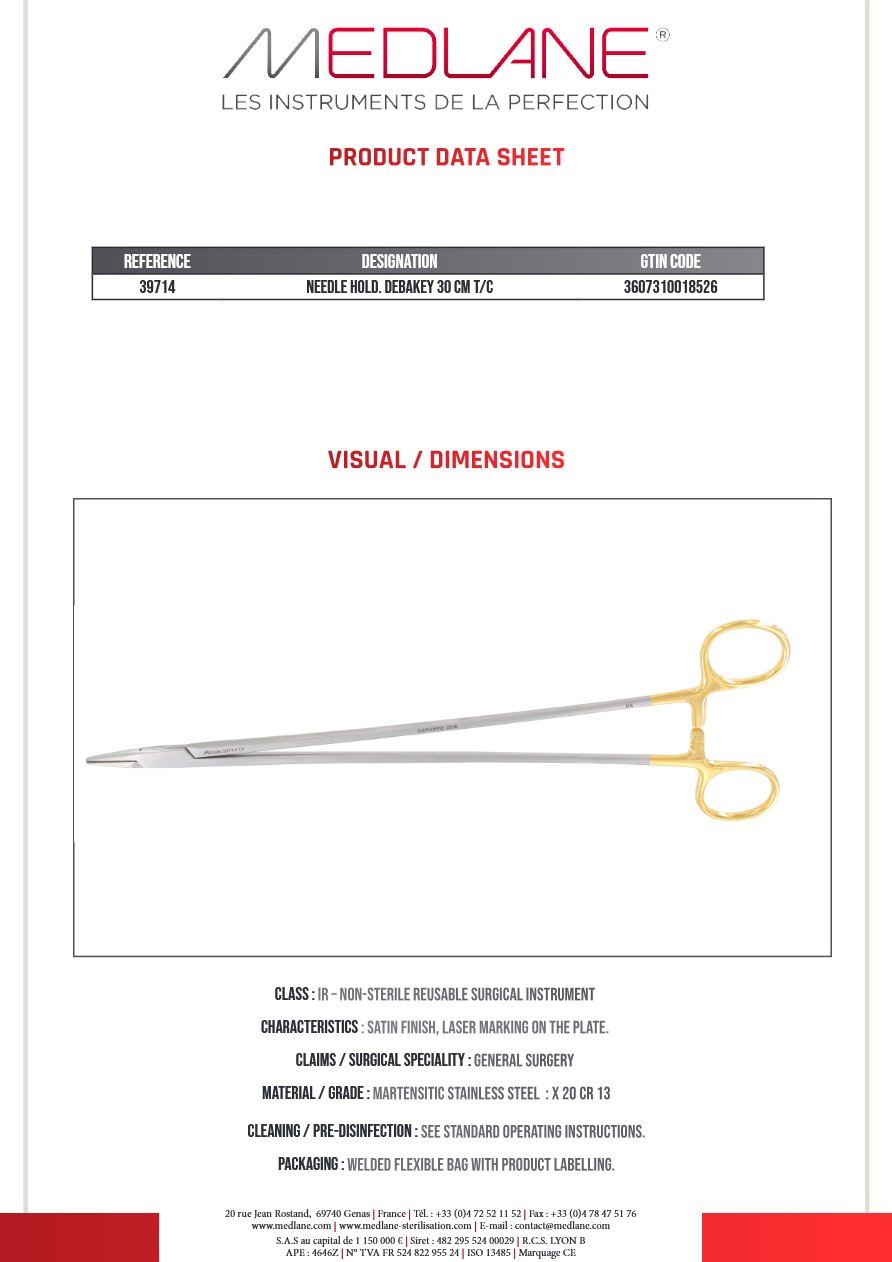
Porte Aiguille Debakey 300 mm Tungstène
REF · 39714P· 300 mm· Tungsten carbide
Ryder
Porte Aiguille Ryder Standard 130 mm Tungstène
REF · 40302P· 130 mm· Tungsten carbide
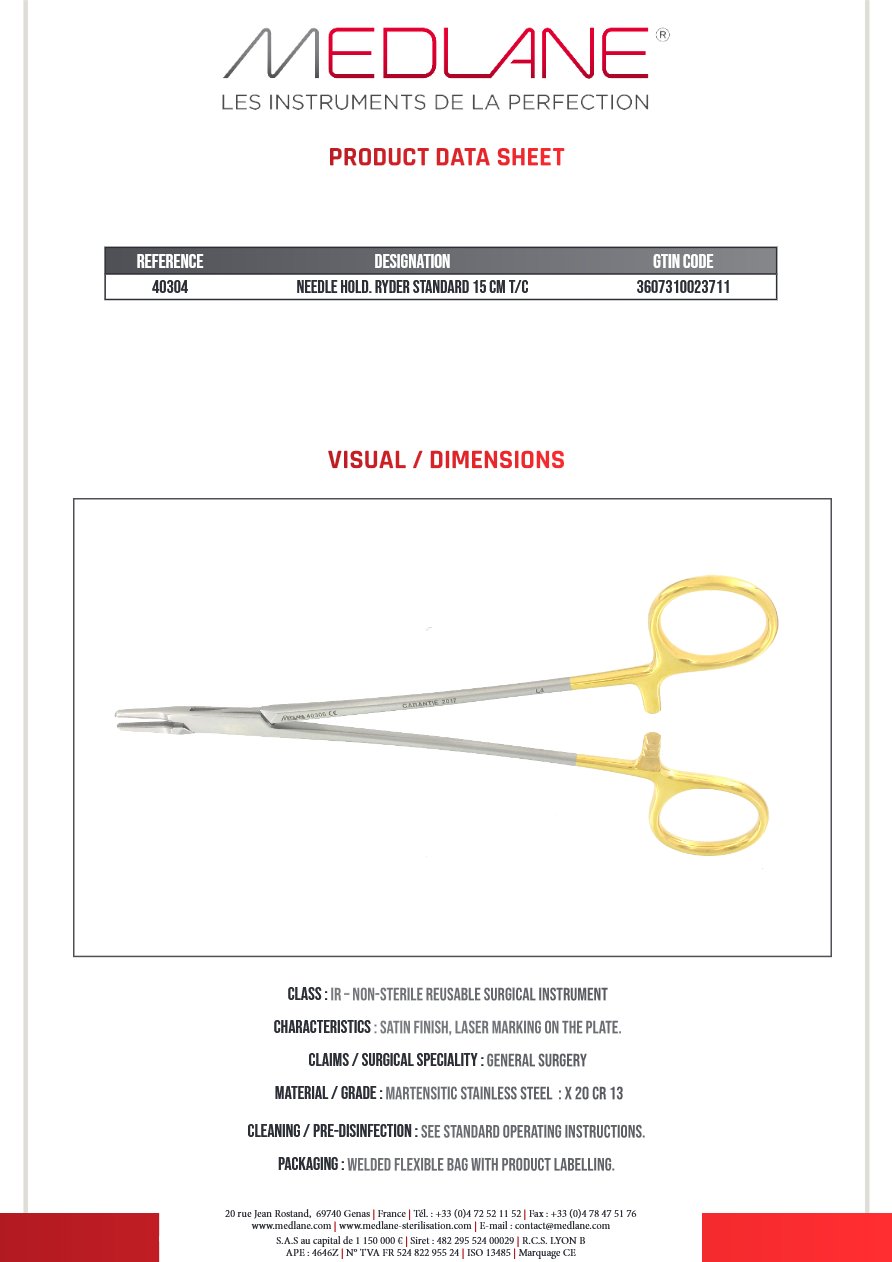
Porte Aiguille Ryder Standard 150 mm Tungstène
REF · 40304P· 150 mm· Tungsten carbide
Porte Aiguille Ryder Standard 200 mm Tungstène
REF · 40308P· 200 mm· Tungsten carbide
Porte Aiguille Ryder Mini 150 mm Tungstène
REF · 40305P· 150 mm· Mini· Tungsten carbide
Porte Aiguille Ryder Mini 200 mm Tungstène
REF · 40309P· 200 mm· Mini· Tungsten carbide
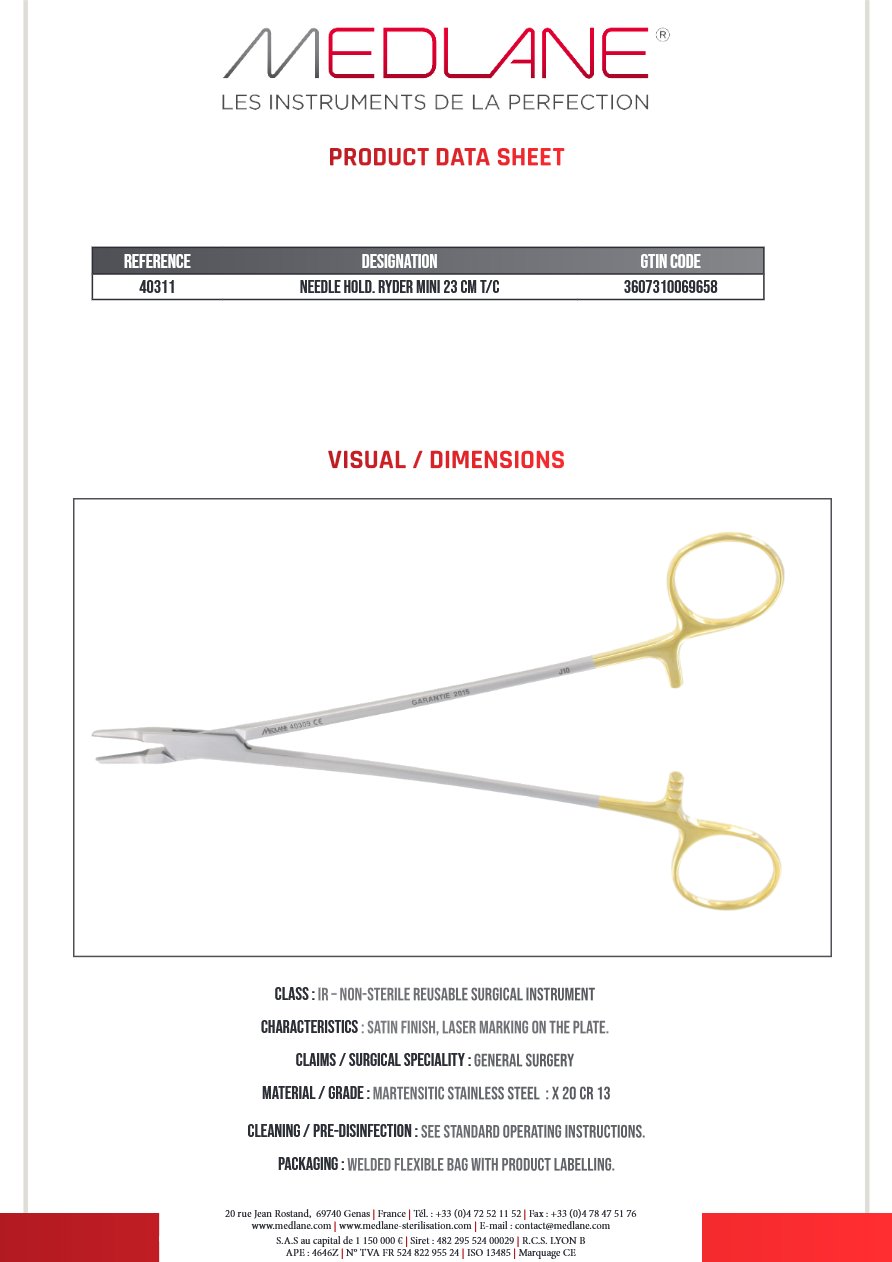
Porte Aiguille Ryder Mini 230 mm Tungstène
REF · 40311P· 230 mm· Mini· Tungsten carbide
Olsen-Hegar, Halsey, Sarot
Porte Aiguille Olsen Hegar Ciseaux 140 mm Tungstène
REF · 40209P· 140 mm· Tungsten carbide
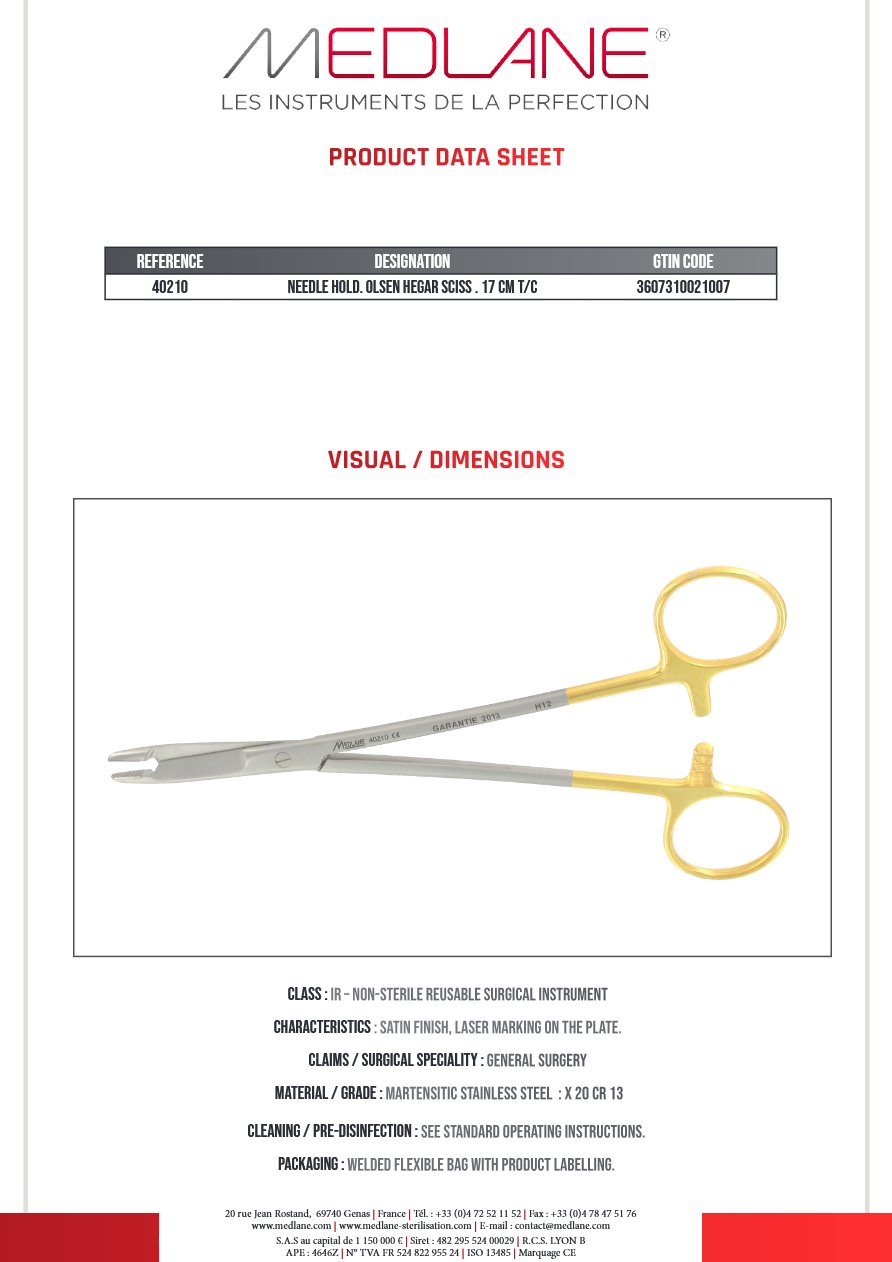
Porte Aiguille Olsen Hegar Ciseaux 170 mm Tungstène
REF · 40210P· 170 mm· Tungsten carbide
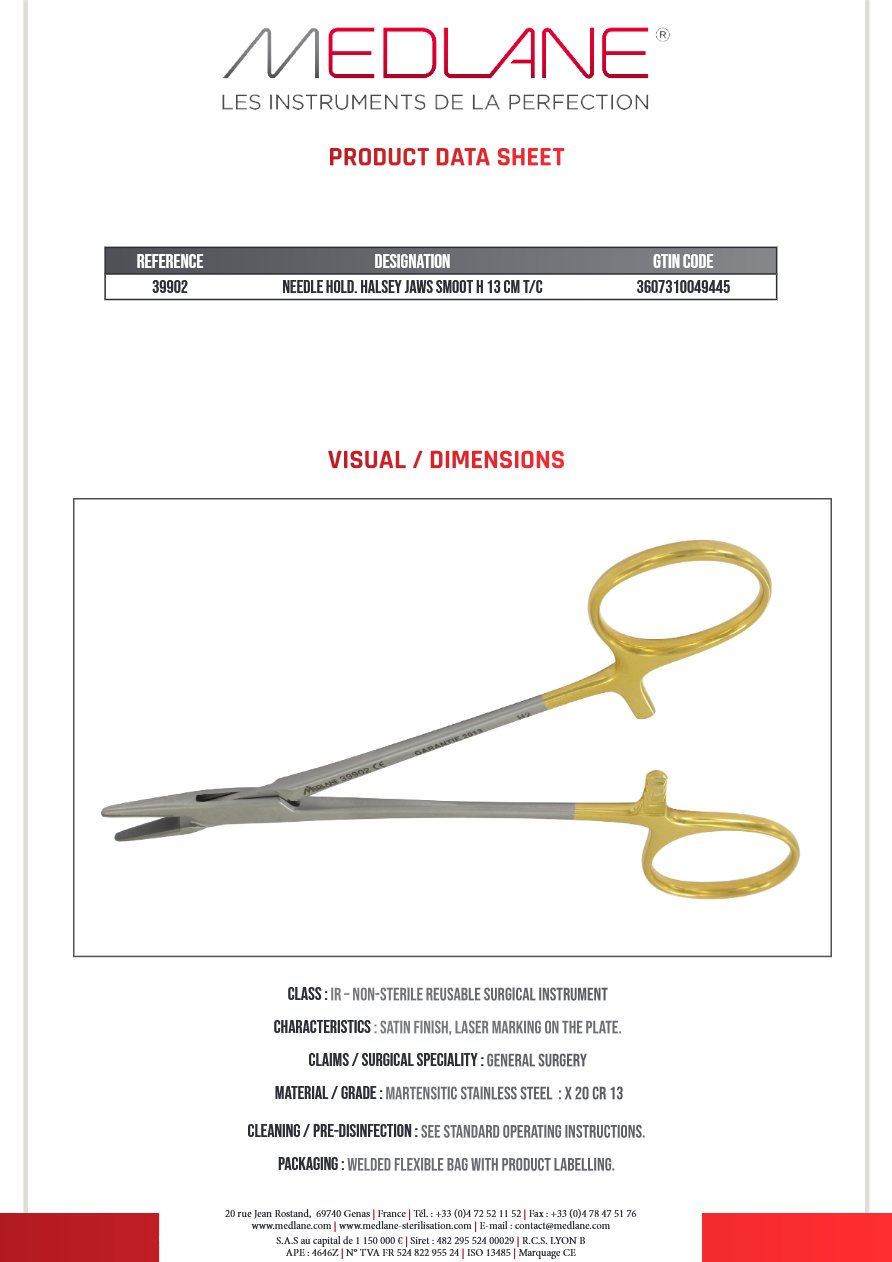
Porte Aiguille Halsey 130 mm Tungstène Lisse
REF · 39902P· 130 mm· Smooth jaws· Tungsten carbide
Porte Aiguille Halsey 130 mm Tungstène
REF · 39903P· 130 mm· Tungsten carbide
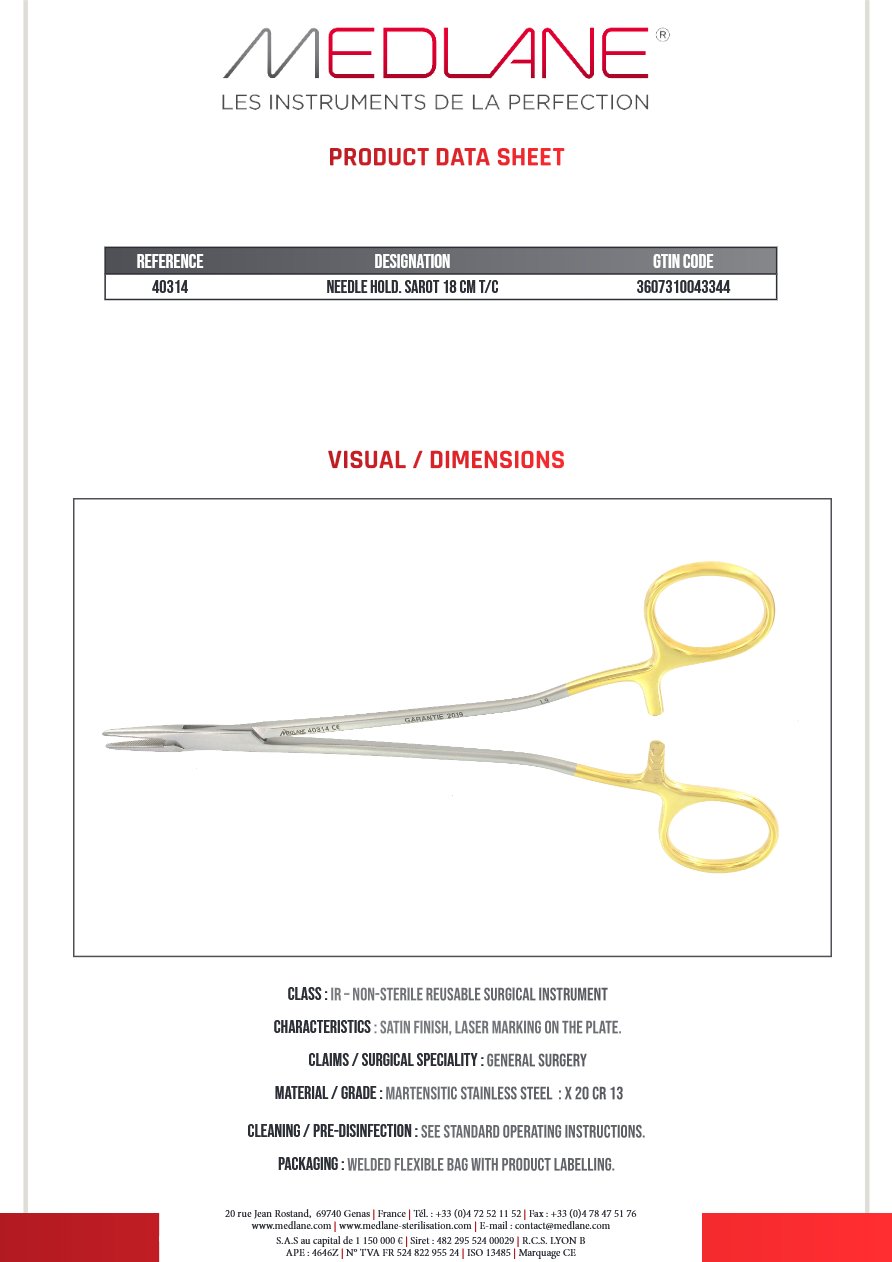
Porte Aiguille Sarot 180 mm Tungstène
REF · 40314P· 180 mm· Tungsten carbide
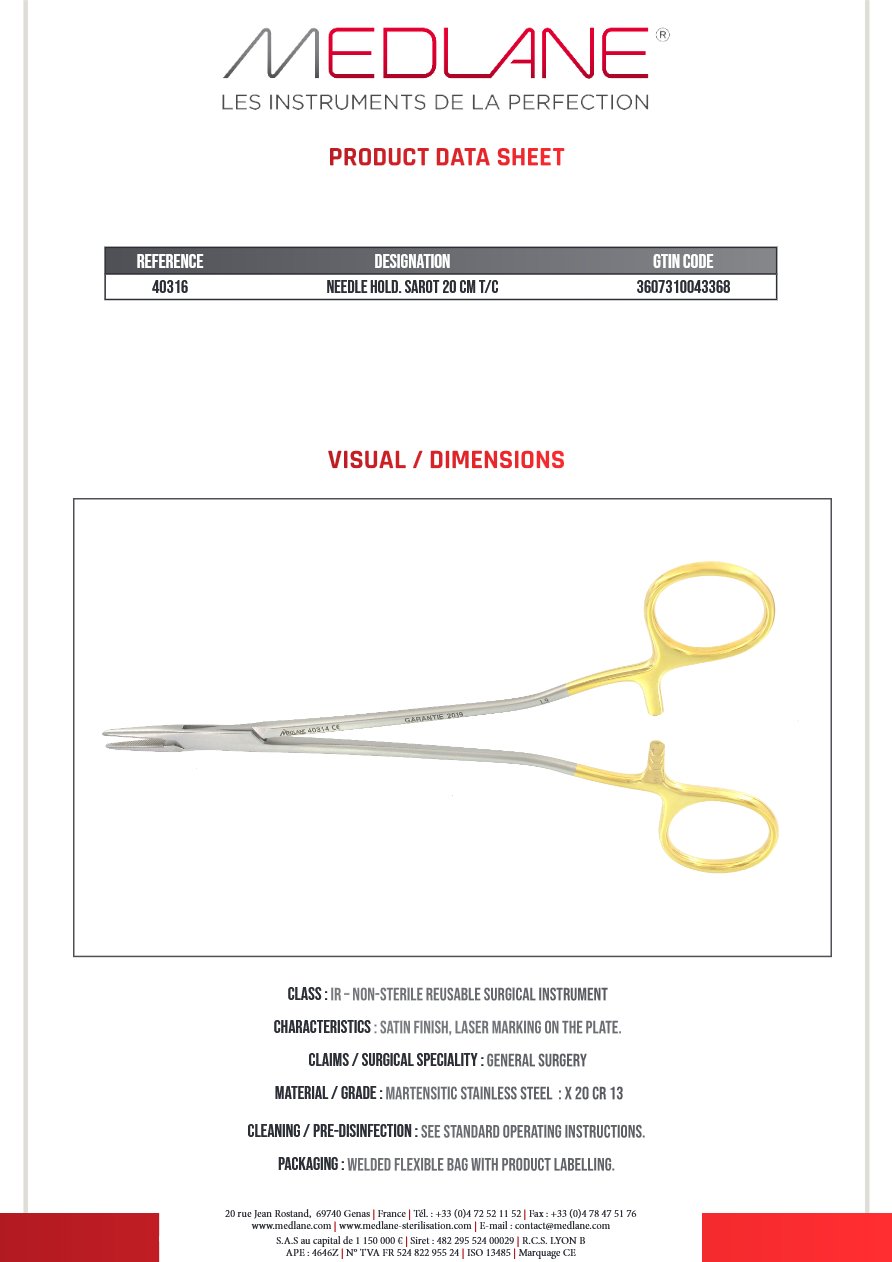
Porte Aiguille Sarot 200 mm Tungstène
REF · 40316P· 200 mm· Tungsten carbide
Can you recognise them?
Four MEDLANE needle holders, four clearly different architectures. Identify each one from what is visible on the photograph.
REVEAL THE ANSWERS
- A — Mayo-HegarPorte Aiguille Mayo Hegar 200 mm Tungstène · REF 40204P
- B — MathieuPorte Aiguille Mathieu Standard 140 mm Tungstène · REF 40001P
- C — Olsen-HegarPorte Aiguille Olsen Hegar Ciseaux 140 mm Tungstène · REF 40209P
- D — DeBakeyPorte Aiguille Debakey 230 mm Tungstène · REF 39712P
Every characteristic quoted here is the one carried by the catalogue designation of the reference shown. The exact configuration is always read from the reference and its documentation.
Finding the right reference, not just the right name
MEDLANE is a French company specializing in surgical instruments, based in Genas near Lyon, ISO 13485 certified for design, production management and distribution. Every reference in this guide links to its full catalogue entry.
Continue exploring instrumentation
- Guide no. 01Metzenbaum & Mayo scissors
Recognise them, understand their differences and identify their variants.
- Guide no. 02Kocher, Kelly, Crile, Halsted & Leriche
Identify and distinguish the main haemostatic forceps.
- Guide no. 03Dissecting forceps
Silhouette, tips and the Adson, Semkin, Gerald and DeBakey architectures.
Documented control protocols
Extracts from MEDLANE technical documentation. They describe documented protocols, not instructions for use nor a statement of conformity.
Elasticity test
- The instrument is closed to the last ratchet tooth and held under load for 3 hours at room temperature.
- After the corrosion test, the instrument is inspected for cracks and permanent deformation.
Gripping function test
- A plastic thread or suture of diameter 0.2 mm or less is placed in the active part, then the instrument is closed.
- A 20 N pull is applied: the thread must not escape under either longitudinal or transverse load.
Corrosion test
- A cleaning cycle is applied to the instrument before testing.
- The instrument is immersed in demineralised water at 90 °C for 1 hour, then air-dried.
- Visual inspection looks for rust marks, micro-cracks and other surface defects.