
Metzenbaum and Mayo scissors are among the most emblematic instruments in surgery. An experienced professional identifies them instantly. For anyone discovering surgical instrumentation — operating theatre and sterilisation staff, biomedical engineers, buyers, distributors, students or new colleagues — their apparent similarity can be confusing.
Yet their architecture quickly reveals the difference.
The Metzenbaum is built around fineness and dissection. The Mayo favours a more robust construction and a cutting capacity suited to tissue or materials requiring more resistance.
An instrument's shape is never incidental. Its geometry tells its function.
Two silhouettes, two instruments
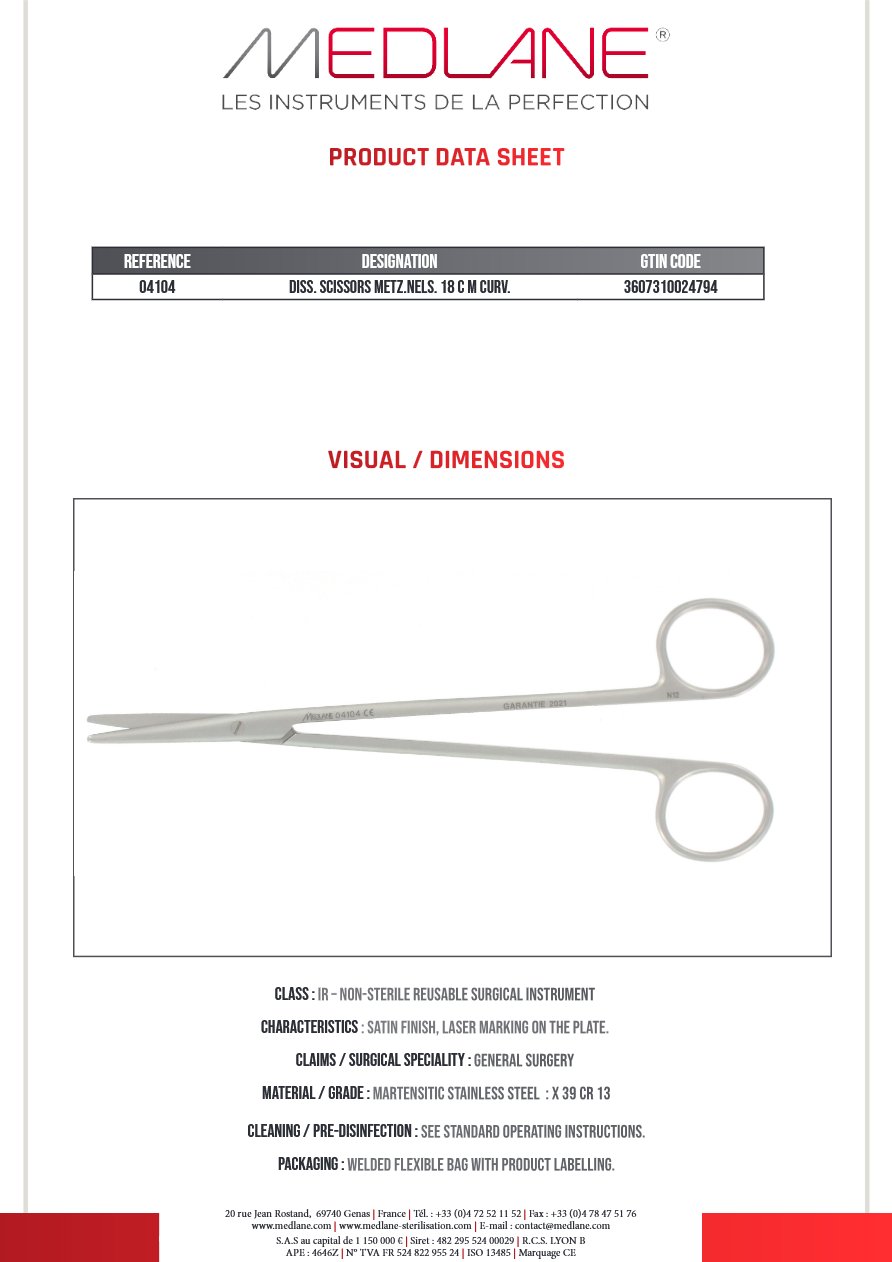
Ciseaux Dissection Metzenbaum nelson 180 mm Courbe · REF 04104P
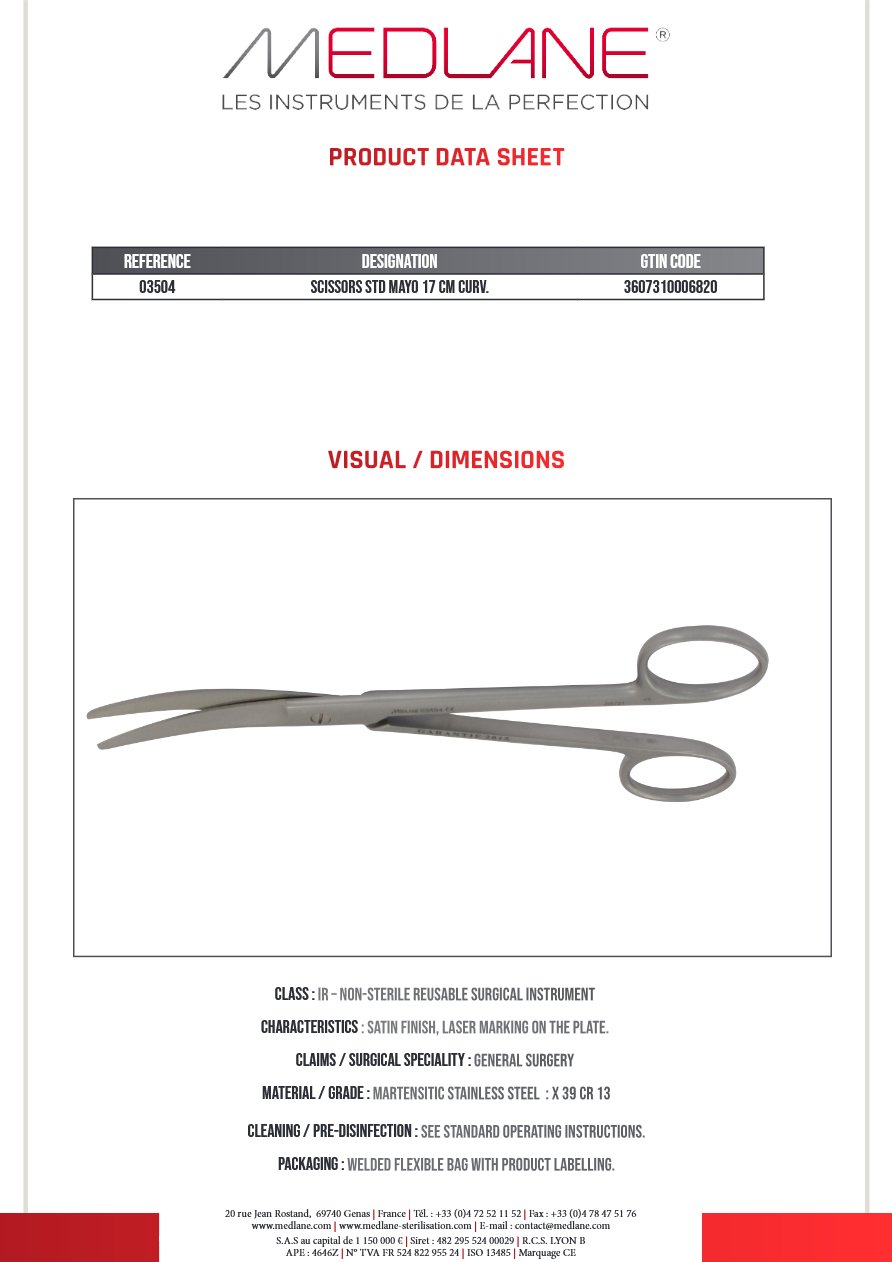
Ciseaux Courants Mayo 170 mm Courbe · REF 03504P
Metzenbaum
- Relatively long shanks
- Fine, short blades
Mayo
- More robust construction
- More substantial blades
The first skill in instrumentation is not memorising a reference. It is learning to observe.
Full instrument → observed zone → identifying detail
- 01 — BLUNT TIPS
- 02 — FINE, SHORT BLADES
- 01 — BLUNT TIPS
- 02 — MORE SUBSTANTIAL BLADES
Behind the name
1876 — 1944
Myron F. Metzenbaum
American physician and surgeon from Cleveland, known in particular for his work in ENT and reconstructive surgery. The instrument bearing his name has become a classic of surgery.
1861 — 1939 · 1865 — 1939
William J. Mayo · Charles H. Mayo
American surgeons belonging to an important surgical tradition. Their name remains associated with Mayo scissors.
The history of surgery is still present in the names of the instruments used every day.
Anatomy of the instrument
Two constructions, two logics
Metzenbaum
- Fine, slender silhouette
- Relatively fine, short blades
- Relatively long shanks
- Characteristic function: dissection and cutting of delicate tissue
- Straight or curved
- Various lengths
- Variants depending on the range
Mayo
- More substantial silhouette
- Wider, more robust blades
- More robust construction
- Characteristic function: cutting that requires more robustness
- Straight or curved
- Various lengths
- Variants depending on the range
A name designates a family of instruments, not a single configuration.
One family, several variants
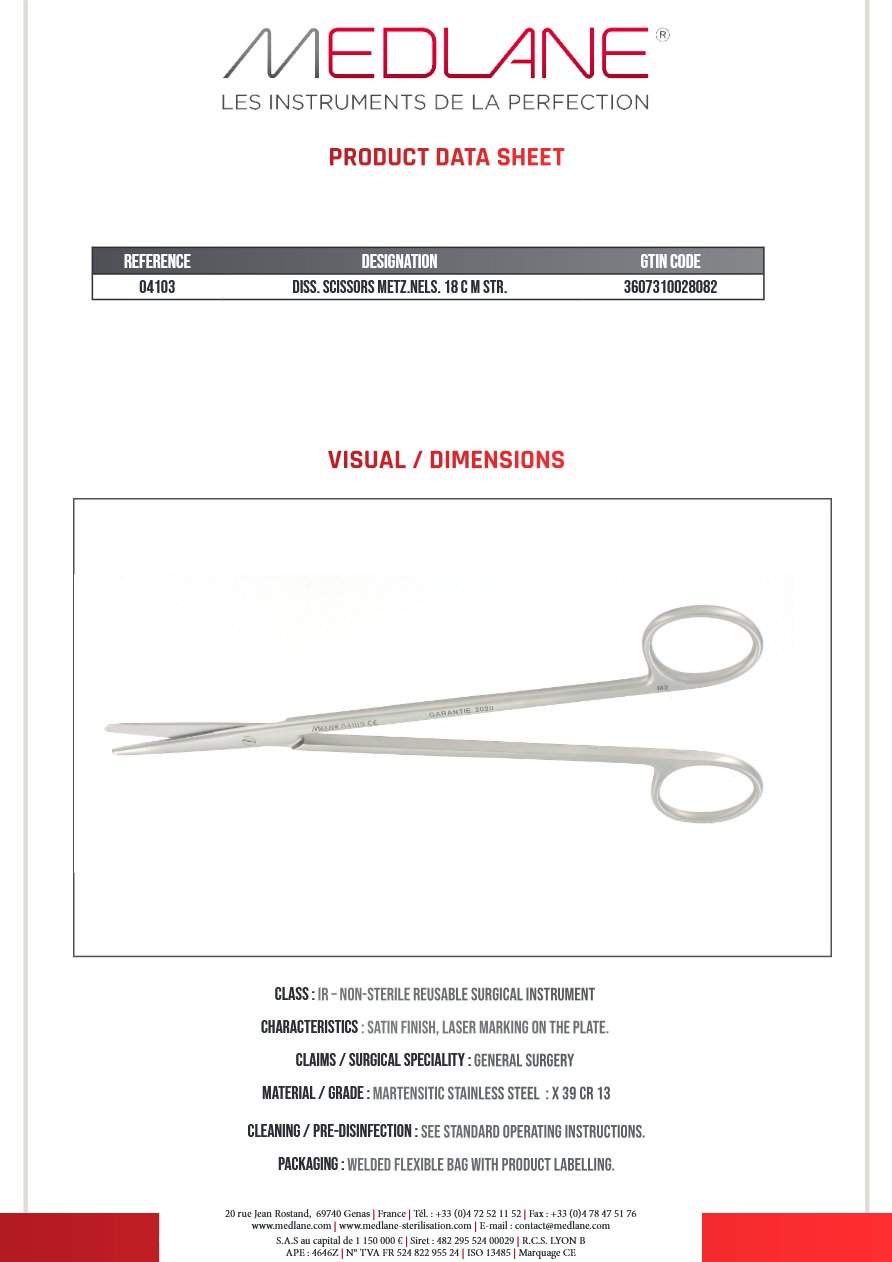
Ciseaux Dissection Metzenbaum nelson 180 mm Droit
REF · 04103P· 180 mm· Straight
Ciseaux Dissection Metzenbaum nelson 180 mm Courbe
REF · 04104P· 180 mm· Curved
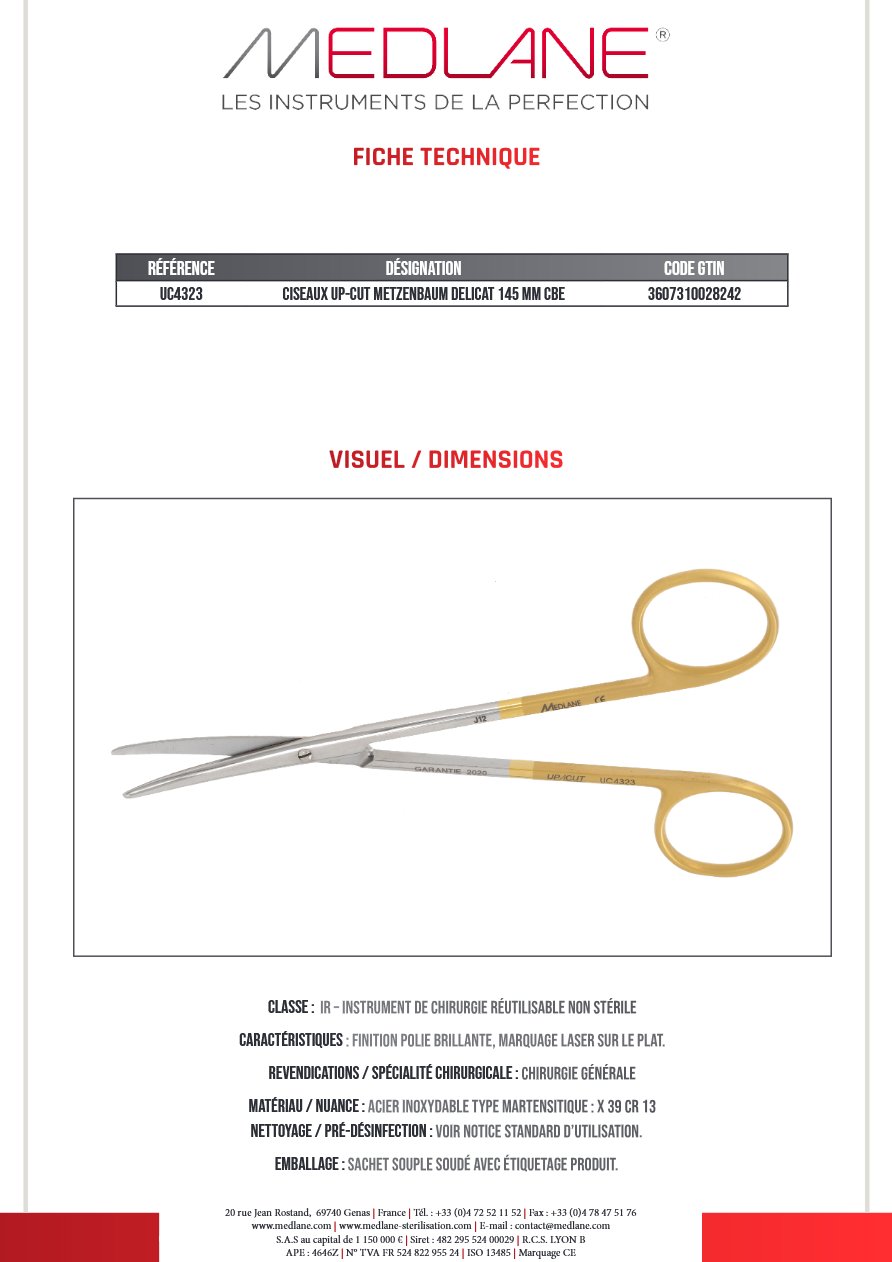
Ciseaux Up-cut Metzenbaum Delicat 145 mm Courbe
REF · UC4323P· 145 mm· Curved
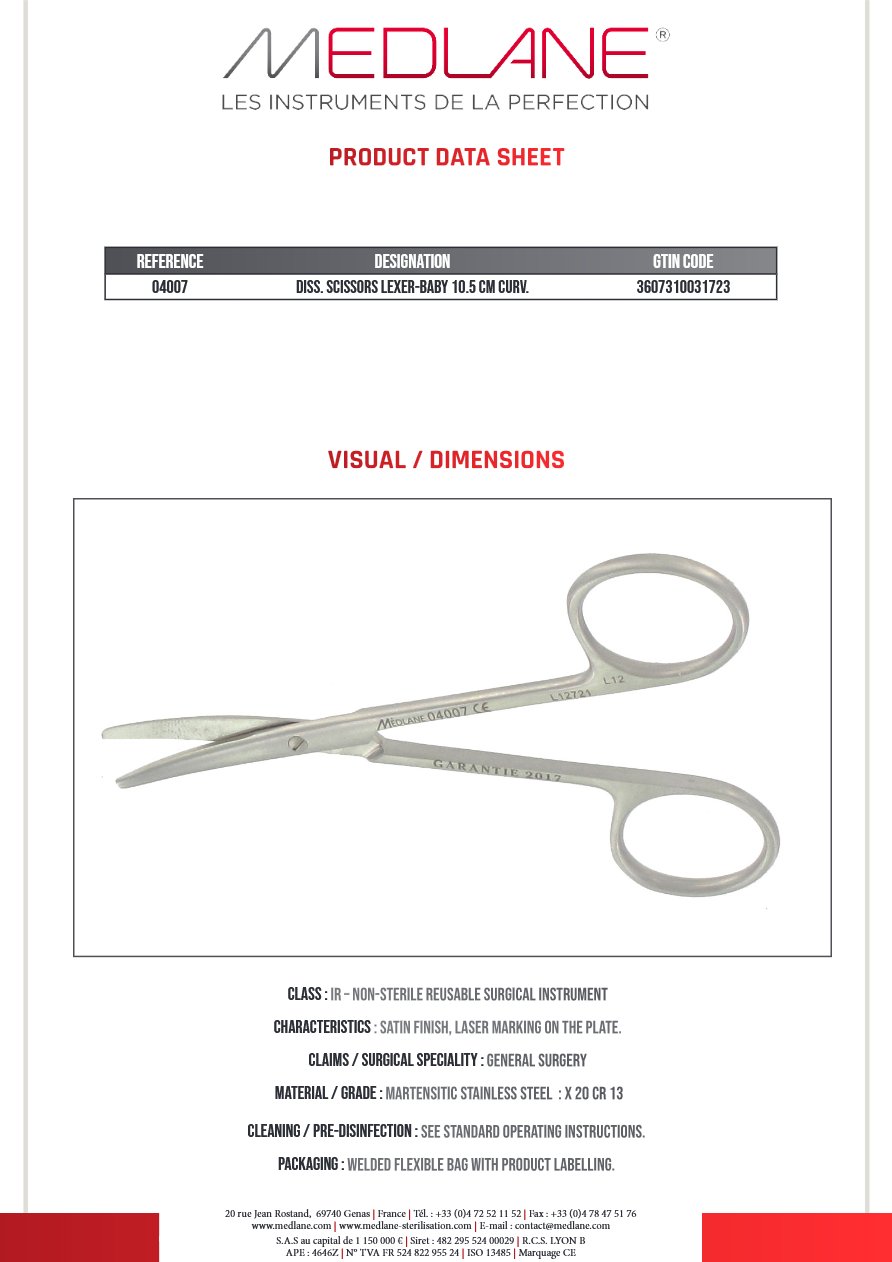
Ciseaux Dissection Lexer-baby 105 mm Courbe
REF · 04007P· 105 mm· Curved
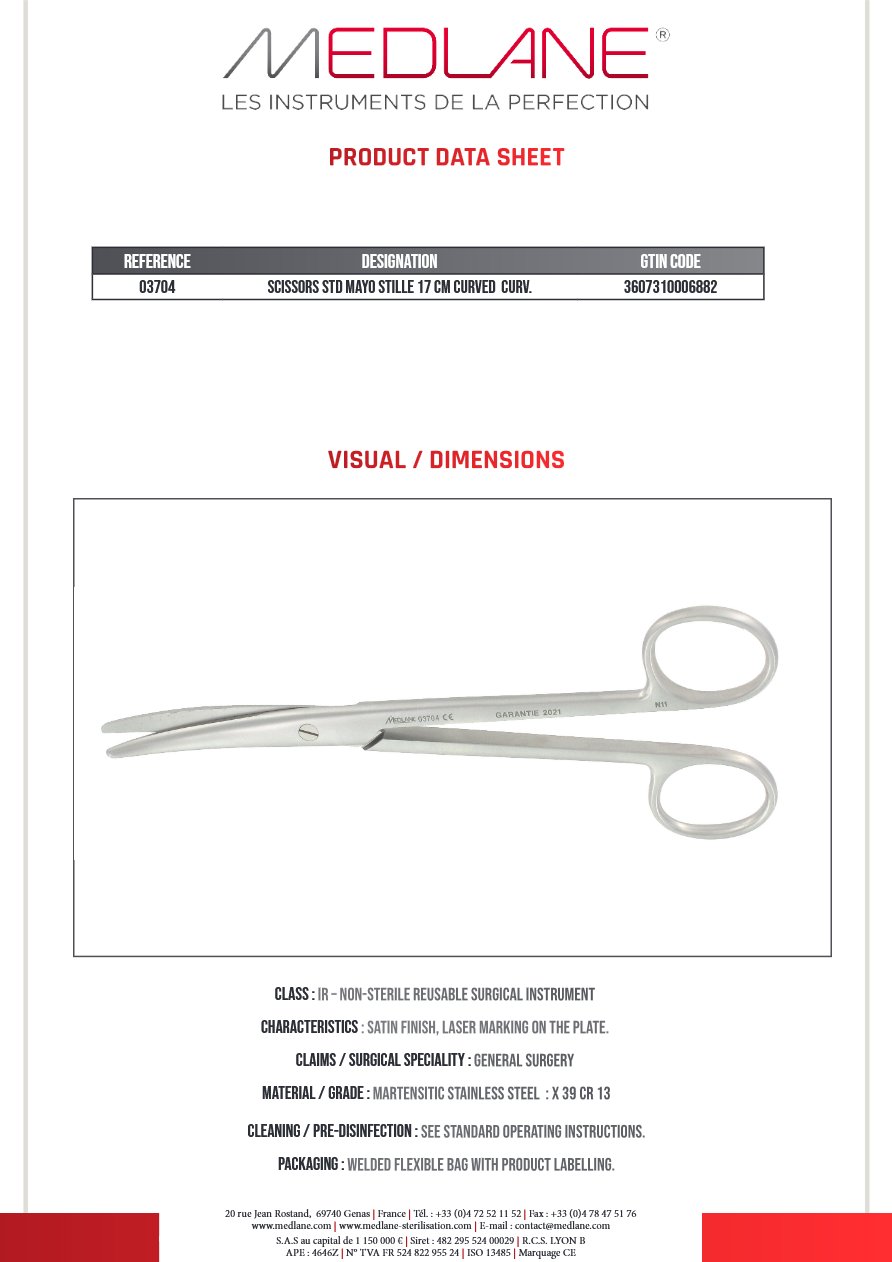
Ciseaux Courants Mayo Stille 170 mm Courbe
REF · 03704P· 170 mm· Curved
- Delicate
- Working part finer than the corresponding standard model. Fineness and length are two different characteristics.
- Baby
- Smaller, more compact variant of a model.
- Mayo-Stille
- Variant with its own geometry: a similar name does not mean an identical instrument.
Look at the rings.
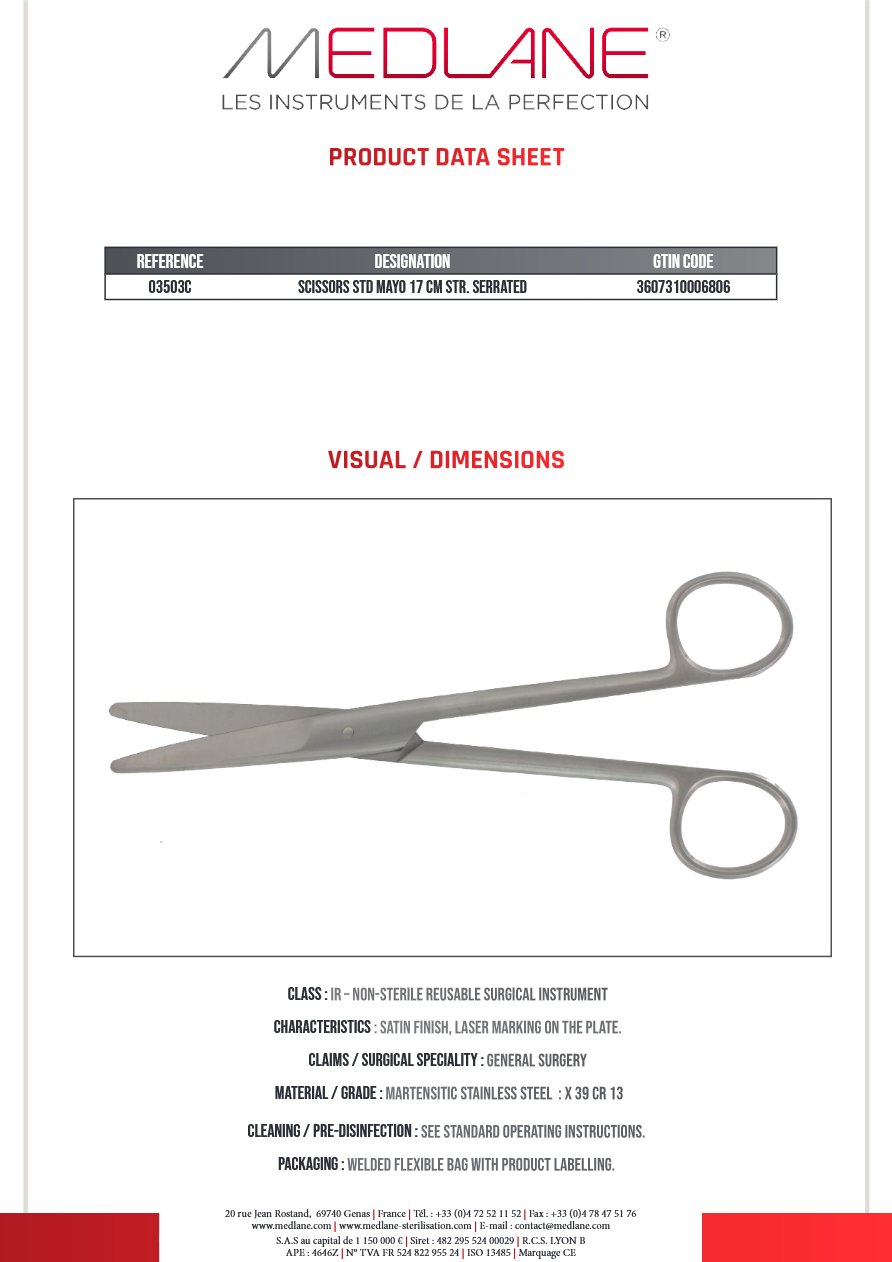
Ciseaux Courants Mayo 170 mm Droit · REF 03503P
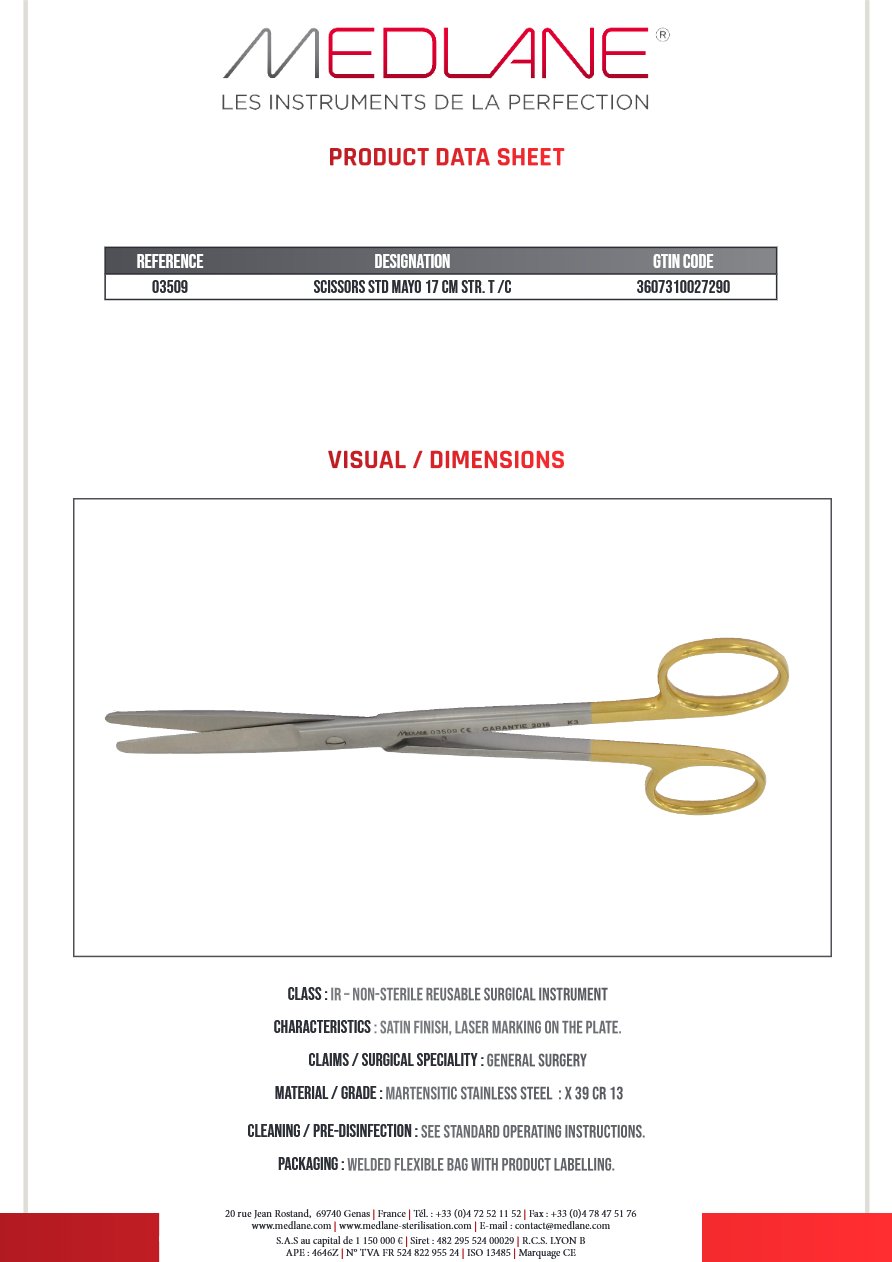
Ciseaux Courants Mayo 170 mm Droit Tungstène · REF 03509P
MACRO — RINGS
REF 03503P
MACRO — RINGS
REF 03509P
On the MEDLANE instruments concerned, gold-coloured rings make it possible to visually identify a version fitted with tungsten carbide on the working part.
Can you recognise them?
Among these four MEDLANE instruments, identify a Mayo, a Metzenbaum, a standard version and a tungsten version.
REVEAL THE ANSWER
- A — MetzenbaumVisual clue: blunt tips · fine, short bladesCiseaux Dissection Metzenbaum nelson 180 mm Courbe · REF 04104P
- B — MayoVisual clue: blunt tips · more substantial bladesCiseaux Courants Mayo 170 mm Courbe · REF 03504P
- C — Standard versionVisual clue: rings not gold-colouredCiseaux Courants Mayo 170 mm Droit · REF 03503P
- D — Tungsten versionVisual clue: gold-coloured ringsCiseaux Courants Mayo 170 mm Droit Tungstène · REF 03509P
Why identify them correctly?
Precise identification notably makes it easier to prepare and recompose sets, to inspect, maintain and replace like for like, to manage references and to communicate between theatre, sterilisation and technical services.
Learning to read a surgical instrument
- 01What is its family?
- 02What is the shape of its blades?
- 03What is their proportion relative to the shanks?
- 04Is it straight or curved?
- 05What is its length?
- 06Is its construction standard or more delicate?
- 07Does it have any particular feature?
- 08Do the rings indicate a MEDLANE version with tungsten carbide?
With practice in observation, an instrument ends up revealing much of its identity before its reference is even read.
That is the eye of the scrub nurse.
Explore the MEDLANE family
Metzenbaum
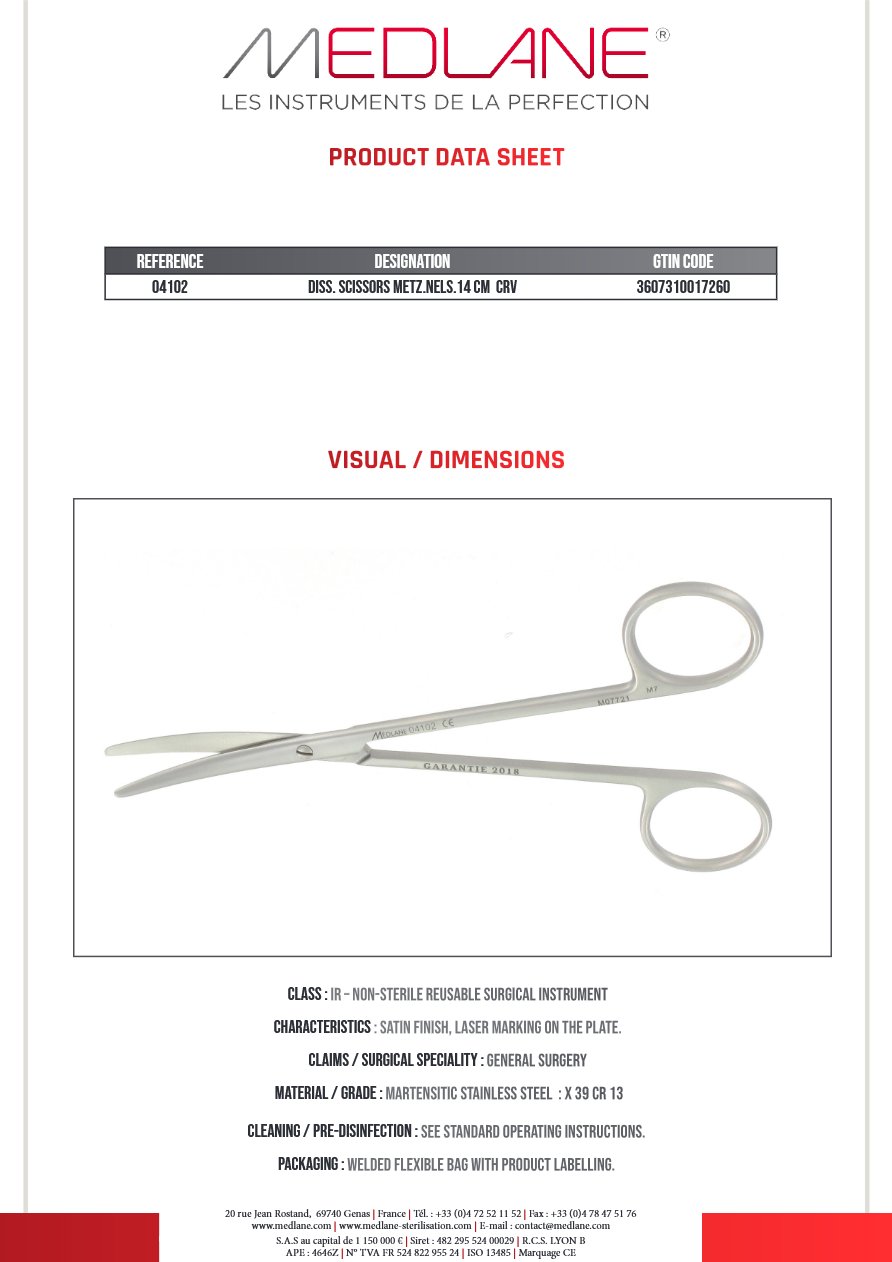
Ciseaux Dissection Metzenbaum nelson 140 mm Courbe
REF · 04102P· 140 mm· Curved
Ciseaux Dissection Metzenbaum nelson 180 mm Courbe
REF · 04104P· 180 mm· Curved
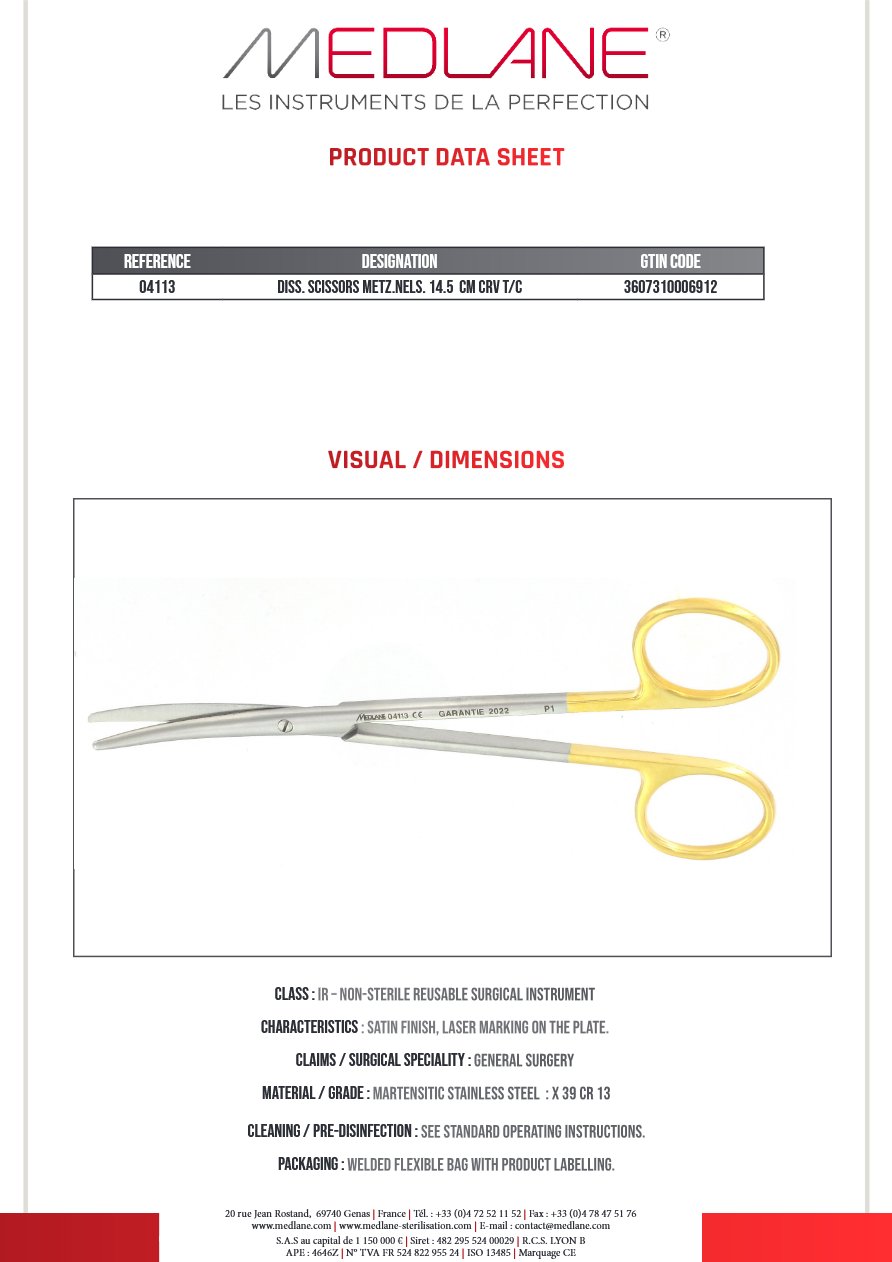
Ciseaux Dissection Metzenbaum nelson 145 mm Courbe Tungstène
REF · 04113P· 145 mm· Curved· Tungsten
Ciseaux Up-cut Metzenbaum Delicat 145 mm Courbe
REF · UC4323P· 145 mm· Curved
Mayo
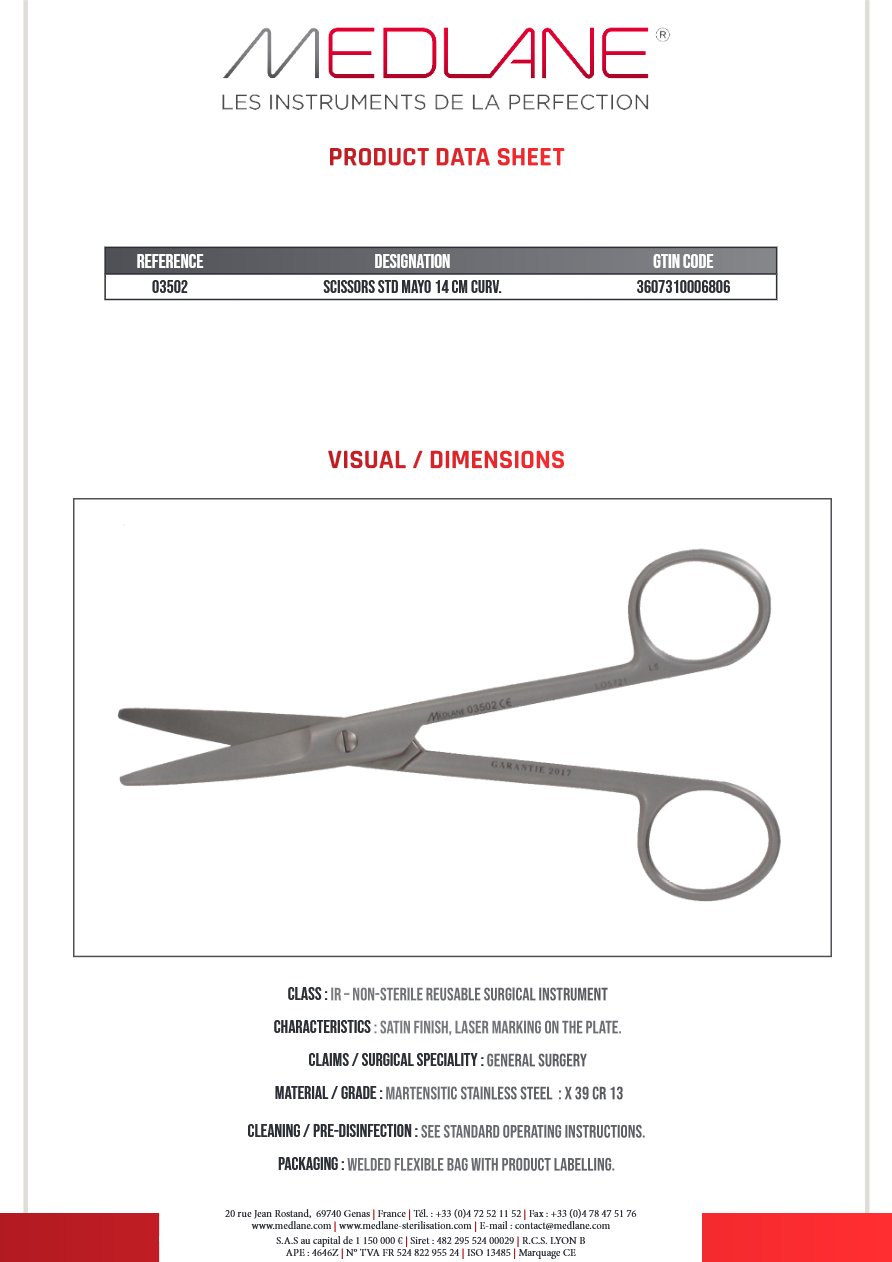
Ciseaux Courants Mayo 140 mm Courbe
REF · 03502P· 140 mm· Curved
Ciseaux Courants Mayo 170 mm Courbe
REF · 03504P· 170 mm· Curved
Ciseaux Courants Mayo 170 mm Droit Tungstène
REF · 03509P· 170 mm· Straight· Tungsten
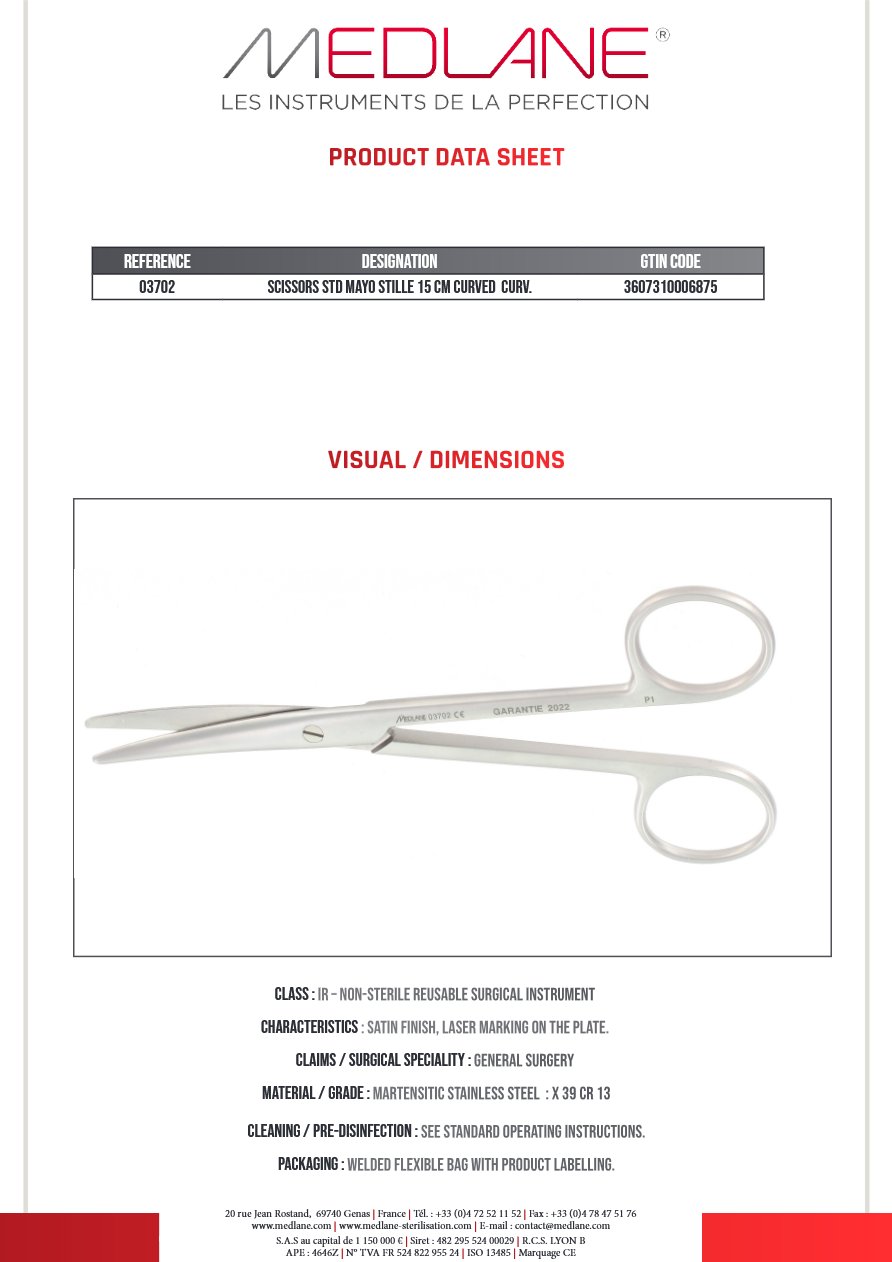
Ciseaux Courants Mayo Stille 150 mm Courbe
REF · 03702P· 150 mm· Curved
The essentials in 30 seconds
Metzenbaum
Fine · slender · relatively fine blades · dissection and more delicate tissue.
Mayo
More robust · more substantial blades · cutting that requires more robustness.
MEDLANE gold rings
Make it possible to identify the models concerned with tungsten carbide.
Observe before reading the reference.
Continue exploring instrumentation
- Coming soon
Kocher · Kelly · Crile
Recognising the main hemostatic forceps
- Coming soon
DeBakey · Adson
Understanding grasping forceps
- Coming soon
Mayo-Hegar · Mathieu · Olsen-Hegar
Recognising the main families of needle holders
Documented control protocols
Extracts from MEDLANE technical documentation. They describe documented protocols, not instructions for use nor a statement of conformity.
Cutting test
- The test material is selected according to the instrument category; Mayo and Metzenbaum scissors appear in the “medium, ring-handled” category of the documented table.
- Cutting is performed over two thirds of the blade, three times, without lateral pressure.
- The expected cut is clean, with no tearing of the test material.
Corrosion test
- A cleaning cycle is applied to the instrument before testing.
- The instrument is immersed in demineralised water at 90 °C for 1 hour, then air-dried.
- Visual inspection looks for rust marks, micro-cracks and other surface defects.